Last updated 11 November 2026.
Thulium
Element 69 · Lanthanide · Mined for itself1
Thulium is a rare earth metal. It is one of the two least common rare earths in the crust. Its uses are small: lasers for surgery and portable X-ray sources. No agency counts its world output. USGS did not have enough information to report a price change for 2025. By the EU count, China did all of its processing in 2016 to 2020.
How thulium compares
The scales are log scales, except for the shares, which go from 0 to 100%.
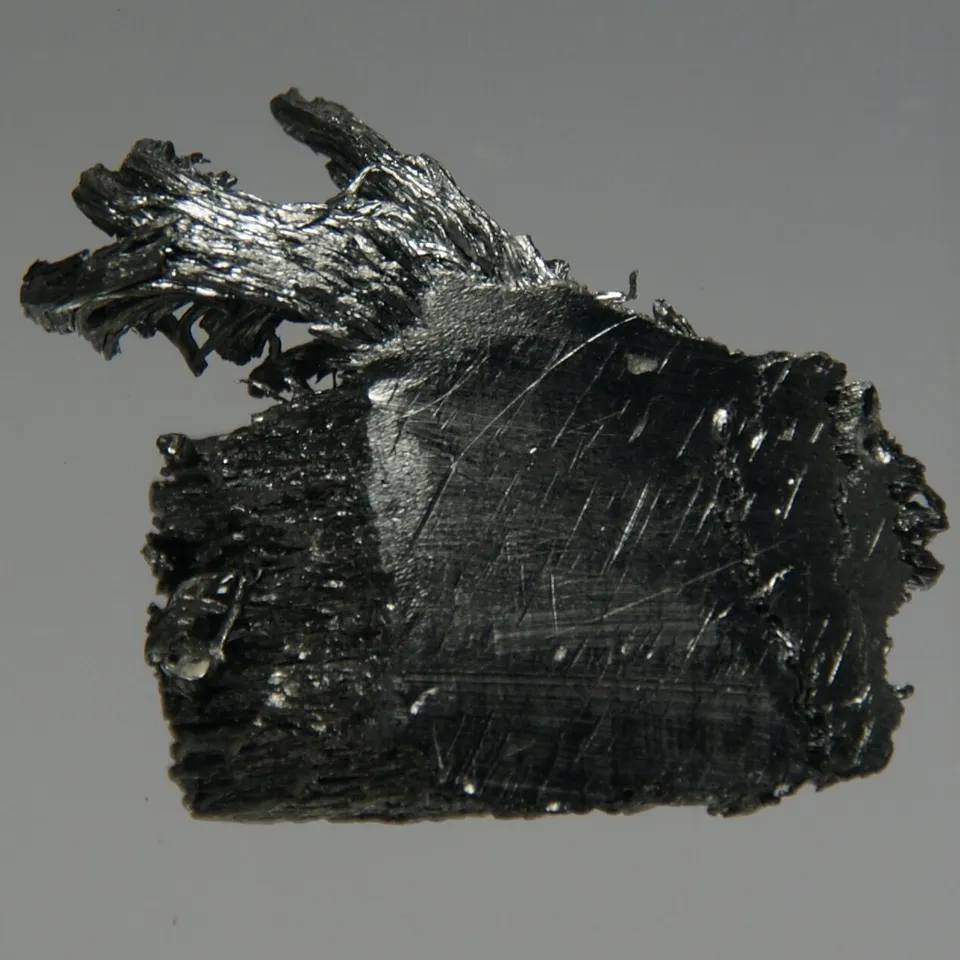

Specimen
- Atomic number
- 69
- Atomic mass
- 168.93
- State at room temperature
- Solid
- Melting point
- 1,545 °C
- Boiling point
- 1,950 °C
- Density
- 9.32 g/cm³
- Discovered
- 1879
Can I eat it?
- In food and water
- Not needed, little studied. Thulium has no known function in the body. In one animal test, 6.25 g of thulium chloride per kg of body weight killed half the animals. TERA found only a few animal studies per lanthanide, and too little human data to set a safe daily dose. 89
- As the pure element
- Little studied. Thulium is a silvery metal. Ames Laboratory classes it as a flammable solid that gives off flammable gas in water. Ames has no data on how toxic the metal is. 10
Learn about thulium
- 01 How much there is And how much of that can we reach? Thulium makes up about 0.5 parts per million of the crust by mass, by USGS data. With lutetium, it is the least common of the rare earths that occur in nature. USGS gives no reserve for thulium alone. All rare earths together have reserves of over 75 million tonnes of oxide. Read →
- 02 Where it is found What is it found in, and where on Earth? Thulium is a minor part of rare earth minerals such as monazite and xenotime, and of ion-adsorption clays. In most ores, it is only a trace. Most heavy rare earths come from clays in southern China. Thulium is always mined with the other rare earths. Read →
- 03 How we get it How much do we make each year, and how? We found no reliable world figure for thulium alone. The EU estimated about 660 tonnes a year for holmium, thulium, lutetium and ytterbium oxides together. Mines produced about 390,000 tonnes of all rare earth oxides in 2025, 69% of them in China. Almost no thulium is recycled. Read →
- 04 What we use it for Where does it go, and why this element? Thulium has few uses, and all of them are small. USGS names lasers, metallurgy and X-ray devices. Thulium lasers are used in surgery and for kidney stones, and radioactive thulium-170 is used in portable X-ray sources. UNEP said in 2011 that thulium had no significant uses. Read →
- 05 What it costs What does it cost, and how is it bought and sold? We found no current official price for thulium. USGS did not have enough information to report a price change for 2025. The latest USGS price that we found is a list price of about $1,500 per kilogram of oxide in 2010. Buyers and sellers agree prices in private deals. Read →
- 06 Who controls it Who controls the supply, and who depends on it? By the EU count, China did all the processing of thulium in 2016 to 2020. The United States relies on imports for all the heavy rare earths it uses. In October 2025, China announced export controls on thulium, then suspended them. The EU, the US and the UK list it as critical. Read →
- 08 History How did our relationship with it begin and change? Per Teodor Cleve found thulium in Sweden in 1879 and named it after Thule, a name for Scandinavia. For decades it had almost no use. Thulium-170 was proposed for X-ray sources in the 1950s, and lasers came later. The US approved the thulium fiber laser for kidney stones in 2019. Read →
Not covered: Social and political problems. Thulium comes from the same mines and plants as the other rare earths, almost all in China. Its social issues are those of the group, on the rare earths page. We found no dispute about thulium itself.
Thulium is one of the rare earth elements. How they are mined, separated, sold and controlled →
Worth knowing
-
Per Teodor Cleve named thulium in 1879 after Thule, an ancient name for Scandinavia. In his first proposal, he spelled it thullium, with two letters l. 11
History → -
A nuclear reactor can turn natural thulium into thulium-170, which emits X-rays. Small, light X-ray machines use a button of this isotope. 11
What we use it for → -
Thulium is on the critical lists of the EU, the US and the UK. But in 2026, USGS did not have enough information on thulium prices to report a change. 12
What it costs → -
In 1911, the chemist Charles James reported pure thulium. He needed 15,000 fractional crystallizations to get it. 13
History → -
The thulium fiber laser received US approval in 2019 for use against kidney stones. The authors of a 2021 review say that it could compete with the holmium laser, the standard tool. 14
What we use it for → -
Thulium is one of the rarest rare earths. Britannica says that it is about as common in the crust as antimony and iodine. 15
How much there is →
The atom
Electrons
| Shell | Electrons |
|---|---|
| 1 (K) | 2 |
| 2 (L) | 8 |
| 3 (M) | 18 |
| 4 (N) | 31 |
| 5 (O) | 8 |
| 6 (P) outermost | 2 |
| Total | 69 |
Configuration [Xe] 4f¹³ 6s²
4f ↑ ↓ ↑ ↓ ↑ ↓ ↑ ↓ ↑ ↓ ↑ ↓ ↑
6s ↑ ↓
Nucleus
| Protons | 69 |
|---|---|
| Neutrons | 100 |
| Mass number | 169 |
Related elements
New articles by e-mail
Sources
- 1
U.S. Geological Survey (Bradley S. Van Gosen, Philip L. Verplanck, Robert R. Seal II, Keith R. Long and Joseph Gambogi), 2017. Rare-earth elements, chapter O of Critical mineral resources of the United States (Professional Paper 1802-O) , Table O1 (crustal abundance); Introduction (deposit types); Sources and production (China).
Crustal abundance of thulium after Lide (2004), and ion-adsorption clays as the main source of the heavy rare earths.
-
REE-bearing ion-adsorption clays are mined in various locations in the southeastern Provinces. In contrast to bastnaesite ores, ion-adsorption clays are valued for their medium REE and HREE content.
-
- 2
European Commission (M. Grohol and C. Veeh), 2023. Study on the Critical Raw Materials for the EU 2023: Final Report , Table A, major global supplier countries (row 46, thulium); list of heavy rare earths; table of end uses (thulium row).
China's share of world thulium supply at the processing stage, 2016-2020, thulium as a heavy rare earth, and the end use that the EU assigned to it.
-
46 thulium P China 100%
-
- 3
Theodore Gray, periodictable.com (data from Wolfram ElementData), 2026. Technical data for Thulium (from Wolfram ElementData) , Abundances.
Abundance in the universe and the crust, as mass fractions. It gives no value for the human body.
-
% in Earth's Crust 0.000045%
-
- 4
UNEP International Resource Panel (T.E. Graedel et al.), 2011. Recycling Rates of Metals: A Status Report , Appendix table of OSR, RC and EOL-RR by metal (Tm row); Appendix A (uses of the rare earths).
End-of-life recycling rate and recycled content below 1% for thulium; thulium has no significant uses.
-
Tm <1 <1
-
- 5
UK Critical Minerals Intelligence Centre, British Geological Survey, 2024. UK 2024 Criticality Assessment , Table 2, candidate materials; Appendix 6, end-of-life recycling rates (REE row and REE table by use).
The UK assessed thulium with the other rare earths as one group, which it found critical, and gives 0% end-of-life recycling for every rare earth use.
-
Rare earth elements (REE) 0 Magnesite 52
-
- 6
IUPAC Commission on Isotopic Abundances and Atomic Weights (CIAAW), 2024. Abridged Standard Atomic Weights 2024 .
The atomic mass shown for the 84 elements that have a standard atomic weight.
- 7
National Center for Biotechnology Information (PubChem), 2026. Periodic Table of Elements .
Electron configuration, melting and boiling points, density and discovery year for all 118 elements.
- 8
Toxicology Excellence for Risk Assessment (TERA), for the US Bureau of Land Management, 1999. Development of Reference Doses and Reference Concentrations for Lanthanides , Section 2.4 (oral toxicity data in experimental animals).
-
the available human data are not sufficient as a basis for the development of either an RfC or an RfD. Moreover, the available animal toxicity data are limited to only a few studies for each of the several lanthanides
-
6250 mg/kg for thulium chloride
-
- 9
Wenyu Wang, Yanfang Yang, Donglei Wang and Lihua Huang (Toxics 12(5):317), 2024. Toxic Effects of Rare Earth Elements on Human Health: A Review , Section 7, Challenges and Perspectives.
-
the hazards of REEs to human health are still largely unknown
-
- 10
Ames Laboratory, US Department of Energy (Materials Preparation Center), 2016. Safety Data Sheet - Thulium (pieces, ingot, rod, foil, sheet, target) , Sections 2 and 11.
-
H260 – In contact with water releases flammable gases which may ignite spontaneously
-
Acute and Chronic Effects: No data Acute Toxicity: No data
-
To the best of our knowledge the chemical, physical and toxicological characteristics of the substance are not fully known.
-
- 11
Royal Society of Chemistry, 2026. Thulium - Element information, properties and uses , Sections Uses, Biological role, Natural abundance, History; podcast transcript (Chemistry in its element: thulium, Brian Clegg).
Discovery, name, uses in X-ray sources and lasers, biological role, minerals and production. The podcast gives a rough figure for yearly output without a year or a source.
-
I propose the name of thullium derived from Thule, the ancient name of Scandinavia
-
A ‘button’ of this isotope is used to make a lightweight, portable x-ray machine for medical use
-
- 12
U.S. Geological Survey, 2026. Mineral Commodity Summaries 2026 , PDF p. 13 (trade policy actions); PDF p. 27 (uses of critical minerals, thulium row); notes to Figure 10A (1-year percent change in prices).
China's export controls of October 2025 and their suspension; the main uses of thulium; USGS had not enough price information for thulium.
-
thulium, and uranium are not shown because there was not enough information available regarding prices
-
- 13
Michal Meyer, Distillations, Science History Institute, 2016. Industrial Vitamins .
Charles James and the 15,000 fractional crystallizations that gave pure thulium in 1911.
-
In 1911 Charles James reported the isolation of a measurable quantity of pure thulium, but only after 15,000 successive fractional crystallizations of his impure sample
-
- 14
Peter Kronenberg, Bm Zeeshan Hameed and Bhaskar Somani, Current Opinion in Urology 31 (2): 80-86, 2021. Outcomes of thulium fibre laser for treatment of urinary tract stones: results of a systematic review , Abstract; Introduction; Thulium fibre laser machine specifications; Conclusion.
The thulium fiber laser for kidney and urinary stones, its approval in the US and Europe, and how it compares with the holmium laser.
-
the TFL has the potential to compete or even replace the Ho:YAG laser
-
- 15
Britannica Editors, Encyclopaedia Britannica, 2026. thulium .
Properties, discovery, name, minerals, isotopes, abundance, production and uses. Read with Firecrawl; the site refused a script.
-
Its abundance in Earth’s crust is nearly the same as those of antimony and iodine
-
- 16
National Institute of Standards and Technology (NIST), 2026. Atomic Weights and Isotopic Compositions for All Elements .
Isotopic composition of each element; the most abundant isotope sets the neutron count in the nucleus view.