Last updated 13 October 2026.
Neodymium
Element 60 · Lanthanide · Mined for itself1
Neodymium is a soft, silvery rare earth metal. Most of it goes into neodymium-iron-boron magnets, the strongest permanent magnets known. These magnets are in the motors of electric cars and in wind turbines. Mines produce neodymium with the other light rare earths. China separates most of it and makes more than 90% of the magnets.
How neodymium compares
Price ~ $73 per kg of neodymium oxide, at least 99.5% pure 1 Not on the scale: this is the price of neodymium oxide, at least 99.5% pure, not of neodymium. What it costs →
The scales are log scales, except for the shares, which go from 0 to 100%.
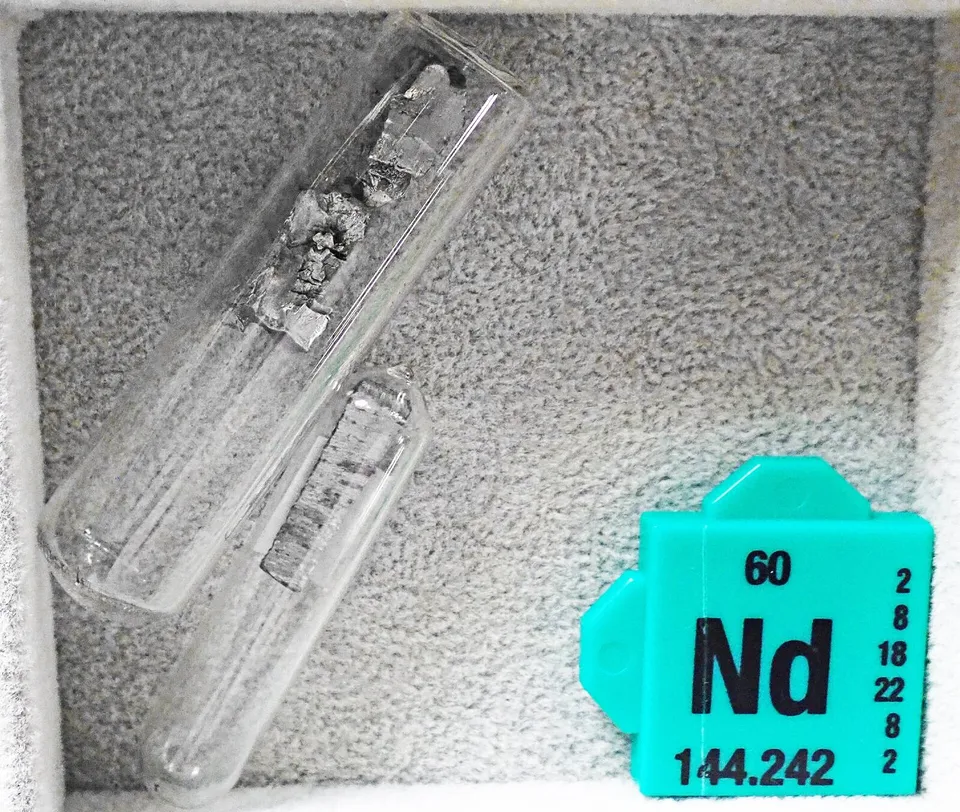

Specimen
- Atomic number
- 60
- Atomic mass
- 144.24
- State at room temperature
- Solid
- Melting point
- 1,021 °C
- Boiling point
- 3,074 °C
- Density
- 7.01 g/cm³
- Discovered
- 1885
Can I eat it?
- In food and water
- Not needed, little studied. Neodymium has no known function in the body. A 1999 TERA review for a US agency found only a few animal studies of each lanthanide. In animal tests, 5.25 g of neodymium chloride per kg of body weight by mouth killed half the animals. 8
- As the pure element
- Little studied. There are few studies of neodymium metal taken by mouth. A 1999 TERA review for a US agency found no data on how the gut takes up insoluble lanthanides. It found only a few animal studies of each lanthanide. 8
Learn about neodymium
- 01 How much there is And how much of that can we reach? Neodymium is more common in the crust than cobalt. Wolfram gives 33 parts per million, the EU 27 and USGS 41.5. USGS gives no reserve for it alone. It is mined with the other light rare earths. With praseodymium, it was 20% of the output by volume but 75% by value in 2019. Read →
- 02 Where it is found What is it found in, and where on Earth? Neodymium is mined mainly from bastnaesite, monazite and ion-adsorption clays. Most comes from carbonatites, such as Bayan Obo in China and Mountain Pass in the US. It always comes with the other rare earths, mostly cerium, lanthanum and praseodymium. Read →
- 03 How we get it How much do we make each year, and how? We found no measured world figure for neodymium alone. Mines produced about 390,000 tonnes of all rare earth oxides in 2025. China refined about 85% of the magnet rare earths in 2025 and made about 94% of the sintered magnets in 2024. Almost none is recycled at end of life. Read →
- 04 What we use it for Where does it go, and why this element? Most neodymium goes into neodymium-iron-boron magnets: 76% of world use in 2008. These magnets drive electric cars and wind turbines, and they are in hard drives, phones and loudspeakers. Neodymium also colors glass, makes lasers and goes into batteries and alloys. Read →
- 05 What it costs What does it cost, and how is it bought and sold? Neodymium oxide sold for about $73 per kilogram in 2025, free on board. The price is volatile. By an EU account of metal and oxide prices, it rose from about $7 per kilogram in 2002 to $467 in July 2011. Neodymium is sold mostly under private contracts, not on an exchange. Read →
- 06 Who controls it Who controls the supply, and who depends on it? China refined about 85% of the magnet rare earths in 2025, by an IEA estimate. It made 94% of the sintered magnets in 2024. Makers of cars, wind turbines and electronics depend on these magnets. The EU, the US and the UK list neodymium as critical, and the EU also as strategic. Read →
- 07 Social and political problems What problems does it cause between people, and who carries them? Patents on neodymium magnets led to trade cases in the US in 1996 and 2012. In 2025, carmakers could not get enough magnets after China's export controls. Doctors supported a US rule of 2022 on small strong magnets; many magnet users opposed it. A court upheld it in 2025. Read →
- 08 History How did our relationship with it begin and change? Carl Auer found neodymium in Vienna in 1885, when he split didymium into two elements. The name means new twin. From the late 1920s, it colored glass. In 1982, Masato Sagawa in Japan and John Croat in the US invented the neodymium-iron-boron magnet, now its main use. Read →
Neodymium is one of the rare earth elements. How they are mined, separated, sold and controlled →
Worth knowing
-
By an EU account, a neodymium-iron-boron magnet can lift 1,300 times its own mass. 9
What we use it for → -
A direct-drive wind turbine holds 700 to 1,200 kg of neodymium magnets for each megawatt. That is 175 to 420 kg of neodymium. 9
What we use it for → -
In 2019, neodymium and praseodymium were about 20% of the rare earths sold by volume, but 75% by value, by an estimate of Roskill. 9
What it costs → -
Glassblowers and welders wear goggles of 'didymium glass', which holds neodymium and praseodymium. 10
What we use it for → -
Almost a quarter of natural neodymium is neodymium-144. It is radioactive, with a half-life of about 2 million billion years. 10
How much there is → -
In a report of 2011, USGS cites one US maker of laser crystals in 2001: 80% of the neodymium used to grow the crystals ends up as scrap. For lack of buyers, the scrap went to landfills. 11
How we get it → -
Hospital emergency departments in the US treated 26,600 cases of swallowed magnets from 2010 to 2021, by an estimate of the Consumer Product Safety Commission. 12
Social and political problems →
The atom
Electrons
| Shell | Electrons |
|---|---|
| 1 (K) | 2 |
| 2 (L) | 8 |
| 3 (M) | 18 |
| 4 (N) | 22 |
| 5 (O) | 8 |
| 6 (P) outermost | 2 |
| Total | 60 |
Configuration [Xe] 4f⁴ 6s²
4f ↑ ↑ ↑ ↑
6s ↑ ↓
Nucleus
| Protons | 60 |
|---|---|
| Neutrons | 82 |
| Mass number | 142 |
Related elements
New articles by e-mail
Sources
- 1
U.S. Geological Survey (Shelby N. Johnston), 2026. Rare Earths, in Mineral Commodity Summaries 2026 , Pp. 152-153: salient statistics (prices), government stockpile, events, world mine production and reserves, recycling.
Prices of neodymium oxide and NdPr oxide from 2021 to 2025, the stockpile plan, world rare earth output and reserves, and China's export controls of 2025.
-
Bastnaesite was mined as a primary product in Mountain Pass, CA
-
Neodymium oxide, 99.5% minimum ... 73
-
- 2
International Energy Agency, 2025. Global Critical Minerals Outlook 2025 , Rare earth elements chapter (pp. 163-176): demand for magnet rare earths, magnet production by country, US tariffs.
Demand for magnet rare earths in 2024 and in the IEA scenarios, China's share of magnet production and of demand, and US tariffs of 2025.
-
its share in the production of these magnets has expanded massively to reach 94% and 80% respectively in 2024
-
- 3
Theodore Gray, periodictable.com (data from Wolfram ElementData), 2026. Technical data for Neodymium (from Wolfram ElementData) , Abundances.
Abundance in the universe and the crust, as mass fractions. It gives no value for the human body.
-
% in Earth's Crust 0.0033%
-
- 4
UK Critical Minerals Intelligence Centre, British Geological Survey, 2024. UK 2024 Criticality Assessment , Table 2, candidate materials; section 4.5.3 (REE prices and export controls); Appendix 6, end-of-life recycling rates (REE row and REE table by use).
The UK assessed neodymium with the other rare earths as one group, which it found critical. Prices of neodymium oxide from 2009 to 2013.
-
Rare earth elements (REE) 0 Magnesite 52
-
- 5
UNEP International Resource Panel (T.E. Graedel et al.), 2011. Recycling Rates of Metals: A Status Report , Appendix table of OSR, RC and EOL-RR by metal (Nd row).
End-of-life recycling rate below 1% and recycled content of 1% to 10% for neodymium.
-
Nd 1 –10 <1
-
- 6
IUPAC Commission on Isotopic Abundances and Atomic Weights (CIAAW), 2024. Abridged Standard Atomic Weights 2024 .
The atomic mass shown for the 84 elements that have a standard atomic weight.
- 7
National Center for Biotechnology Information (PubChem), 2026. Periodic Table of Elements .
Electron configuration, melting and boiling points, density and discovery year for all 118 elements.
- 8
Toxicology Excellence for Risk Assessment (TERA), for the US Bureau of Land Management, 1999. Development of Reference Doses and Reference Concentrations for Lanthanides , Section 2.4 (oral toxicity data in experimental animals).
-
the available animal toxicity data are limited to only a few studies for each of the several lanthanides
-
5250 mg/kg for neodymium chloride
-
No data on insoluble or chelated lanthanide absorption were identified.
-
- 9
European Commission (G.A. Blengini and others), 2020. Study on the EU's list of Critical Raw Materials (2020): Factsheets on Critical Raw Materials , Chapter 21, Light rare earth elements: sections 21.1.1.8, 21.2.1, 21.2.2.8, 21.2.4.9, 21.3.2, 21.3.3.8, 21.3.4.1, 21.4.2.8 and 21.4.4.
Crust abundance, minerals, uses, magnets in cars and wind turbines, substitutes, EU consumption and trade, prices from 2002 to 2019, forecasts and recycling.
-
A NdFeB magnet can lift 1300 times its own mass.
-
Direct-drive wind turbines contain 700–1200 kg of NdFeB magnets per MW, which corresponds to 175–420 kg of pure neodymium per MW.
-
Magnet materials neodymium and praseodymium represent 75% of the total REE value and 20% of the volume
-
- 10
Royal Society of Chemistry, 2026. Neodymium - Element information, properties and uses , Sections History, Uses and properties, Biological role, Natural abundance, Isotopes; podcast transcript by Andrea Sella.
Discovery, name, first pure metal, uses in magnets, glass and lasers, biological role, isotopes and didymium glass.
-
Neodymium is a component, along with praseodymium, of didymium glass. This is a special glass for goggles used during glass blowing and welding.
-
144 Nd 143.910 23.8 2.1 x 10 15 y
-
- 11
U.S. Geological Survey (Thomas G. Goonan), 2011. Rare Earth Elements—End Use and Recyclability (Scientific Investigations Report 2011–5094) , Table 2; sections on neodymium-iron-boron magnets and on glass and lasers.
World use of neodymium oxide by end use in 2008, magnet recycling, and the scrap from laser crystal production. Based on data from Bade (2010).
-
During production, 80 percent of the neodymium input is lost to a scrap material
-
- 12
U.S. Consumer Product Safety Commission, Federal Register, 2022. Safety Standard for Magnets (Final rule, 87 FR 57756) , Summary; Dates; sections on the incident data, the court case and the comments.
The US rule on small, strong magnets in consumer products, the injury estimates behind it, and the earlier court case.
-
estimated 26,600 (2,800 in 2021) ED-treated magnet ingestions involving magnet products of various types from 2010 through 2021
-
- 13
National Institute of Standards and Technology (NIST), 2026. Atomic Weights and Isotopic Compositions for All Elements .
Isotopic composition of each element; the most abundant isotope sets the neutron count in the nucleus view.