Last updated 10 October 2026.
Cobalt
Element 27 · Transition metal · By-product of copper and nickel1
Most cobalt goes into rechargeable batteries, for electric cars, phones and laptops. The largest use outside batteries is in alloys for jet engines, which stay strong when hot. Nearly all cobalt comes as a by-product of copper or nickel mines. In 2025, by USGS estimates, the Democratic Republic of the Congo mined about 73% of the world's cobalt and Indonesia about 14%. Amnesty International has reported child labor in small Congolese mines since 2016. In 2025 the Congo banned cobalt exports from February to October, to stop a fall in prices. Then it set export quotas.
How cobalt compares
The scales are log scales, except for the shares, which go from 0 to 100%.
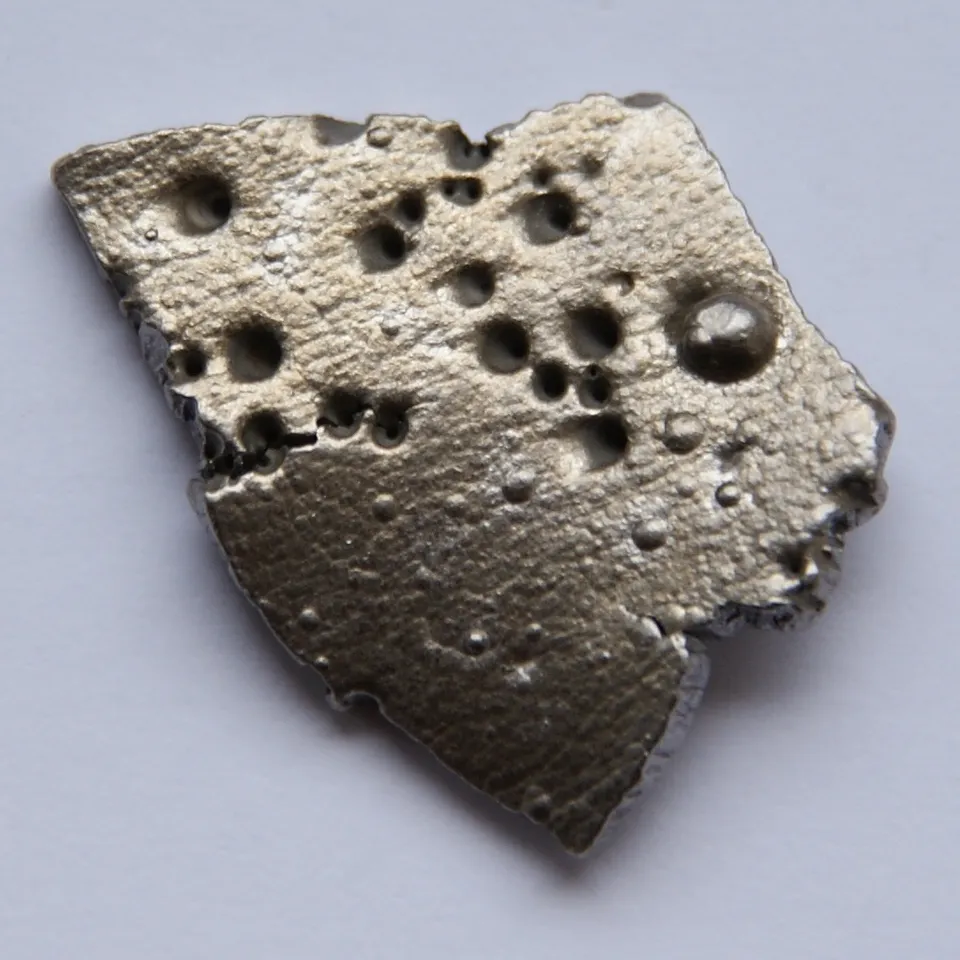

Specimen
- Atomic number
- 27
- Atomic mass
- 58.933
- State at room temperature
- Solid
- Melting point
- 1,495 °C
- Boiling point
- 2,927 °C
- Density
- 8.86 g/cm³
- Discovered
- 1735
Can I eat it?
- In food and water
- Your body needs it. The body needs cobalt only as part of vitamin B12 (cobalamin). ATSDR says that swallowed cobalt in other forms can harm the blood and the thyroid. 89
- As the pure element
- Harmful. Swallowed cobalt metal can cause stomach pain and vomiting, according to the ICSC. Repeated contact can cause skin allergy, and the dust can cause asthma. In 2022, IARC classed cobalt metal as probably carcinogenic to humans (Group 2A), from animal and mechanistic evidence. 1011
Learn about cobalt
- 01 How much there is And how much of that can we reach? Cobalt is about 30 parts per million of Earth's crust. USGS estimates world reserves at 12 million tonnes, about 39 years of mining at the 2025 rate. Resources on land are about 25 million tonnes. Seabed nodules may hold 5 billion tonnes, but no one mines them yet. Read →
- 02 Where it is found What is it found in, and where on Earth? Most cobalt comes from copper deposits in the Copperbelt of the Congo and Zambia. Much of the rest comes from nickel ores: laterites, as in Indonesia, and sulfide deposits, as in Canada and Russia. In 2017 USGS wrote that only Morocco mined cobalt as the main product. Read →
- 03 How we get it How much do we make each year, and how? Mines produced about 310,000 tonnes of cobalt in 2025, by USGS estimates, 73% of it in the Congo. Most Congolese cobalt leaves the country as a crude hydroxide and is refined in China. In 2023, China made 82% of the world's refined cobalt. Recycling meets about a tenth of demand. Read →
- 04 What we use it for Where does it go, and why this element? Batteries take about three quarters of the world's cobalt. Electric cars took about 41% in 2025 and phones, laptops and other portable devices about 34%, by Cobalt Institute figures. Superalloys for jet engines took about 7%. Cars with iron phosphate batteries need no cobalt. Read →
- 05 What it costs What does it cost, and how is it bought and sold? Cobalt metal cost about $33 per kg on the London Metal Exchange in 2025, by USGS estimates. Prices of cobalt swing widely. After the Congo's export ban, the price of cobalt hydroxide rose by 328% in 2025. The US unit value was about $237 per kg in 1979, in 2025 dollars. Read →
- 06 Who controls it Who controls the supply, and who depends on it? Supply is very concentrated. In 2025 the Congo mined about 73% of the world's cobalt, and mines with majority Chinese owners gave 72% of that. In 2023 China made 82% of the refined cobalt. The US, the EU and the UK list cobalt as critical. Read →
- 07 Social and political problems What problems does it cause between people, and who carries them? Amnesty International reported in 2016 that children as young as seven dug cobalt in small Congolese mines. In 2023 it reported forced evictions near large mines. In 2024 a US appeals court upheld the dismissal of a child labor case against Apple, Tesla and others. Read →
- 08 History How did our relationship with it begin and change? Cobalt colored glass and pottery blue for over 3,000 years. In the 1730s Georg Brandt showed that it is a metal. He named it after the kobold, a German goblin. Jet engines became a main use in the 20th century. Batteries became the largest use in 2003, and electric cars in 2021. Read →
Worth knowing
-
Cobalt stays magnetic at the highest temperature of any metal. 1
What we use it for → -
Vitamin B12 has a cobalt atom at its center. The human body contains only about 1 milligram of cobalt. 12
How much there is → -
By Amnesty International's figures, the average electric car battery needs more than 13 kg of cobalt, and a phone battery about 7 g. 13
What we use it for → -
The name comes from the German word for goblin. Miners in Germany blamed goblins for an ore that looked like silver ore but gave none. 12
History → -
One company, CMOC, mined 117,500 t of cobalt in 2025, about 39.5% of the world's mined cobalt, by Cobalt Institute figures. 14
Who controls it → -
USGS estimates that nodules on the sea floor hold about 5 billion t of cobalt. That is more than 400 times the world reserves on land. 2
How much there is → -
At the Tenke Fungurume mine in the Congo, 3.3 t of rock must be moved for each tonne of ore. 1
How we get it →
The atom
Electrons
| Shell | Electrons |
|---|---|
| 1 (K) | 2 |
| 2 (L) | 8 |
| 3 (M) | 15 |
| 4 (N) outermost | 2 |
| Total | 27 |
Configuration [Ar] 3d⁷ 4s²
3d ↑ ↓ ↑ ↓ ↑ ↑ ↑
4s ↑ ↓
Nucleus
| Protons | 27 |
|---|---|
| Neutrons | 32 |
| Mass number | 59 |
Related elements
New articles by e-mail
Sources
- 1
U.S. Geological Survey (J.F. Slack, B.E. Kimball, K.B. Shedd), 2017. Cobalt, chap. F of Critical Mineral Resources of the United States (Professional Paper 1802-F) , Summary; Uses; Strategic and Critical Resource Issues; Geology (deposit types, mineralogy, geochemistry); Resources and Production; Environmental Considerations.
Deposit types, ore minerals, grades, resources, by-product supply, the crust and seawater content, health and mine waste.
-
That nearly all cobalt is mined as a byproduct of other, more abundant metals, such as nickel or copper, means that production is driven primarily by the markets for the principal metals, not by the need for cobalt
-
Cobalt also is ferromagnetic, and it retains this property at the highest temperature of any metal
-
has an approximate stripping ratio of 3.3:1 (International Mining, 2012), which means that 3.3 metric tons of rock must be moved to extract 1 metric ton of ore
-
- 2
U.S. Geological Survey (S.M. Ewing), 2026. Cobalt, in Mineral Commodity Summaries 2026 , p. 1, Domestic Production and Use, Salient Statistics, Recycling, Import Sources; p. 2, Events, Trends, and Issues, World Mine Production and Reserves, World Resources, Substitutes, footnotes.
World mine production and reserves by country, prices, US use and imports, recycling, substitutes, the 2025 export ban and quotas in the Congo.
-
7,780 9,100 302,000 310,000
-
24.21 23.17 30.78 28.83 17.20 15.48 16.77 11.84 21 15
-
21 15 ... 7,780 9,100 302,000 310,000
-
200 300 4,780 3,700 3,350 3,500 2,000 2,000 226,000 230,000 3,450 2,000 35,000 44,000 3,100 3,900 2,630 2,800 3,100 3,700 8,000 7,700 2,200 1,900 7,780 9,100 302,000 310,000
-
An estimated 5 billion tons of cobalt is contained globally in sea floor polymetallic nodules
-
- 3
Theodore Gray (periodictable.com), data from Wolfram Research ElementData, 2026. Technical data for the element Cobalt , Abundances.
Abundance of cobalt in the universe, crust, oceans and humans, as mass fractions.
-
% in Earth's Crust 0.003%
-
- 4
UK Critical Minerals Intelligence Centre, British Geological Survey, 2024. UK 2024 Criticality Assessment , Criticality results table (Cobalt row); appendix table of end uses and end-of-life recycling rates (Cobalt).
Cobalt assessed as critical in the UK in 2024 and 2021; an end-of-life recycling rate of 48%.
-
Cobalt (Co) 48
-
- 5
UNEP International Resource Panel (T.E. Graedel et al.), 2011. Recycling Rates of Metals: A Status Report , Appendix C, Table C1 (non-ferrous metals).
End-of-life recycling rate and recycled content of cobalt.
-
Co 50d 32d 68d
-
- 6
IUPAC Commission on Isotopic Abundances and Atomic Weights (CIAAW), 2024. Abridged Standard Atomic Weights 2024 .
The atomic mass shown for the 84 elements that have a standard atomic weight.
- 7
National Center for Biotechnology Information (PubChem), 2026. Periodic Table of Elements .
Electron configuration, melting and boiling points, density and discovery year for all 118 elements.
- 8
European Food Safety Authority (EFSA), 2017. Dietary Reference Values for nutrients. Summary report (amended 2019) .
Summaries of the EFSA NDA Panel opinions on each vitamin and mineral, section 4 (minerals) and section 5 (cobalamin).
-
Cobalamin is a metal complex with a central cobalt atom bonded to six ligands
-
- 9
Agency for Toxic Substances and Disease Registry (ATSDR), 2024. ToxFAQs for Cobalt .
-
Oral exposure to cobalt may cause adverse effects in the blood and thyroid.
-
- 10
International Labour Organization and World Health Organization (International Chemical Safety Cards), 2004. ICSC 0782 - Cobalt , Ingestion; Effects of long-term or repeated exposure.
-
Ingestion Abdominal pain. Vomiting.
-
Repeated or prolonged contact may cause skin sensitization. Repeated or prolonged inhalation may cause asthma.
-
- 11
International Agency for Research on Cancer (IARC), 2022. IARC Monographs evaluate the carcinogenicity of cobalt, antimony compounds, and weapons-grade tungsten alloy (Questions and Answers) , 1. What are the results of the evaluation?.
-
Cobalt metal (without tungsten carbide or other metal alloys) and soluble cobalt(II) salts were classified as probably carcinogenic to humans (Group 2A) on the basis of sufficient evidence for cancer in experimental animals and strong mechanistic evidence
-
- 12
Royal Society of Chemistry, 2026. Cobalt (Periodic Table) , Uses; Biological role; History; podcast transcript.
Discovery, the name, early blue glass, uses, the body's cobalt.
-
The amount we need is very small, and the body contains only about 1 milligram
-
he gave it the name by which its ore was cursed by miners in Germany, where it was sometimes mistaken for a silver ore
-
- 13
Amnesty International, 2023. DRC: Cobalt and copper mining for batteries leading to human rights abuses .
Forced evictions near Kolwezi; the answers of COMMUS and Chemaf; cobalt in batteries.
-
The average electric vehicle battery requires more than 13kg of cobalt, and a mobile phone battery about 7g
-
- 14
Cobalt Institute (prepared by Benchmark Mineral Intelligence), 2026. Cobalt Market Report 2025 , Executive summary; sections 3 (supply), 4 (demand), 5 (prices), 6 (geopolitics), 7 (outlook).
Industry association. World demand by use, mined and refined supply, companies, prices, the export ban and quotas of the Congo, policy, forecasts to 2035.
-
produced 117.5kt in 2025, up 3% from the previous year and exceeding its guidance target for another year. CMOC's global market share was at 39.5%
-
- 15
National Institute of Standards and Technology (NIST), 2026. Atomic Weights and Isotopic Compositions for All Elements .
Isotopic composition of each element; the most abundant isotope sets the neutron count in the nucleus view.