Last updated 10 October 2026.
Zinc
Element 30 · Transition metal · Mined for itself1
Most zinc protects steel from rust. A thin coat of zinc on steel (galvanizing) takes more than half of the world's zinc. Mines produced about 13 million tonnes in 2025, by USGS estimates, and China mined about a third of it. Zinc smelters also recover cadmium, germanium and indium, and the IEA calls such smelters strategic. The human body needs zinc, and zinc deficiency is common in low-income and middle-income countries.
How zinc compares
The scales are log scales, except for the shares, which go from 0 to 100%.
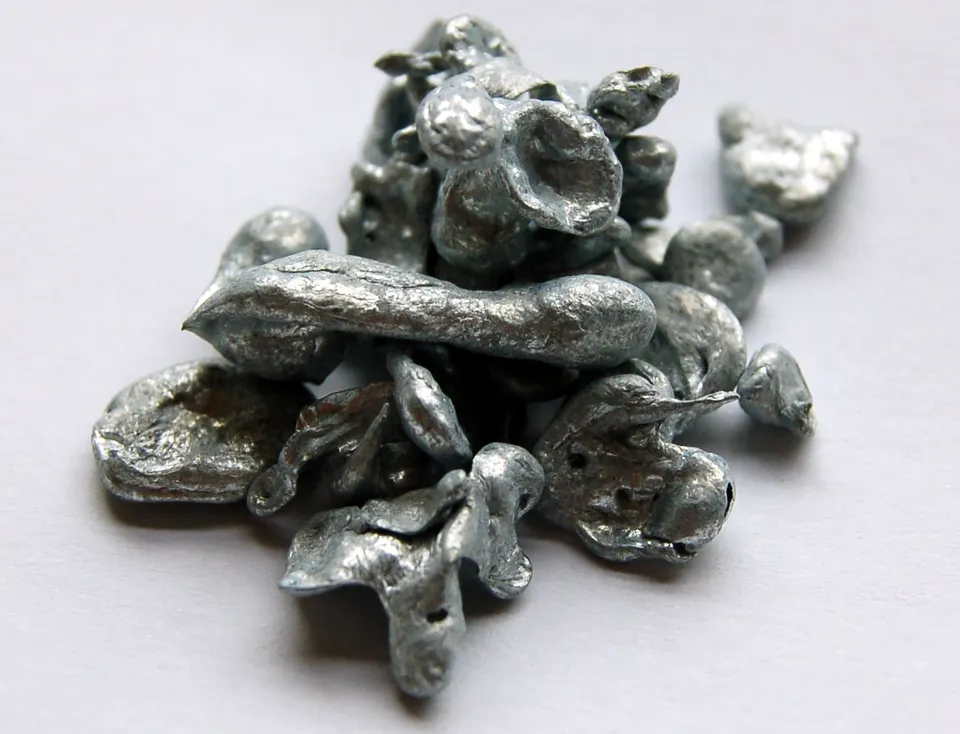

Specimen
- Atomic number
- 30
- Atomic mass
- 65.38
- State at room temperature
- Solid
- Melting point
- 419.5 °C
- Boiling point
- 906.9 °C
- Density
- 7.134 g/cm³
- Discovered
- 1746
Can I eat it?
- In food and water
- Your body needs it. Zinc is an essential nutrient for enzymes of all six classes. Vegetarians can need up to 50% more zinc, because the body absorbs less zinc from grains and legumes. 910
- As the pure element
- Harmful. Stomach acid corrodes zinc. A two-year-old boy swallowed a zinc-based US penny. Doctors removed the corroded coin and found a bleeding stomach ulcer. Some very fine zinc powder catches fire by itself in air, according to the ICSC. It also gives off a flammable gas in water. 1112
Learn about zinc
- 01 How much there is And how much of that can we reach? Zinc is common in the crust, at about 78 parts per million. USGS gives world reserves of 240 million tonnes in 2025, about 18 years of mine output, and identified resources of 1.9 billion tonnes. By IZA's reading of USGS data, reserves have kept pace with production since 1990. Read →
- 02 Where it is found What is it found in, and where on Earth? The main zinc ores are zinc sulfide (zinc blende, or sphalerite) and calamine. Many zinc deposits lie in sedimentary rocks. Zinc ores usually also hold lead, and small amounts of cadmium, germanium, indium, silver and other metals. Read →
- 03 How we get it How much do we make each year, and how? Mines produced about 13 million tonnes of zinc in 2025, by USGS estimates. China mined about a third of it, and made about half of the world's refined zinc in 2022. Most smelters roast the concentrate, leach it in sulfuric acid and recover the zinc by electrolysis. Read →
- 04 What we use it for Where does it go, and why this element? More than half of all zinc protects steel from rust, as a coating on galvanized steel. The rest goes into brass, die-cast parts, zinc sheet and chemicals such as zinc oxide. Aluminum, plastics and paint can replace some of these uses. Read →
- 05 What it costs What does it cost, and how is it bought and sold? Zinc trades on the London Metal Exchange (LME). By USGS estimates, the average LME cash price was 130 US cents per pound in 2025, about $2.87 per kg. In 2025 dollars, the US price was highest in 1915 and lowest in the early 1930s and early 2000s. Read →
- 06 Who controls it Who controls the supply, and who depends on it? Many countries mine zinc. China mined about a third of the world's zinc in 2025 and refined about half of it in 2022. The United States and the UK list zinc as critical. The EU does not. Read →
- 07 Social and political problems What problems does it cause between people, and who carries them? Cadmium from a zinc mine caused itai-itai disease in Japan. Human Rights Watch reports lead pollution around a former lead and zinc mine at Kabwe, Zambia. In Alaska, Teck mines zinc on land of NANA, an Iñupiat corporation, under an agreement of 1982. Read →
- 08 History How did our relationship with it begin and change? People made brass before they knew zinc as a metal. China and India made zinc metal centuries before Europe. The Royal Society of Chemistry credits Andreas Marggraf with the discovery in 1746. Galvanizing became the main use. Mine output grew about seven times from 1943 to 2021. Read →
Worth knowing
-
Refined zinc production rose 80% from 1990 to 2019. Over the same years, the number of years that reserves would last at current output did not change, by IZA figures. 13
How much there is → -
In 2020 about 234 million tonnes of zinc were in use in buildings, cars and other products. IZA puts this at about the size of the world's zinc reserves. 13
How we get it → -
In 2006 the metal in a US penny was worth more than one cent. The US Mint then limited the melting and export of pennies and nickels. 14
What it costs → -
In 1963 scientists knew of three enzymes that need zinc. By 2013 they knew of more than 300. 15
-
The Red Dog zinc mine in Alaska is on land of NANA, a corporation owned by the Iñupiat. Teck operates the mine under an agreement made in 1982. 16
Social and political problems → -
A zinc smelter is also a source of other metals. In 2022 the US smelter at Clarksville, Tennessee, also made cadmium metal, a germanium product and sulfuric acid. 17
Where it is found →
The atom
Electrons
| Shell | Electrons |
|---|---|
| 1 (K) | 2 |
| 2 (L) | 8 |
| 3 (M) | 18 |
| 4 (N) outermost | 2 |
| Total | 30 |
Configuration [Ar] 3d¹⁰ 4s²
3d ↑ ↓ ↑ ↓ ↑ ↓ ↑ ↓ ↑ ↓
4s ↑ ↓
Nucleus
| Protons | 30 |
|---|---|
| Neutrons | 34 |
| Mass number | 64 |
Related elements
New articles by e-mail
Sources
- 1
U.S. Geological Survey (Amy C. Tolcin), 2026. Zinc, in Mineral Commodity Summaries 2026 .
World mine production and reserves by country, prices, US production, imports and uses, the ILZSG forecast for 2025.
-
Zinc was mined in five States at six mining operations by five companies
-
1,270 1,500 e 310 430 239 230 1,730 2,000 11,900 13,000
-
145.8 136.3 114 190.2 158.1 133 151.3 120.1 105 144.2 126.0 110 149 130 110
-
149 130 110 ... 1,730 2,000 11,900 13,000
-
Mine production9 2024 2025e 759 670 1,100 1,100 512 500 4,000 4,100 e 870 870 e 380 360 773 780 1,270 1,500 e 310 430 239 230 1,730 2,000 11,900 13,000
-
- 2
periodictable.com (Theodore Gray), data from Wolfram ElementData, 2026. Technical data for the element Zinc .
Mass fractions of zinc in the universe, the crust and the human body.
-
% in Earth's Crust 0.0078%
-
- 3
UNEP International Resource Panel (T.E. Graedel et al.), 2011. Recycling Rates of Metals: A Status Report , Table D1.
Recycling rates of zinc from several studies.
-
Zn 19n, 35 –40p, 71o 18 o, 27n 19n, 35 – 60p, 52o
-
- 4
UK Critical Minerals Intelligence Centre, British Geological Survey, 2024. UK 2024 Criticality Assessment .
UK criticality result for zinc, and the by-products of zinc.
-
Zinc (Zn) 33
-
- 5
International Zinc Association (industry association), 2024. Zinc Recycling: Closing the Loop .
Share of galvanizing in zinc use, recycling input rates and the end-of-life recycling rate for 2020, from Fraunhofer ISI.
-
a global average of 19% of available zinc at the end of life was recovered and recycled in 2020
-
- 6
International Zinc Association (industry association), 2022. Zinc 2050 Demand and Supply .
Fraunhofer ISI scenario for zinc demand, recycling and mining to 2050.
-
the End-of-Life Recycling Rate (EoL RR) for zinc could rise from 34% in 2019 to over 50% by 2050
-
- 7
IUPAC Commission on Isotopic Abundances and Atomic Weights (CIAAW), 2024. Abridged Standard Atomic Weights 2024 .
The atomic mass shown for the 84 elements that have a standard atomic weight.
- 8
National Center for Biotechnology Information (PubChem), 2026. Periodic Table of Elements .
Electron configuration, melting and boiling points, density and discovery year for all 118 elements.
- 9
European Food Safety Authority (EFSA), 2017. Dietary Reference Values for nutrients. Summary report (amended 2019) .
Summaries of the EFSA NDA Panel opinions on each vitamin and mineral, section 4 (minerals) and section 5 (cobalamin).
-
It has a catalytic role in each of the six classes of enzymes
-
- 10
Health Canada, from the Institute of Medicine (US) Dietary Reference Intakes reports, 2010. Dietary Reference Intakes tables (Institute of Medicine values), updated November 2010 , Reference Values for Elements, footnotes 20 to 27.
The joint US and Canadian reference intakes. The values are from the Institute of Medicine reports of 1997 to 2004 and 2010.
-
The requirement for zinc may be as much as 50 percent greater for vegetarians, particularly for strict vegetarians whose major food staples are grains and legumes, due to the lower bioavailability of zinc from a vegetarian diet.
-
- 11
Apgar B., American Family Physician 61(4):1173-1174 (summary of a study by O'Hara and others), 2000. Potential for Gastric Erosion from Retention of Zinc-Based Pennies .
-
Coins made of zinc can cause a corrosive reaction when they are exposed to gastric acid.
-
Endoscopy yielded a blackened, corroded 1989 penny and revealed a bleeding gastric ulcer.
-
- 12
International Labour Organization and World Health Organization (International Chemical Safety Cards), 2019. ICSC 1205 - Zinc powder (pyrophoric) , Classification and labelling.
-
Catches fire spontaneously if exposed to air In contact with water releases flammable gases which may ignite spontaneously
-
- 13
International Zinc Association (industry association), 2024. Zinc: Material Supply .
Zinc in use in products, extractable resources, reserve lifetime.
-
although refined zinc production increased 80% between 1990 and 2019, the reserve lifetime for zinc has remained unchanged
-
in 2020 the stock of material in use (~234 Mt, Figure 2), the so-called urban mine, was of the same order of magnitude as that considered as proven and probable reserves
-
- 14
U.S. Geological Survey, 2006. Zinc, in 2006 Minerals Yearbook , Text (Government actions).
The US Mint rule of December 2006 on the melting and export of coins.
-
On December 20, the U.S. Mint issued an interim rule limiting the exportation, melting, and treatment of the penny and nickel coins. High copper, nickel, and zinc prices caused the metal values of these coins to exceed their monetary values
-
- 15
A.S. Prasad (Advances in Nutrition 4: 176-190), 2013. Discovery of Human Zinc Deficiency: Its Impact on Human Health and Disease .
History of the discovery that humans need zinc, signs of deficiency, number of zinc enzymes.
-
In 1963, we knew of only 3 enzymes that required zinc for their activities, but now we know of >300 enzymes
-
- 16
Teck Resources (mine operator), 2026. Red Dog Operations .
The 1982 agreement with NANA, the mining method, the expected mine life.
-
In 1982, Red Dog Operations was developed through an innovative operating agreement between the operator Teck and the land-owner NANA, a Regional Alaska Native corporation owned by the Iñupiat of northwest Alaska
-
- 17
U.S. Geological Survey (Amy C. Tolcin), 2024. Zinc, in 2022 Minerals Yearbook , Text; table 17 (world smelter production).
World mine and smelter output in 2022, US mines and smelters, recycling of steel dust, stockpile, critical list, events at mines and smelters, US consumption by use.
-
Byproducts included cadmium metal, copper cementate, copper sulfate, germanium leach product, sulfuric acid, and synthetic gypsum
-
- 18
National Institute of Standards and Technology (NIST), 2026. Atomic Weights and Isotopic Compositions for All Elements .
Isotopic composition of each element; the most abundant isotope sets the neutron count in the nucleus view.