Last updated 14 October 2026.
Thallium
Element 81 · Post-transition metal · By-product of zinc, lead and copper1
Thallium is a soft, very toxic metal with no known role in the body. Refiners recover it from the flue dust of copper, lead and zinc smelters. Small amounts go into radiation detectors, infrared optics, special glass and heart scans, and use in heart scans continues to fall. The United States has produced none since 1981. Thallium was once used as a rat poison, and it has a long record as a murder poison.
How thallium compares
Catalogue price ~ $9,300 per kg 1 Not on the scale: a laboratory catalogue price for small amounts. What it costs →
The scales are log scales, except for the shares, which go from 0 to 100%.
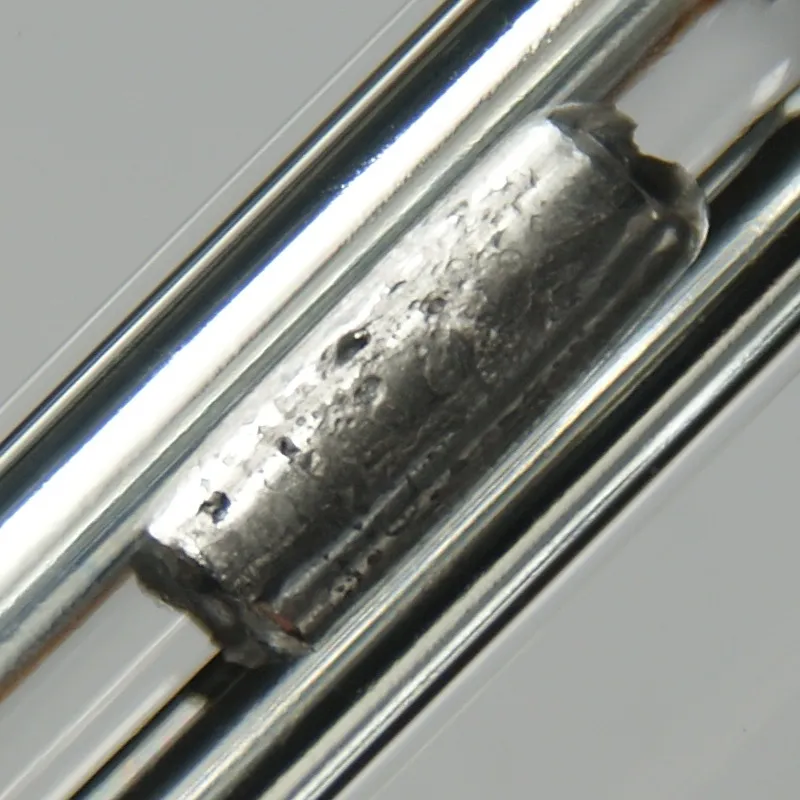

Specimen
- Atomic number
- 81
- Atomic mass
- 204.38
- State at room temperature
- Solid
- Melting point
- 303.9 °C
- Boiling point
- 1,473 °C
- Density
- 11.8 g/cm³
- Discovered
- 1861
Can I eat it?
- In food and water
- Poison. Thallium salts are very toxic. Poisoning by mouth harms the nerves and the gut, causes hair loss, and can kill. Thallium takes the place of potassium in the body. 78
- As the pure element
- Poison. Thallium is a soft, bluish-white metal. The ILO and WHO safety card classes it as fatal if swallowed. The gut absorbs it, and it harms the gut and the nerves and causes hair loss. 9
Learn about thallium
- 01 How much there is And how much of that can we reach? Published estimates of thallium in Earth's crust range from 0.3 to 0.85 parts per million. Most is spread thinly in clays, granites and soils. The USGS has given no reserve figure since 2013. It says world resources are adequate for world needs. Read →
- 02 Where it is found What is it found in, and where on Earth? Thallium minerals are rare, and the USGS says they have no commercial importance. Industry recovers thallium from traces in the sulfide ores of copper, lead and zinc. A few deposits rich in thallium are known, in Brazil, China, North Macedonia and Russia. Read →
- 03 How we get it How much do we make each year, and how? The USGS estimates world production at about 10 tonnes in 2023. Most producers keep their figures secret, so the number is rough. By USGS estimate, China, Kazakhstan and Russia lead. Thallium comes from the flue dust of copper, lead and zinc smelters, and none is recycled. Read →
- 04 What we use it for Where does it go, and why this element? Most thallium goes into electronics, mainly photoelectric cells and radiation detectors. Smaller amounts go into heart scans, infrared optics, special glass and superconductors. Use in heart scans continues to fall, because doctors use technetium-99m instead. Read →
- 05 What it costs What does it cost, and how is it bought and sold? No public price exists for bulk thallium. The USGS estimate for 2025, about $9,300 per kg, is for 100-gram lots from retailers and producers. In real terms the US price rose more than 100 times from 1980 to 2016. Part of that rise came from changes in what the price measures. Read →
- 06 Who controls it Who controls the supply, and who depends on it? The USGS names China, Kazakhstan and Russia as the leading producers, but no shares are published. The United States imports all its thallium, most of it from Mexico. Thallium is not on the critical mineral lists of the United States or the EU. Read →
- 07 Social and political problems What problems does it cause between people, and who carries them? We found no war or armed group linked to thallium. Its harms are murders and pollution near ores, mines and refineries. At Lanmuchang, China, people grew ill from thallium in local food and water. An unsolved poisoning of 1994 led to public debate in China in 2013 and 2023. Read →
- 08 History How did our relationship with it begin and change? Crookes found thallium in 1861 from a green line in its spectrum, and named it after the Greek for a green twig. It was first a medicine, then a rat poison. US bans began in 1965, but many developing countries still use the poison. Electronics, optics and heart scans replaced it. Read →
Worth knowing
-
The whole world makes only about 10 tonnes of thallium a year. Most producers keep their figures secret. 1
How we get it → -
Thallium salts that dissolve easily in water have no color, smell or taste. A 2024 review calls thallium the poisoner's poison. 10
-
No one sells thallium in bulk at a public price. The USGS price is for 100-gram lots from three sellers. 1
What it costs → -
The USGS estimated that world coal holds about 630,000 tonnes of thallium. Zinc resources hold up to 17,000 tonnes. 11
How much there is → -
At Lanmuchang, in China, an adult took in about 1.9 mg of thallium a day from local food crops, a 2005 study estimated. 12
Social and political problems → -
Before a shortage of technetium in 2009, thallium-201 was used in about 25% of US heart perfusion tests, by a USGS estimate. During the shortage it was the most common replacement. 13
What we use it for →
The atom
Electrons
| Shell | Electrons |
|---|---|
| 1 (K) | 2 |
| 2 (L) | 8 |
| 3 (M) | 18 |
| 4 (N) | 32 |
| 5 (O) | 18 |
| 6 (P) outermost | 3 |
| Total | 81 |
Configuration [Xe] 4f¹⁴ 5d¹⁰ 6s² 6p¹
4f ↑ ↓ ↑ ↓ ↑ ↓ ↑ ↓ ↑ ↓ ↑ ↓ ↑ ↓
5d ↑ ↓ ↑ ↓ ↑ ↓ ↑ ↓ ↑ ↓
6s ↑ ↓
6p ↑
Nucleus
| Protons | 81 |
|---|---|
| Neutrons | 124 |
| Mass number | 205 |
Related elements
New articles by e-mail
Sources
- 1
U.S. Geological Survey (Souleymane H. Saloum), 2026. Thallium, in Mineral Commodity Summaries 2026 .
World production in 2023, uses, US trade and price, recycling, health limits, deposits, resources and substitutes.
-
byproduct recovered from flue dust in the roasting of copper, lead, and zinc ores
-
In 2023 (the latest year for which data were available), global production of thallium was estimated to be about 10,000 kilograms
-
Price, metal, dollars per kilograme, 4 ... 9,300
-
Recycling: None.
-
Because most producers withhold thallium production data, global production data were limited
-
Estimated average price of thallium 99.99%-pure granules in 100-gram lots from three retailers and producers as of November 7, 2025
-
- 2
Theodore Gray, periodictable.com (Wolfram ElementData), 2026. Technical data for Thallium .
Abundance in the universe and the crust.
-
% in Earth's Crust 0.000054%
-
- 3
UK Critical Minerals Intelligence Centre, British Geological Survey, 2024. UK 2024 Criticality Assessment , Section 2.6.3; Appendix 6 (end uses and recycling).
Thallium left out of the assessment for lack of data; BGS estimates of its end uses and recycling.
-
Thallium (Tl) Electronics industry in photoelectric cells 65 0 BGS in-house estimate
-
- 4
UNEP International Resource Panel (T.E. Graedel et al.), 2011. Recycling Rates of Metals: A Status Report , Table F1.
End-of-life recycling rates, recycled content and old scrap ratios for 60 metals.
-
Tl 0 0 0
-
- 5
IUPAC Commission on Isotopic Abundances and Atomic Weights (CIAAW), 2024. Abridged Standard Atomic Weights 2024 .
The atomic mass shown for the 84 elements that have a standard atomic weight.
- 6
National Center for Biotechnology Information (PubChem), 2026. Periodic Table of Elements .
Electron configuration, melting and boiling points, density and discovery year for all 118 elements.
- 7
Agency for Toxic Substances and Disease Registry (ATSDR), 2024. Toxicological Profile for Thallium (Draft for Public Comment), Chapter 1: Relevance to Public Health , Chapter 1, dermal effects.
-
Alopecia (hair loss) is a classic symptom of acute thallium poisoning
-
Body weight decreases, dermal effects, nervous system effects, gastrointestinal effects, and death were the most sensitive targets following oral exposure to thallium
-
- 8
Royal Society of Chemistry, Periodic Table, 2026. Thallium - Element information, properties and uses .
Reference page; its Biological role and Natural abundance sections are quoted.
-
Thallium has no known biological role. It is very toxic ... It can displace potassium around the body
-
- 9
International Labour Organization and World Health Organization (International Chemical Safety Cards), 2013. ICSC 0077 - Thallium .
-
Fatal if swallowed May cause damage to gastrointestinal tract and the nervous system if swallowed
-
The substance can be absorbed into the body by ingestion. Effects of short-term exposure Ingestion could cause effects on the gastrointestinal tract and nervous system. Ingestion could cause hair loss. Ingestion of large amounts could cause death.
-
- 10
J. Fujihara and N. Nishimoto, Current Research in Toxicology 6, 2024. Thallium - poisoner's poison: An overview and review of current knowledge on the toxicological effects and mechanisms .
Toxicity, lethal dose, poisonings, Prussian blue and the novel by Agatha Christie.
-
Tl is poisoner’s poison ... Tl salts with high solubility are uncolored, inodorous, and tasteless compounds
-
- 11
U.S. Geological Survey, 2021. Thallium, in Mineral Commodity Summaries 2021 .
Thallium in world zinc and coal resources, the last edition with these figures.
-
World identified resources of coal contain an estimated 630 million kilograms of thallium
-
- 12
T. Xiao, L. He, J. Guha, J. Lin and J. Chen, WIT Transactions on Ecology and the Environment 85, 2005. Environmental exposure of thallium and potential health risk in an area of high natural concentrations of thallium: southwest Guizhou, China .
Thallium in ores, water, crops and people at Lanmuchang, and the poisonings of the 1960s and 1970s.
-
The daily intake 1.9 mg Tl from the consumed food crops was estimated for a local adult inhabitant of Lanmuchang
-
- 13
U.S. Geological Survey, 2010. Thallium, in Mineral Commodity Summaries 2010 .
The technetium shortage of 2009, the price rise since 2005 and Chinese export policy.
-
The thallium isotope 201 was the most common alternative to technetium-99 for use in scans ... It was estimated that before the shortage, thallium was used in about 25% of all cardiac-perfusion tests performed in the United States
-
- 14
National Institute of Standards and Technology (NIST), 2026. Atomic Weights and Isotopic Compositions for All Elements .
Isotopic composition of each element; the most abundant isotope sets the neutron count in the nucleus view.