Last updated 5 October 2026.
Boron
Element 5 · Metalloid · Mined for itself1
Boron is a light element that people almost never use in its pure form. Industry buys it as borates, salts mined from dry lake beds in volcanic regions. Most borates go into glass, glass fiber, ceramics and fertilizer. Turkey holds about three quarters of the known reserves. Its state company Eti Maden and Rio Tinto in California produce most of the world's supply. Borax has been used for more than a thousand years. It came by caravan from Tibet and later by mule team from Death Valley. In 2025 the United States added boron to its list of critical minerals.
How boron compares
Unit value $1,400 per tonne of B2O3 in boron minerals and compounds 3 Not on the scale: this is the price of B2O3 in boron minerals and compounds, not of boron. What it costs →
The scales are log scales, except for the shares, which go from 0 to 100%.
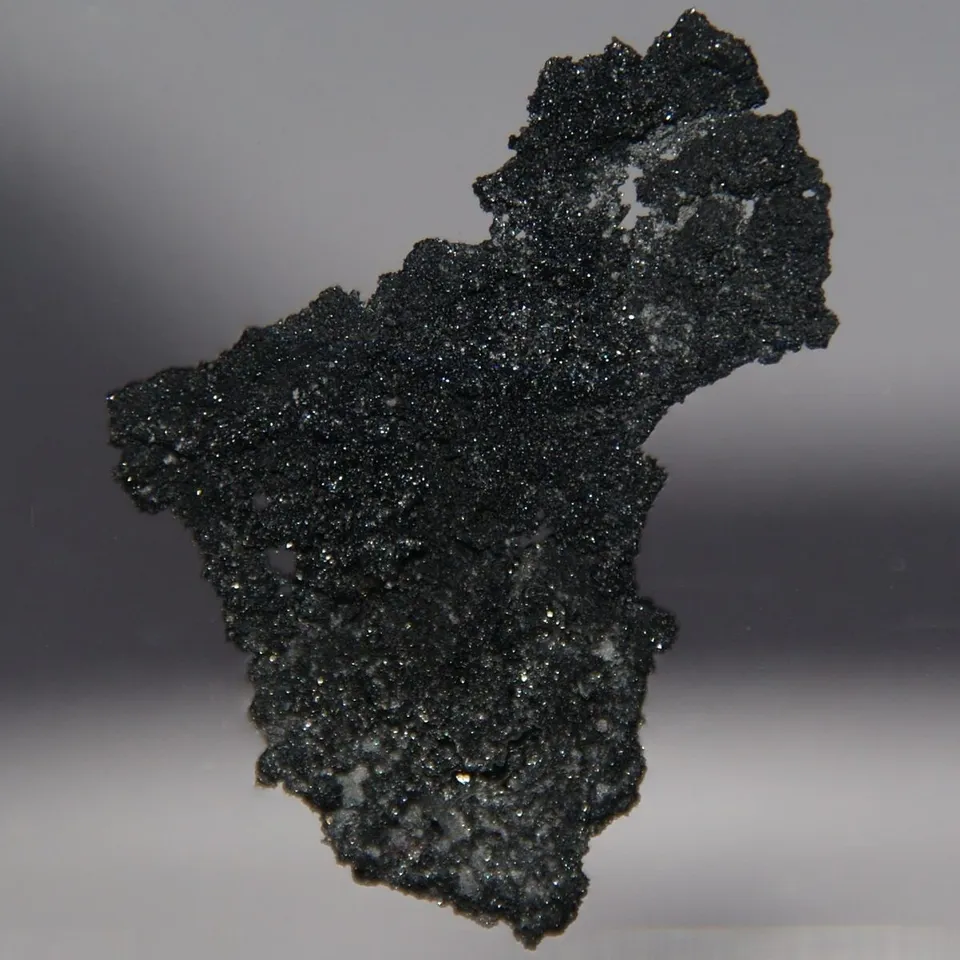

Specimen
- Atomic number
- 5
- Atomic mass
- 10.81
- State at room temperature
- Solid
- Melting point
- 2,075 °C
- Boiling point
- 4,000 °C
- Density
- 2.37 g/cm³
- Discovered
- 1808
Can I eat it?
Learn about boron
- 01 How much there is And how much of that can we reach? Boron is rare in the crust, about 9 parts per million, but some dry volcanic basins hold very rich deposits. Most known reserves are in Turkey. USGS does not say in what form it counts reserves, so we cannot give them in tonnes of boron. Read →
- 02 Where it is found What is it found in, and where on Earth? Almost all boron is mined from borates that formed in salty lakes near volcanoes, in dry climates. The richest deposits are in western Turkey, the Mojave Desert of California and the high Andes. China's deposits are of low grade. Read →
- 03 How we get it How much do we make each year, and how? The world mined about 4 million tonnes of borate ore a year in 2016 to 2020. It used about 700,000 tonnes of boron in 2018. Turkey's state company Eti Maden and Rio Tinto in California produce most of it. Very little boron is recycled. Read →
- 04 What we use it for Where does it go, and why this element? Most boron goes into glass: insulation wool, glass fiber, heat-resistant and display glass. Ceramic glazes and fertilizer are the next largest uses. Plants need boron, so in fertilizer nothing can replace it. In detergents and insulation, other materials can. Read →
- 05 What it costs What does it cost, and how is it bought and sold? Borates sell for a few hundred dollars a tonne. Producers keep prices private. USGS puts the US value of boron products at $1,400 per tonne of boric oxide (B2O3) in 2022, about $1,540 in 2025 dollars. In 2025 dollars, it has stayed between about $590 and $2,450 since 1914. Read →
- 06 Who controls it Who controls the supply, and who depends on it? Two companies, Turkey's state-owned Eti Maden and Rio Tinto's U.S. Borax, make 80% to 85% of the world's borates. Turkey also holds most of the reserves. The EU gets nearly all its boron from Turkey. The EU, the US and the UK all list boron as critical. Read →
- 07 Social and political problems What problems does it cause between people, and who carries them? The largest dispute is over Rio Tinto's Jadar lithium and borate project in Serbia, halted after protests in 2022 and restarted in 2024. Rio Tinto later put it on care and maintenance. In California, a 107-day lockout at the Boron mine in 2010 ended with a new union contract. Read →
- 08 History How did our relationship with it begin and change? People used borax for more than a thousand years before chemists isolated boron in 1808. Supply moved from Tibet to Tuscany, then to California and Turkey. Today glass is the main use. Read →
Worth knowing
-
Turkey's energy ministry says Turkey holds 73% of the world's boron reserves. The main deposits are at Kırka, Bigadiç, Kestelek and Emet. 11
Where it is found → -
In the 1880s, teams of twenty mules pulled borax wagons 165 miles from Death Valley to the railhead near Mojave. The trip took ten days. 12
History → -
Plants need boron. Normal leaves hold 25 to 100 parts per million, and 1 kilogram of boron per hectare of soil is enough to keep that level. 13
What we use it for → -
Boron carbide is the third hardest known material, after cubic boron nitride and diamond. It goes into lightweight body armor. 13
What we use it for → -
Nuclear reactors use boron to control fission. The isotope boron-10 absorbs free neutrons, so it is put in control rods and in reactor cooling water. 13
What we use it for → -
For centuries, crude borax from Tibetan lakes came over the Himalayas in bags tied to sheep. 14
History → -
The WHO drinking-water guideline for boron is 2.4 mg per liter. Canada's guideline is lower, 2 mg per liter. 2
-
Under the EU chemicals law REACH, boron trioxide is identified as toxic for reproduction. 2
The atom
Electrons
| Shell | Electrons |
|---|---|
| 1 (K) | 2 |
| 2 (L) outermost | 3 |
| Total | 5 |
Configuration [He] 2s² 2p¹
2s ↑ ↓
2p ↑
Nucleus
| Protons | 5 |
|---|---|
| Neutrons | 6 |
| Mass number | 11 |
Related elements
New articles by e-mail
Sources
- 1
A.S. Brioche, U.S. Geological Survey, 2026. Boron, in Mineral Commodity Summaries 2026 , World Production and Reserves table; Events, Trends, and Issues.
Production by country in mixed forms, reserves, US trade, substitutes, new projects and the 2025 US critical list.
-
The leading boron producer mined borate ores, which contain the minerals kernite, tincal, and ulexite, by open pit methods
-
- 2
SCRREEN2 (EU Horizon 2020 project), 2023. SCRREEN2 factsheets updates based on the EU factsheets 2020: Borates , Tables 1 and 3; demand; outlook for supply; recycling; health.
World production shares 2016 to 2020, EU supply, consumption in 2018, recycling and drinking-water limits.
-
World borates consumption was about 2,290 ktonnes in B2O3 content or 821 ktonnes in B content in 2018
-
World borates consumption was about 2,290 ktonnes in B2O3 content
-
Turkey 48% ... USA 25% ... Chile 11% ... Bolivia 5%
-
the guideline value for boron is set at 2.4 mg/l. Similar guidelines developed by the government of Canada, set the guideline value even lower, at 2 mg/l
-
The oxide of boron, boron trioxide, is identified as toxic for reproduction. (REACH 2012)
-
- 3
U.S. Geological Survey (D.A. Buckingham, P.A. Lyday, D.S. Kostick, D.E. Polyak, M.A. Angulo, R.D. Crangle, Jr., A.S. Brioche), 2023. Boron statistics, in Historical Statistics for Mineral and Material Commodities in the United States (Data Series 140) , Columns: Unit value ($/t); Unit value (98$/t); embedded notes.
US production to 2005 and the US unit value of boron products per t of B2O3, 1900 to 2022.
-
Unit value ($/t) ... 2022 ... 1400
-
- 4
Theodore Gray, periodictable.com (data from Wolfram ElementData), 2026. Technical data for Boron (from Wolfram ElementData) , Abundances.
Abundance in the universe, crust, oceans and human body, as mass fractions.
-
% in Earth's Crust 0.00086%
-
- 5
IUPAC Commission on Isotopic Abundances and Atomic Weights (CIAAW), 2024. Abridged Standard Atomic Weights 2024 .
The atomic mass shown for the 84 elements that have a standard atomic weight.
- 6
National Center for Biotechnology Information (PubChem), 2026. Periodic Table of Elements .
Electron configuration, melting and boiling points, density and discovery year for all 118 elements.
- 7
European Commission, 2011. Commission Regulation (EU) No 1129/2011 establishing a Union list of food additives , Annex, Parts B and E.
The text as adopted by the EU in 2011, from legislation.gov.uk. Later EU amendments are not in it.
-
E 284 Boric acid 4 000 (54) only Sturgeons’ eggs (Caviar)
-
- 8
European Commission, 2009. Commission Regulation (EC) No 1170/2009 amending Directive 2002/46/EC and Regulation (EC) No 1925/2006 , Article 2.
The text as adopted by the EU, from legislation.gov.uk. EUR-Lex served the quote checker an empty page.
-
In Annex I, the word ‘Boron’ is added in the list in point 2.
-
- 9
National Center for Biotechnology Information (PubChem), with text from the Hazardous Substances Data Bank (HSDB), 2026. Boron (CID 5462311), compound summary, Toxicity section , Toxicity Summary; Human Toxicity Excerpts.
-
Elemental boron exists as a solid at room temperature, either as black monoclinic crystals or as a yellow or brown amorphous powder when impure
-
Elemental boron is not considered to be a poison
-
- 10
National Institute of Technology and Evaluation (NITE), Japan, 2019. GHS classification result, Boron (FY2019 revised classification) , Acute toxicity (Oral).
-
LD50 for rats: >2,000 mg/kg
-
- 11
Republic of Türkiye Ministry of Energy and Natural Resources, 2026. Boron .
Turkey's reserves, Eti Maden sales and exports, new boron product plants and the government's view on prices and recycling.
-
Türkiye holds 73% of the world’s boron reserves, with the main deposits located in Eskişehir-Kırka, Balıkesir-Bigadiç, Bursa-Kestelek, and Kütahya-Emet
-
- 12
U.S. National Park Service, Death Valley National Park, 2026. Twenty Mule Teams .
The borax wagon teams of 1883 to 1889.
-
a grueling 165 mile, ten day trip across primitive roads
-
- 13
A.S. Brioche, U.S. Geological Survey, 2024. Boron, in 2019 Minerals Yearbook (advance release) , pp. 13.1-13.6.
Producers, uses, trade, history and projects by country, 2019.
-
Normal plant leaves typically contain 25 to 100 parts per million boron; 1 kilogram of boron per hectare (1 pound per acre) in soil is adequate to maintain these levels
-
Boron carbide, the third hardest known material after cubic boron nitride and diamond, was a key ingredient in lightweight ceramic armor
-
The isotope boron-10, in particular, possesses a high propensity for absorbing free neutrons
-
- 14
J. Wisniak, Indian Journal of Chemical Technology 12, 2005. Borax, boric acid, and boron: From exotic to commodity , pp. 488-500.
History of borax trade, the isolation of boron and the start of each borate industry.
-
The crude borax crystals from Tibetan lakes were transported in bags tied to sheep, which were driven by caravan over the Himalayas
-
- 15
National Institute of Standards and Technology (NIST), 2026. Atomic Weights and Isotopic Compositions for All Elements .
Isotopic composition of each element; the most abundant isotope sets the neutron count in the nucleus view.