Last updated 13 October 2026.
Iodine
Element 53 · Halogen · Mined for itself1
Iodine forms dark, shiny crystals and a violet vapor. The human body needs iodine for its thyroid hormones, and iodized salt prevents deficiency in most countries. Chile gets iodine from caliche ore together with nitrate. Japan and the United States get it from brines that come up with natural gas and oil. The largest use is X-ray contrast media for medical imaging.
How iodine compares
The scales are log scales, except for the shares, which go from 0 to 100%.
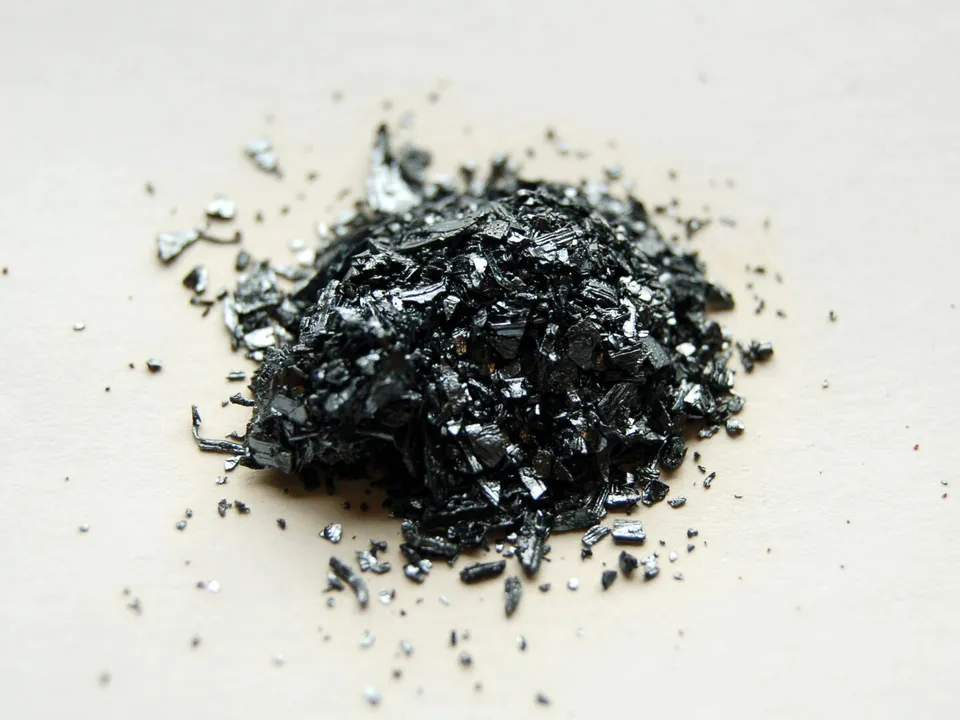

Specimen
- Atomic number
- 53
- Atomic mass
- 126.9
- State at room temperature
- Solid
- Melting point
- 113.7 °C
- Boiling point
- 184.4 °C
- Density
- 4.93 g/cm³
- Discovered
- 1811
Can I eat it?
Learn about iodine
- 01 How much there is And how much of that can we reach? Iodine is rare: about 0.5 parts per million of the crust and 0.06 in seawater. The USGS puts world reserves at more than 6.3 million tonnes, most in Japan, or about 185 years of 2025 output. Few places have brine or ore rich enough to process. Read →
- 02 Where it is found What is it found in, and where on Earth? Iodine comes from two kinds of deposit. In the Atacama Desert of Chile, it is in caliche, a salt-rich crust with nitrate. In Japan and Oklahoma, it is dissolved in old brines that come up with natural gas and oil. In 2014, China got almost all of its iodine from seaweed. Read →
- 03 How we get it How much do we make each year, and how? The USGS estimates world production at about 34,000 tonnes in 2025, without the United States. Chile made about two thirds and Japan about a quarter. Chile leaches iodine from ore with water; Japan and the US take it from brine. About 17% of supply is recycled. Read →
- 04 What we use it for Where does it go, and why this element? The largest use is X-ray contrast media, which make blood vessels and organs visible on medical scans. The next uses, in order, are LCD polarizing film, medicines, disinfectants, animal feed and fluorine chemicals. For nutrition, the USGS knows of no comparable substitute. Read →
- 05 What it costs What does it cost, and how is it bought and sold? Spot iodine crystal cost about $73 per kg in 2025. Spot prices reached $80 to $95 in December 2011, fell to about $20 by 2017, and then more than tripled. Most iodine is sold on contracts between buyers and sellers. Read →
- 06 Who controls it Who controls the supply, and who depends on it? Chile and Japan make about 94% of the iodine in the USGS world total. One Chilean company, SQM, had about a third of world sales in 2022. Iodine is not on the main lists of critical minerals. In 2012, about 120 countries required iodized salt. Read →
- 07 Social and political problems What problems does it cause between people, and who carries them? The main dispute is about water in the Atacama Desert. A Chilean producer was found guilty of illegal groundwater use in 2014. High prices help producers but can make iodized salt harder to afford. In the United States, a 1948 bill to make iodized salt mandatory was defeated. Read →
- 08 History How did our relationship with it begin and change? Bernard Courtois found iodine in seaweed ash in 1811. The name comes from the Greek for violet. It became a medicine for goiter, and from the 1920s iodized salt prevented goiter in whole populations. Chile and Japan replaced seaweed as sources. The largest use is medical imaging. Read →
Worth knowing
-
The name iodine comes from the Greek word for violet-colored, after the color of its vapor. 9
History → -
The oceans hold an estimated 90 billion tons of iodine, but at only 0.06 parts per million. 1
How much there is → -
Kelp of the Laminaria family can collect up to 0.45% of its dry weight as iodine. 1
Where it is found → -
The brine under Chiba, Japan, has about 2,000 times more iodine than seawater. 10
Where it is found → -
Many elements have higher atomic numbers than iodine, but no other forms soluble compounds of low toxicity. That is why X-ray contrast media use iodine. 11
What we use it for → -
In the US, part of the iodine in milk comes from iodine cleaners for milk cans and cow teats. 9
What we use it for →
The atom
Electrons
| Shell | Electrons |
|---|---|
| 1 (K) | 2 |
| 2 (L) | 8 |
| 3 (M) | 18 |
| 4 (N) | 18 |
| 5 (O) outermost | 7 |
| Total | 53 |
Configuration [Kr] 4d¹⁰ 5s² 5p⁵
4d ↑ ↓ ↑ ↓ ↑ ↓ ↑ ↓ ↑ ↓
5s ↑ ↓
5p ↑ ↓ ↑ ↓ ↑
Nucleus
| Protons | 53 |
|---|---|
| Neutrons | 74 |
| Mass number | 127 |
Related elements
New articles by e-mail
Sources
- 1
U.S. Geological Survey (Emily K. Schnebele), 2026. Iodine, in Mineral Commodity Summaries 2026 .
World production 2024 and 2025 and reserves by country, US trade and unit values, spot prices, uses, recycling, substitutes and resources.
-
Chile accounted for about two-thirds of world production in 2025. Most of the world’s iodine supply comes from three areas: the Chilean desert nitrate mines
-
World total (rounded) Mine productione 2024 2025 W W 210 210 22,000 23,000 30 50 700 700 9,300 9,000 5 8 800 800 4 4 33,000 34,000
-
spot prices for iodine crystal averaged about $73 per kilogram during the first 10 months of 2025
-
Seawater contains 0.06 part per million iodine, and the oceans are estimated to contain approximately 90 billion tons of iodine
-
Seaweeds of the Laminaria family are able to extract and accumulate up to 0.45% iodine on a dry basis
-
- 2
Theodore Gray, periodictable.com (Wolfram ElementData), 2026. Technical data for Iodine .
Abundance in the crust, the universe and the human body.
-
% in Earth's Crust 0.000049%
-
- 3
IUPAC Commission on Isotopic Abundances and Atomic Weights (CIAAW), 2024. Abridged Standard Atomic Weights 2024 .
The atomic mass shown for the 84 elements that have a standard atomic weight.
- 4
National Center for Biotechnology Information (PubChem), 2026. Periodic Table of Elements .
Electron configuration, melting and boiling points, density and discovery year for all 118 elements.
- 5
European Food Safety Authority (EFSA), 2017. Dietary Reference Values for nutrients. Summary report , Section 4.5 (iodine) and 4.9 (molybdenum).
-
Iodine is an essential nutrient for mammals, required as a mandatory structural and functional element of thyroid hormones ... an Adequate Intake (AI) for iodine for adult men and women can be set at 150 µg/day
-
- 6
Royal Society of Chemistry, 2026. Iodine - Element information, properties and uses .
-
A deficiency of iodine can cause the thyroid gland to swell up (known as goitre).
-
- 7
National Center for Biotechnology Information (PubChem), 2026. PubChem Compound Summary for CID 807, Iodine , Safety and Hazards; Toxicity.
-
Concentrated iodine is very corrosive and can damage the mucous membrane if swallowed.
-
Probably the mean lethal dose lies between 2 and 4 g of free iodine
-
- 8
International Labour Organization and World Health Organization (International Chemical Safety Cards), 2004. ICSC 0167 - Iodine , Ingestion; Chemical dangers; Effects of short-term exposure.
-
The substance is severely irritating to the eyes and respiratory tract.
-
- 9
Angela M. Leung, Lewis E. Braverman and Elizabeth N. Pearce, Nutrients 4(11), 2012. History of U.S. Iodine Fortification and Supplementation .
Early history of iodine and goiter, the US goiter belt, iodized salt, and iodine in US dairy.
-
termed after the Greek word, ioeides, translated as violet-colored
-
iodine is present in dairy foods (due to the iodophor cleansers of milk cans and teats)
-
- 10
K&O Energy Group Inc., 2026. Iodine business .
History of iodine in Japan, the Chiba brine, production methods and Japan's trade in iodine.
-
the iodine concentration of brine water is nearly 2,000 times that of seawater
-
- 11
U.S. Geological Survey, 2021. Iodine, in 2019 Minerals Yearbook .
Producers in Chile, Japan and Oklahoma, recycling, uses, prices, potassium iodide, nutrition and US drug controls in 2019.
-
although many elements have higher atomic numbers than iodine, no other element has the chemical characteristics to form soluble compounds with low toxicity
-
- 12
National Institute of Standards and Technology (NIST), 2026. Atomic Weights and Isotopic Compositions for All Elements .
Isotopic composition of each element; the most abundant isotope sets the neutron count in the nucleus view.