Last updated 13 October 2026.
Xenon
Element 54 · Noble gas · Extracted from air, water or natural gas1
Xenon is the rarest stable noble gas in the air, less than one part in ten million. Large air separation plants collect it, always together with krypton. Xenon goes into bright lamps, chip making, satellite thrusters, dark matter detectors and a few medical uses. Supply is small and grows only when new large plants open, so the price has risen and fallen many times.
How xenon compares
The scales are log scales, except for the shares, which go from 0 to 100%.
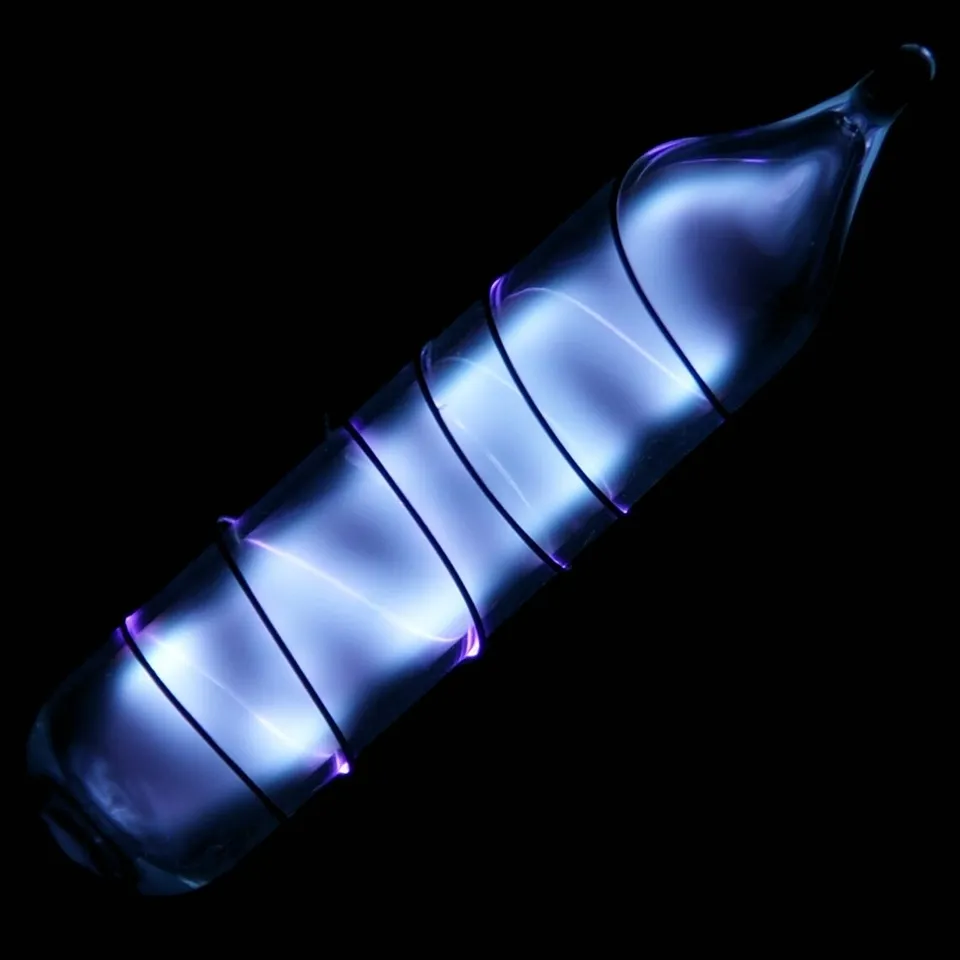

Specimen
- Atomic number
- 54
- Atomic mass
- 131.29
- State at room temperature
- Gas
- Melting point
- -111.8 °C
- Boiling point
- -108.1 °C
- Density
- 0.005887 g/cm³
- Discovered
- 1898
Can I eat it?
- In food and water
- Not needed, little harm known. Xenon is a gas with no known function in the body. The RSC says xenon itself is not toxic. Its compounds are highly toxic because they are strong oxidizers. 6
Learn about xenon
- 01 How much there is And how much of that can we reach? Xenon is about 0.087 parts per million of dry air, about 2 billion tonnes in all. People collect about 71 tonnes a year. The limit on supply is the number of large air separation plants that recover it, not the amount in the air. Read →
- 02 Where it is found What is it found in, and where on Earth? Xenon has no ores or deposits. All of it comes from the air, through large air separation plants, mostly at steel works. About 40% comes from plants that supply oxygen to chemical works, such as the Sasol coal plant in South Africa. Read →
- 03 How we get it How much do we make each year, and how? The USGS estimates world output at about 12 million liters in 2025, about 71 tonnes. Large air separation plants collect xenon in a crude mix with krypton, and a few plants purify it. No one publishes output by country. Gas companies collect some used xenon and clean it. Read →
- 04 What we use it for Where does it go, and why this element? In 2017 about a third of the world's xenon went into lamps and a quarter into satellite thrusters, according to DERA. Research, anesthesia and chip making took most of the rest. LEDs have replaced many xenon lamps, and iodine is being tested in thrusters. Read →
- 05 What it costs What does it cost, and how is it bought and sold? Xenon has no published world price. In April 2026 a Chinese market data firm gave 20,000 yuan per cubic meter, about $500 per kg. The market is small, so the price swings a lot. In China it fell by about 88% from September 2022 to September 2023. Read →
- 06 Who controls it Who controls the supply, and who depends on it? Xenon comes from air plants in many countries. China has the most plants, and Russia was a large exporter before 2022. The United States imports almost all the xenon it uses. Xenon is not on the EU, US or UK critical lists. Russia required export licenses for noble gases in 2022. Read →
- 07 Social and political problems What problems does it cause between people, and who carries them? Xenon comes from air plants, not mines, so there are no mining disputes about it. The war in Ukraine disrupted rare gas supply from 2022 and raised prices for a time. Since 2014, athletes may not use xenon. We found no reports of worker or community harm specific to xenon. Read →
- 08 History How did our relationship with it begin and change? William Ramsay and Morris Travers found xenon in London in 1898. In 1962 Neil Bartlett used it to make the first compound of a noble gas. Later xenon went into bright lamps, satellite thrusters, anesthesia and chip making. Read →
Worth knowing
-
To make one cubic meter of xenon gas (5.9 kg), a plant must process more than 10 million cubic meters of air, about 12,920 tonnes. 9
How we get it → -
In 1962 Neil Bartlett made the first compound of a noble gas, from xenon. Until then, chemists had regarded the noble gases as inert. 10
History → -
The LZ dark matter detector holds ten tonnes of liquid xenon. That is about one seventh of the world's xenon output in 2025 (10 of about 71 tonnes). 11
What we use it for → -
When the Soviet Union broke up, its xenon stocks reached the world market. The price fell from about $20 per liter in 1984 to about $1 in 1990 and 1991. 9
What it costs → -
Radioactive xenon from a nuclear test can travel a long way. In 2013 a station in Japan, about 1,000 km from the North Korean test site, detected xenon that fit the February test. 12
-
Since 2014, athletes may not use xenon. The World Anti-Doping Agency put it on its prohibited list in 2014. 13
Social and political problems → -
About 40% of the world's xenon comes from air plants that supply oxygen to chemical works, not steel works. The best known is the Sasol coal gasification plant in South Africa. 9
Where it is found →
The atom
Electrons
| Shell | Electrons |
|---|---|
| 1 (K) | 2 |
| 2 (L) | 8 |
| 3 (M) | 18 |
| 4 (N) | 18 |
| 5 (O) outermost | 8 |
| Total | 54 |
Configuration [Kr] 4d¹⁰ 5s² 5p⁶
4d ↑ ↓ ↑ ↓ ↑ ↓ ↑ ↓ ↑ ↓
5s ↑ ↓
5p ↑ ↓ ↑ ↓ ↑ ↓
Nucleus
| Protons | 54 |
|---|---|
| Neutrons | 78 |
| Mass number | 132 |
Related elements
New articles by e-mail
Sources
- 1
U.S. Geological Survey (Robert C. Goodin), 2026. Helium and rare gases, in Mineral Commodity Summaries 2026 , p. 1 (US sales, uses, imports, net import reliance), p. 2 (world rare gas production table, recycling, stockpile).
World and US xenon production in 2024 and 2025 (from Intelligas and Techcet), US uses, imports and import reliance.
-
Rare gases are extracted from the atmospheric air.
-
Rare gases productione, 4 (million liters) Neon Krypton Xenon ... 800 800 112 110 12 12
-
- 2
Century Securities (世纪证券), with prices from SCI (卓创资讯), 2026. 装备制造行业周报(4月第4周):氦气价格涨幅扩大 (Equipment industry weekly report, fourth week of April 2026) , p. 1, industry views, item 1.
Weekly average prices of industrial and rare gases in China, week to 23 April 2026, from SCI. A broker report.
-
氙气市场周均价 20000 元/立方 米
-
- 3
Theodore Gray, periodictable.com (data from Wolfram ElementData), 2026. Technical data for Xenon .
Abundance of xenon in the crust, the oceans and the universe, by mass.
-
% in Earth's Crust 2×10⁻⁹%
-
- 4
IUPAC Commission on Isotopic Abundances and Atomic Weights (CIAAW), 2024. Abridged Standard Atomic Weights 2024 .
The atomic mass shown for the 84 elements that have a standard atomic weight.
- 5
National Center for Biotechnology Information (PubChem), 2026. Periodic Table of Elements .
Electron configuration, melting and boiling points, density and discovery year for all 118 elements.
- 6
Royal Society of Chemistry, 2026. Xenon - Element information, properties and uses .
-
Xenon has no known biological role. It is not itself toxic, but its compounds are highly toxic because they are strong oxidising agents.
-
It is not itself toxic
-
- 7
National Center for Biotechnology Information (PubChem), 2026. PubChem Compound Summary for CID 23991, Xenon , Safety and Hazards; Toxicity.
-
Xenon has anesthetic properties in high concentrations (1 atmosphere).
-
- 8
International Labour Organization and World Health Organization (International Chemical Safety Cards), 2007. ICSC 0609 - Xenon , Ingestion; Chemical dangers; Effects of short-term exposure.
-
High concentrations in the air cause a deficiency of oxygen with the risk of unconsciousness or death.
-
- 9
Harald Elsner, Deutsche Rohstoffagentur (DERA) at the Federal Institute for Geosciences and Natural Resources (BGR), 2018. Edelgase – Versorgung wirklich kritisch? (Noble gases: is supply really critical?) , Summary pp. 11-12; Table 1 p. 17 (density); Table 3 p. 20 (air); p. 21 (origin); 3.1.5 p. 27 (production); 3.2.5 pp. 47-48 (uses); 3.3 p. 49 (toxicity); 3.4 pp. 53-54 (recycling); 4.5 pp. 71-72 (demand, Fig. 26); 5.5 pp. 90-93 (supply); 6.5 pp. 99-100 (balance); 7.5 pp. 103-105 (price); annex South Africa p. 169; Table 37 p. 193.
World supply, demand, uses, plants and prices of xenon, in German. Most xenon figures come from the consultant Richard Betzendahl.
-
Für die Herstellung von 1 m3 Xe (5,9 kg) unter Normalbedingungen (1.013 hPa, 0 °C) muss man mehr als 10 Mio. m3 Luft (12.920 t) verarbeiten!
-
rund 20,0 US$/l kostete ... Mit dem Zerfall der Sowjetunion gelangten große sowjetische Bestände auf den Weltmarkt und der Preis fiel in den Jahren 1990/91 auf 1,0 US$/l zurück
-
Rund 40 % des weltweiten Xenons fallen in Luftzerlegungsanlagen an, die nicht Stahlhütten, sondern Chemieanlagen mit Sauerstoff versorgen. Bekanntestes Beispiel ist die Kohlevergasungsanlage von Sasol in Südafrika
-
- 10
American Chemical Society, National Historic Chemical Landmarks, 2006. Neil Bartlett and the Reactive Noble Gases .
The first noble gas compound, made from xenon in 1962, and uses of xenon compounds. Read with Firecrawl, because the site refuses scripts.
-
had previously been regarded as inert. By combining xenon with a platinum fluoride, Bartlett created the first noble gas compound.
-
- 11
Lawrence Berkeley National Laboratory, 2022. Berkeley Lab Researchers Record Successful Startup of LUX-ZEPLIN Dark Matter Detector at Sanford Underground Research Facility .
The LZ detector and its ten tonnes of liquid xenon.
-
two nested titanium tanks filled with ten tonnes of very pure liquid xenon
-
- 12
Comprehensive Nuclear-Test-Ban Treaty Organization (CTBTO), 2013. CTBTO detects radioactivity consistent with 12 February announced North Korean nuclear test .
Detection of xenon-131m and xenon-133 after the 2013 North Korean test, and the CTBTO noble gas network. Read with Firecrawl, because the site refuses scripts.
-
The detection was made at the radionuclide station in Takasaki, Japan, located at around 1,000 kilometres, or 620 miles, from the DPRK test site.
-
- 13
Hong Kong Anti-Doping Committee, 2014. WADA makes amendment to Section S.2.1 of 2014 Prohibited List .
WADA's addition of xenon and argon to the 2014 Prohibited List, from 1 September 2014.
-
Xenon and Argon, as examples of Hypoxia-Inducible Factor (HIF) stabilizers and activators, will be added to the 2014 Prohibited List effective from 1 September 2014
-
- 14
National Institute of Standards and Technology (NIST), 2026. Atomic Weights and Isotopic Compositions for All Elements .
Isotopic composition of each element; the most abundant isotope sets the neutron count in the nucleus view.