Last updated 14 October 2026.
Plutonium
Element 94 · Actinide · Made in reactors or accelerators1
Plutonium is a radioactive metal that people make in nuclear reactors. Only traces of it formed in nature. Every power reactor turns some of its uranium into plutonium, about 70 tonnes a year in the world's spent fuel. Part of this is separated and used again as fuel. The same metal is used in nuclear weapons and kept in civil stores. A rare isotope, plutonium-238, gives heat and electricity to spacecraft.
How plutonium compares
The scales are log scales, except for the shares, which go from 0 to 100%.
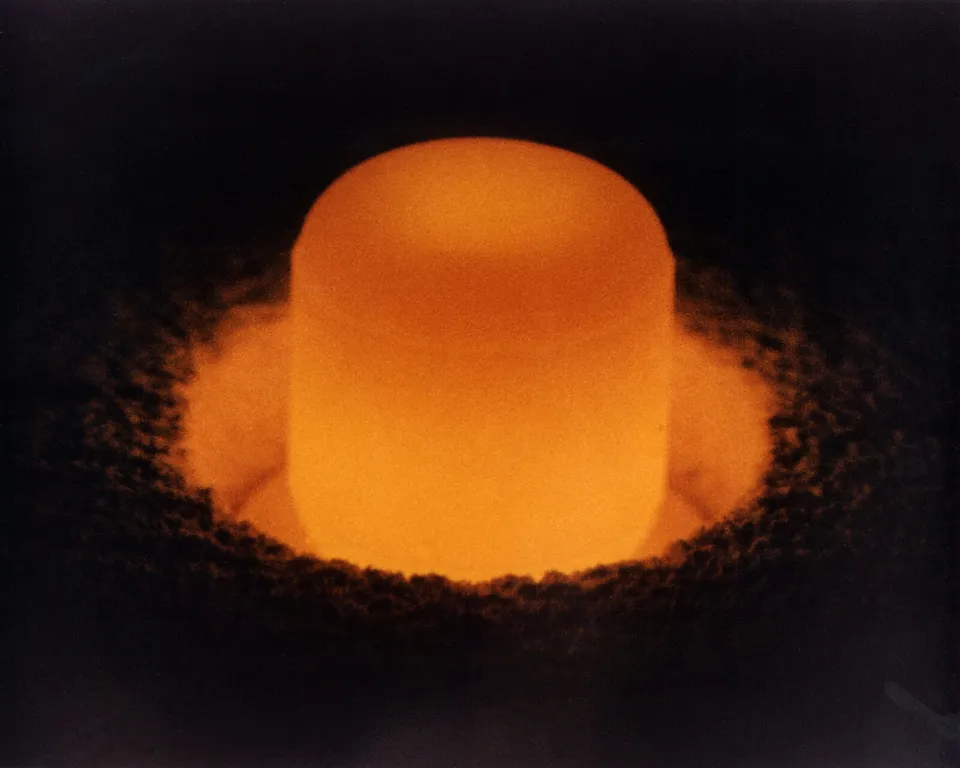

Specimen
- Atomic number
- 94
- Atomic mass
- [244]
- State at room temperature
- Solid
- Melting point
- 639.9 °C
- Boiling point
- 3,228 °C
- Density
- 19.84 g/cm³
- Discovered
- 1940
Can I eat it?
- In food and water
- Radioactive. Plutonium is radioactive. Its main health effect is cancer of the lung, bone or liver, years after exposure. The levels that most people meet are very low. 6
Learn about plutonium
- 01 How much there is And how much of that can we reach? Almost all plutonium on Earth was made by people. By an IPFM estimate, the world held about 565 tonnes of separated plutonium at the start of 2025. More is in spent reactor fuel. No source gives reserves, because nobody mines it. Read →
- 03 How we get it How much do we make each year, and how? Plutonium forms from uranium in every nuclear reactor: about 70 tonnes a year in the world's spent fuel, by a WNA estimate. A few countries separate part of it by reprocessing. No source gives the amount separated each year. Read →
- 04 What we use it for Where does it go, and why this element? Plutonium burns in the fuel of power reactors, where it forms. Some is separated and made into MOX fuel. The IPFM estimates that about 140 tonnes are in nuclear weapons or available for them. Plutonium-238 powers spacecraft. No source gives shares by use. Read →
- 05 What it costs What does it cost, and how is it bought and sold? Plutonium has no open market and no market price. Governments and state companies hold almost all of it. Transfers happen between governments, under agreements, or as fuel in MOX. Japan owns about 34.5 tonnes that are stored in the UK and France. Read →
- 06 Who controls it Who controls the supply, and who depends on it? A few governments own almost all separated plutonium. By IPFM estimates, Russia, the UK, France and the United States own most of the world's stock of about 565 tonnes. Because a bomb needs only about 10 kg, governments treat it as a weapon material. Read →
- 07 Social and political problems What problems does it cause between people, and who carries them? Plutonium for weapons left contaminated sites and harmed people nearby. A waste tank explosion at Mayak in 1957 forced more than 10,000 people to move. US researchers injected eighteen patients with plutonium. Governments still disagree about surplus plutonium. Read →
- 08 History How did our relationship with it begin and change? Glenn Seaborg's group at Berkeley made plutonium in December 1940, by bombarding uranium oxide with deuterons. Within five years it was the core of the first nuclear test and of the bomb used on Nagasaki. Later it became a reactor fuel and a heat source for spacecraft. Read →
Not covered: Where it is found. Plutonium has no ore and no deposits that anyone mines. Only trace quantities occur in nature, in uranium deposits and at the natural reactor at Oklo in Gabon8.
Worth knowing
-
The World Nuclear Association says that more than one-third of the energy in most nuclear power plants comes from plutonium made in the fuel. 1
What we use it for → -
Glenn Seaborg chose the symbol Pu as a joke. He did not expect it to be accepted. 8
History → -
A nuclear bomb needs about 10 kilograms of almost pure plutonium-239. 1
Who controls it → -
By August 1942 there was enough plutonium to see: 3 millionths of a gram. 8
History → -
Some early heart pacemakers ran on plutonium-238. After 30 years, some still worked. 1
What we use it for → -
Plutonium metal has six crystal forms, more than any other element. 1
What we use it for → -
Nuclear tests in the atmosphere released about 10,000 kg of plutonium, by an Argonne estimate. 9
The atom
Electrons
| Shell | Electrons |
|---|---|
| 1 (K) | 2 |
| 2 (L) | 8 |
| 3 (M) | 18 |
| 4 (N) | 32 |
| 5 (O) | 24 |
| 6 (P) | 8 |
| 7 (Q) outermost | 2 |
| Total | 94 |
Configuration [Rn] 5f⁶ 7s²
5f ↑ ↑ ↑ ↑ ↑ ↑
7s ↑ ↓
Nucleus
| Protons | 94 |
|---|---|
| Neutrons | 150 |
| Mass number | 244 |
Related elements
New articles by e-mail
Sources
- 1
World Nuclear Association, 2026. Plutonium , Updated 30 March 2026.
Industry association. Plutonium in power reactors, isotopes and grades, stocks, Pu-238 for spacecraft, weapons and disposition.
-
Plutonium is formed in nuclear power reactors from uranium-238 by neutron capture.
-
Total world generation of reactor-grade plutonium in spent fuel is some 70 tonnes per year.
-
Over one-third of the energy produced in most nuclear power plants comes from plutonium.
-
It takes about 10 kilograms of nearly pure Pu-239 to make a bomb
-
Early heart pacemakers used Pu-238 as the power source, and after 30 years some were still running well.
-
In pure form plutonium exists in six allotropic forms or crystal structure ... more than any other element.
-
- 2
Glenn T. Seaborg, 1951. The Transuranium Elements: Present Status, Nobel Lecture , Nobel Lecture, 12 December 1951.
The first synthesis of plutonium, the names, and the first weighing.
-
A bombardment of uranium oxide with the 16-MeV deuterons from the 60-inch cyclotron was performed in December, 1940
-
- 3
Royal Society of Chemistry, 2025. Plutonium, in the Periodic Table .
Uses, biological role, how the metal is made and early history.
-
They produced it by bombarding uranium-238 with deuterium nuclei (alpha particles). This first produced neptunium-238 with a half-life of two days, and this decayed by beta emission to form element 94
-
- 4
IUPAC Commission on Isotopic Abundances and Atomic Weights (CIAAW), 2024. Radioactive Elements .
Mass number and half-life of the longest-lived isotope of the 34 elements with no standard atomic weight.
-
94 Pu plutonium 244 81.3(3) Ma
-
- 5
National Center for Biotechnology Information (PubChem), 2026. Periodic Table of Elements .
Electron configuration, melting and boiling points, density and discovery year for all 118 elements.
- 6
Agency for Toxic Substances and Disease Registry (ATSDR), 2010. Plutonium | ToxFAQs .
-
The main health effect from exposure to plutonium is cancer which may occur years after exposure. The types of cancers you would most likely develop are cancers of the lung, bones, and liver.
-
The levels which most people are exposed are very low and of little health consequence.
-
- 7
US Environmental Protection Agency, 2026. Radionuclide Basics: Plutonium .
Added by the auditor. The Plutonium and Health section is quoted.
-
Plutonium that is ingested from contaminated food or water does not pose a serious threat to humans because the stomach does not absorb plutonium easily, it passes out of the body in the feces.
-
Most forms of plutonium emit alpha particles, which are not very harmful outside the body, but can be very damaging when inhaled.
-
- 8
Los Alamos National Laboratory, 2025. Plutonium, in the Periodic Table of Elements .
Hesperium, the first bombs, natural traces, the symbol and the secrecy.
-
Trace quantities are found in natural uranium deposits and in the natural nuclear fission reactor in Oklo, Gabon.
-
Co-discoverer Glenn Seaborg chose the letters ... to represent plutonium as a joke, referencing something that stinks. Seaborg didn’t expect it to be accepted
-
But by August 1942, there was enough to see—just three millionths of a gram.
-
- 9
Argonne National Laboratory, EVS, 2005. Plutonium, Human Health Fact Sheet , Plutonium fact sheet (August 2005), in the collected Argonne fact sheets.
Origin, amounts made in the United States and released by tests, uptake by the body and health risk.
-
About 10,000 kg were released to the atmosphere during these tests.
-