Last updated 14 October 2026.
Thorium
Element 90 · Actinide · By-product of cerium, lanthanum and neodymium1
Thorium is a weakly radioactive metal. Most of it comes from monazite, a mineral that is mined for its rare earths. For about a hundred years thorium made gas lamp mantles glow. Reactors can use it to make uranium-233, a nuclear fuel. Mostly test and prototype reactors have done so, and no country uses it to make power on a large scale.
How thorium compares
Unit value ~ $26 per kg of thorium compounds (oxide, nitrate and others) imported into the United States from France 1 Not on the scale: this is the price of thorium compounds (oxide, nitrate and others) imported into the United States from France, not of thorium. What it costs →
The scales are log scales, except for the shares, which go from 0 to 100%.
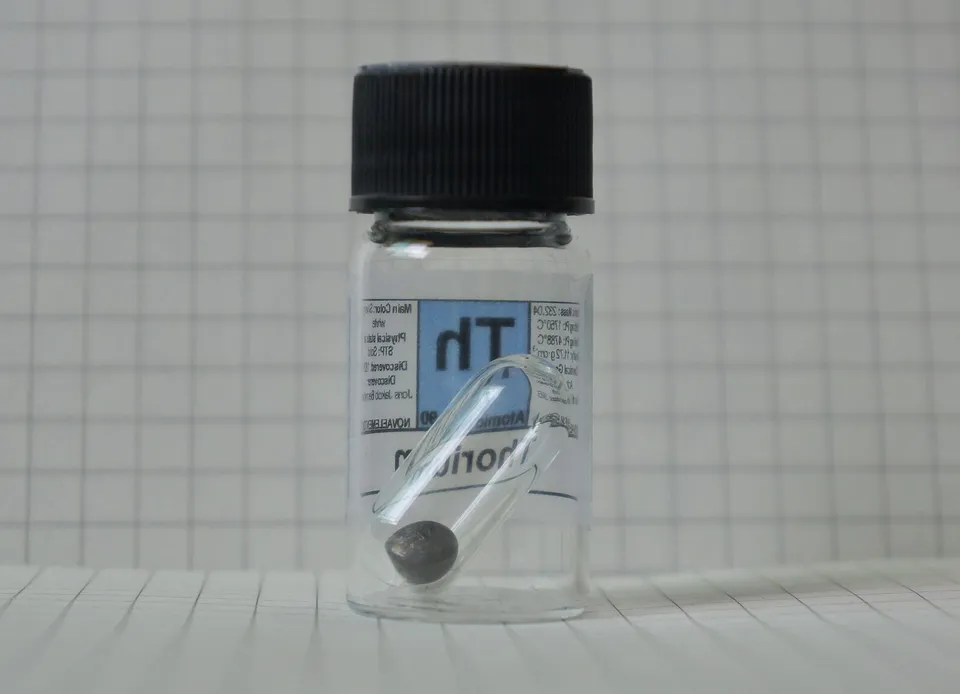

Specimen
- Atomic number
- 90
- Atomic mass
- 232.04
- State at room temperature
- Solid
- Melting point
- 1,750 °C
- Boiling point
- 4,788 °C
- Density
- 11.72 g/cm³
- Discovered
- 1828
Can I eat it?
Learn about thorium
- 01 How much there is And how much of that can we reach? Thorium is common for a heavy element: about 6 parts per million of the Earth's crust, roughly three times as much as uranium. Identified resources are about 6.4 million tonnes of thorium. Nobody has measured them well, because there is little demand. Read →
- 02 Where it is found What is it found in, and where on Earth? The main source of thorium is monazite, a phosphate mineral of the rare earths that collects in beach and river sands. The largest resources are in placer sands, carbonatites and veins. In 2016, the NEA and IAEA named beach sands in Brazil and India as the only sources. Read →
- 03 How we get it How much do we make each year, and how? Very little thorium is produced on purpose. No agency counts world production after 1977. The IAEA gives only estimates for a few countries. Monazite is mined for its rare earths, and most of its thorium goes into waste. Thorium is not recycled. Read →
- 04 What we use it for Where does it go, and why this element? Thorium goes into welding electrodes, heat-resistant ceramics, catalysts, lamps and nuclear reactors, all in small amounts. Substitutes that are not radioactive exist for many uses. Read →
- 05 What it costs What does it cost, and how is it bought and sold? Thorium has no world market price. The best public number is the value of US imports: about $26 per kilogram of thorium compounds from France in 2025. The trade is tiny. Monazite, the ore, is traded for its rare earths, and China is the main buyer. Read →
- 06 Who controls it Who controls the supply, and who depends on it? Thorium resources are spread over many countries. India, Brazil, the United States and Australia each have more than half a million tonnes. Few users depend on it today. Governments treat it as a nuclear material. China and India run programs to use it as a reactor fuel. Read →
- 07 Social and political problems What problems does it cause between people, and who carries them? The disputes are about thorium waste from rare earth plants in Malaysia. At Bukit Merah, residents sued a Mitsubishi joint venture from 1985, and the plant closed in 1994. Since 2012, the residue of the Lynas plant near Kuantan has led to protests and license conditions. Read →
- 08 History How did our relationship with it begin and change? Jöns Jacob Berzelius found thorium in a Norwegian mineral in 1828 or 1829 and named it after the god Thor. From the 1890s it was used in gas mantles for lamps. After 1945 it became a possible nuclear fuel. In the 1990s most US users changed to materials that are not radioactive. Read →
Worth knowing
-
Thorium oxide has one of the highest melting points of all oxides, about 3,300 °C. 9
What we use it for → -
The half-life of thorium-232 is about three times the age of the Earth. Most of the thorium that was in the Earth when it formed is still here. 9
How much there is → -
Thorium cannot start a chain reaction alone. In a reactor it takes up a neutron and becomes uranium-233, which can. 9
Who controls it → -
In 1900 the gas mantle was the only commercial use of thorium. In 1950 mantles still took 92% of the thorium used in the United States for purposes other than fuel. 10
History → -
In 2000, USGS wrote that worry about health was not a main reason why US companies stopped using thorium. The costs of rules, waste disposal and legal risk were. 10
What we use it for → -
Berzelius used the name thorium twice. The first time, in 1815, the new element was a mistake: the mineral held yttrium phosphate. 11
History →
The atom
Electrons
| Shell | Electrons |
|---|---|
| 1 (K) | 2 |
| 2 (L) | 8 |
| 3 (M) | 18 |
| 4 (N) | 32 |
| 5 (O) | 18 |
| 6 (P) | 10 |
| 7 (Q) outermost | 2 |
| Total | 90 |
Configuration [Rn] 6d² 7s²
6d ↑ ↑
7s ↑ ↓
Nucleus
| Protons | 90 |
|---|---|
| Neutrons | 142 |
| Mass number | 232 |
Related elements
New articles by e-mail
Sources
- 1
U.S. Geological Survey (Kristin N. Sheaffer), 2026. Thorium, in Mineral Commodity Summaries 2026 , Pp. 1-2: production and use, salient statistics, recycling, import sources, events, resources, substitutes.
US imports, unit values, uses, world resources after the World Nuclear Association, substitutes, and the statement that thorium is not recycled.
-
Globally, monazite was produced primarily for its rare-earth-element content, and only a small fraction of the byproduct thorium was recovered and consumed.
-
Price, average unit value of imports, compounds, ... NA 29 NA NA 26 NA 74 29 NA NA 27 NA NA 26 NA
-
Recycling: None.
-
- 2
periodictable.com (Theodore Gray), data from Wolfram ElementData, 2026. Technical data for Thorium , Abundances.
Mass fractions of thorium in the universe, the crust and the oceans.
-
% in Earth's Crust 0.0006%
-
- 3
Agency for Toxic Substances and Disease Registry (US), 2019. ToxGuide for Thorium .
Thorium in the crust, Thorotrast, workers exposed to thorium, health effects and the IARC classification.
-
crust at an average lithospheric concentration of 8–12 μg/g (ppm)
-
- 4
UK Critical Minerals Intelligence Centre, British Geological Survey, 2024. UK 2024 Criticality Assessment , Section 2.6.3 (materials left out); end-use table, row Thorium (Th).
Thorium left out of the assessment, and a BGS in-house estimate of thorium end uses and recycling.
-
Thorium (Th) Nuclear reactor 50 0 Heat resistant ceramics 20 0 Refractory metal manufacturing 20 0
-
- 5
IUPAC Commission on Isotopic Abundances and Atomic Weights (CIAAW), 2024. Abridged Standard Atomic Weights 2024 .
The atomic mass shown for the 84 elements that have a standard atomic weight.
- 6
National Center for Biotechnology Information (PubChem), 2026. Periodic Table of Elements .
Electron configuration, melting and boiling points, density and discovery year for all 118 elements.
- 7
Agency for Toxic Substances and Disease Registry (ATSDR), 2019. Toxicological Profile for Thorium, Chapter 1: Relevance to Public Health , Chapter 1, overview.
-
concentrations of thorium in air, food, and/or drinking water are normally very low and thorium-containing substances are not generally readily absorbed by the body.
-
Hematological effects and pulmonary effects (cirrhosis and cancer of the lung) were observed in animals following inhalation exposure to thorium.
-
thorium-containing substances are not generally readily absorbed by the body.
-
- 8
Royal Society of Chemistry, Periodic Table, 2026. Thorium - Element information, properties and uses .
Reference page; its Biological role and Natural abundance sections are quoted.
-
Thorium has no known biological role. It is toxic due to its radioactivity.
-
A weakly radioactive, silvery metal.
-
- 9
World Nuclear Association (an industry association), 2026. Thorium .
Thorium in nature, monazite, thorium as a nuclear fuel, reactors that used it, China's and India's programs, and U-233 in weapons.
-
also called thoria, has one of the highest melting points of all oxides (3300 C)
-
its half-life is about three times the age of the Earth
-
upon absorbing a neutron will transmute to uranium-233 (U-233)
-
- 10
U.S. Geological Survey (James B. Hedrick), 2001. Thorium, in Minerals Yearbook 2000 , Pp. 78.1-78.2: introduction and the section 'Thorium in the 20th Century'.
Thorium in gas mantles from 1900, the share of mantles in 1950, the move to substitutes in the 1990s and its reasons.
-
manufacture was its only commercial application at the start of the 20th century and accounted for 92% of its nonfuel use in 1950
-
Increased costs to comply with environmental regulations, to deter potential legal liabilities, and to purchase storage and waste disposal space were the principal deterrents to its commercial use. Concern of the effect of thorium’s natural radioactivity on health has not been a significant factor in switching to alternative nonradioactive materials.
-
- 11
Royal Society of Chemistry, 2026. Thorium - Element information, properties and uses , Sections History, Uses and properties, Biological role, Supply risk; podcast transcript by Lars Öhrström.
Discovery, name, radioactivity, uses, biological role, gas mantles and Thorotrast.
-
what he though was a new element was in fact yttrium phosphate
-
- 12
National Institute of Standards and Technology (NIST), 2026. Atomic Weights and Isotopic Compositions for All Elements .
Isotopic composition of each element; the most abundant isotope sets the neutron count in the nucleus view.