Last updated 14 October 2026.
Americium
Element 95 · Actinide · Made in reactors or accelerators1
Americium is a radioactive metal that forms in nuclear reactors when plutonium captures neutrons. Its best-known use is in ionization smoke detectors, which hold less than a millionth of a gram of americium-241 oxide each. Power reactors had made about 87 tonnes by 2003, but nearly all of it stays in spent fuel and waste. In the United States, Los Alamos restarted production in 2017. The UK National Nuclear Laboratory and the French company Orano plan supplies for space power.
How americium compares
The scales are log scales, except for the shares, which go from 0 to 100%.
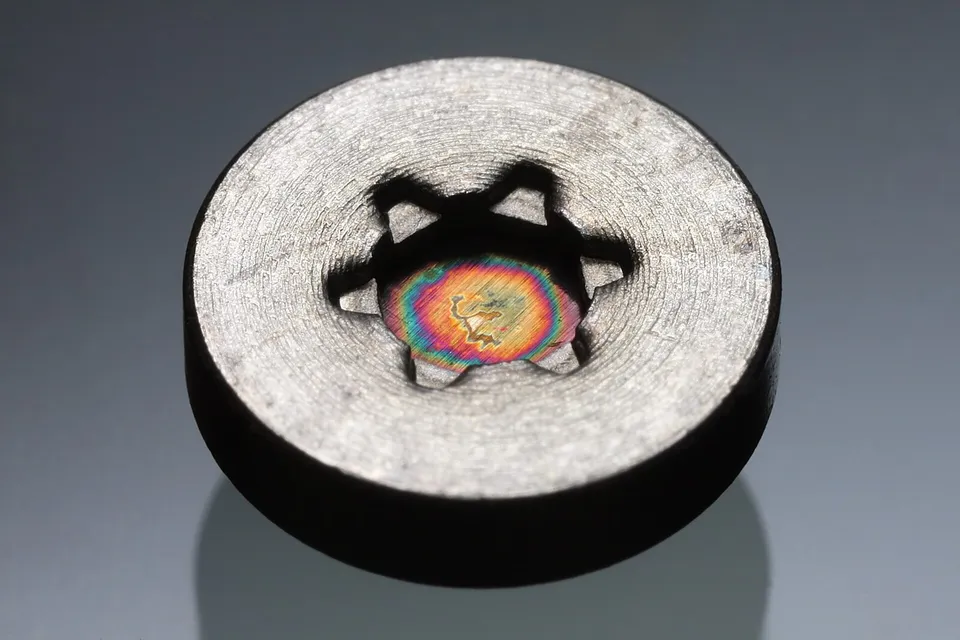

Specimen
- Atomic number
- 95
- Atomic mass
- [243]
- State at room temperature
- Solid
- Melting point
- 1,176 °C
- Boiling point
- 2,011 °C
- Density
- 13.69 g/cm³
- Discovered
- 1944
Can I eat it?
- In food and water
- Radioactive. Americium is radioactive. Inside the body it collects in the bones and stays there for a long time. Its radiation can cause bone cancer. 6
Learn about americium
- 01 How much there is And how much of that can we reach? Almost none occurs in nature. Nuclear reactors make americium from plutonium. Nearly all of it stays in spent fuel and waste. Read →
- 03 How we get it How much do we make each year, and how? Power reactors add about 4 tonnes of americium a year to spent fuel, by an estimate for 2003. Almost none of it is separated. A few laboratories and plants recover americium-241 from old plutonium, in amounts of grams to kilograms. Read →
- 04 What we use it for Where does it go, and why this element? Its most common use is in ionization smoke detectors. Americium-241 also goes into neutron sources for oil wells and soil moisture gauges, and into gauges that measure thickness. Space agencies are testing it as a heat source for power systems. Read →
- 05 What it costs What does it cost, and how is it bought and sold? There is no exchange and no public price list. The US Atomic Energy Commission first sold americium dioxide in 1962, at 1,500 dollars a gram. Read →
- 06 Who controls it Who controls the supply, and who depends on it? Americium forms in every country with nuclear power, but only a few sites separate it. From 2004 the United States depended on Russian supplies. Since the first shipment from Los Alamos in 2020, that dependence is smaller. Read →
- 07 Social and political problems What problems does it cause between people, and who carries them? States disagree on whether americium can be used in nuclear weapons. In 1976 an explosion at Hanford contaminated the worker Harold McCluskey with americium-241. Read →
- 08 History How did our relationship with it begin and change? A team led by Glenn Seaborg made americium in 1944 for the Manhattan Project. It was named after the Americas, by analogy with europium. Read →
Not covered: Where it is found. Americium forms no ore, and nobody mines it. At most, extremely small traces may occur in uranium minerals8.
Worth knowing
-
The public first heard of americium on a children's radio show. In November 1945 a child on Quiz Kids asked Glenn Seaborg about new elements, and he named elements 95 and 96. 3
History → -
One gram of americium dioxide holds enough americium-241 for more than three million household smoke detectors. 9
What we use it for → -
Glenn Seaborg held a US patent on element 95, americium, and on methods to produce it. He filed it in 1946. 10
History → -
In 1976 a Hanford worker, Harold McCluskey, was contaminated with americium-241 in an explosion. He was kept in an isolation tank for five months, and lived until 1987. 11
Social and political problems → -
Americium-241 builds up in stored plutonium. After 20 years, a kilogram of fresh weapons-grade plutonium holds about 6 grams of it, by a Los Alamos estimate. 3
How we get it → -
Power reactors had made about 87 tonnes of americium by 2003. ISIS very roughly estimated the world stock of separated americium at less than 100 kilograms. 2
How we get it →
The atom
Electrons
| Shell | Electrons |
|---|---|
| 1 (K) | 2 |
| 2 (L) | 8 |
| 3 (M) | 18 |
| 4 (N) | 32 |
| 5 (O) | 25 |
| 6 (P) | 8 |
| 7 (Q) outermost | 2 |
| Total | 95 |
Configuration [Rn] 5f⁷ 7s²
5f ↑ ↑ ↑ ↑ ↑ ↑ ↑
7s ↑ ↓
Nucleus
| Protons | 95 |
|---|---|
| Neutrons | 148 |
| Mass number | 243 |
Related elements
New articles by e-mail
Sources
- 1
Royal Society of Chemistry, 2026. Americium - Element information, properties and uses , Sections Uses, Biological role, Natural abundance, History; podcast transcript by Brian Clegg.
The discovery, the first names, natural traces and Oklo, uses in smoke detectors and the amount in one detector.
-
The main source of the element is the neutron bombardment of plutonium in nuclear reactors
-
working on the Manhattan Project in the Metallurgical Laboratory at the University of Chicago, produced it in 1944
-
- 2
David Albright and Kimberly Kramer, Institute for Science and International Security (ISIS), 2005. Neptunium 237 and Americium: World Inventories and Proliferation Concerns , Revised 22 August 2005; pp. 1-13 and Tables 1, 2 and 5.
World amounts of americium in spent fuel to the end of 2003, by country, separated stocks, uses, the weapons debate and the IAEA monitoring scheme.
-
Currently, the americium inventory increases by about 4 tonnes per year.
-
The total worldwide inventory of separated americium is very roughly estimated to be less than a hundred kilograms.
-
- 3
Los Alamos National Laboratory, Actinide Research Quarterly, 2023. United States of Americium , 1 November 2023.
The discovery and its announcement, US production from 1962 to 1984, dependence on Russia, the restart at Los Alamos from 2017, the process, the uses and the ESA program.
-
they bombarded plutonium-239 with neutrons in small-scale reactions. Two successive neutron capture (n,γ) reactions occur, giving plutonium-241 (half-life of 14.3 years), followed by beta decay, yielding americium-241
-
Recently there have been two elements discovered—elements with atomic numbers 95 and 96.
-
after 20 years, 1 kg of fresh weapons-grade plutonium will contain around 6 g of americium-241
-
- 4
IUPAC Commission on Isotopic Abundances and Atomic Weights (CIAAW), 2024. Radioactive Elements .
Mass number and half-life of the longest-lived isotope of the 34 elements with no standard atomic weight.
-
95 Am americium 243 7.350(9) ka
-
- 5
National Center for Biotechnology Information (PubChem), 2026. Periodic Table of Elements .
Electron configuration, melting and boiling points, density and discovery year for all 118 elements.
- 6
Agency for Toxic Substances and Disease Registry (ATSDR), 2004. Americium | ToxFAQs .
-
Inside your body, americium is concentrated in your bones, where it remains for a long time. The radiation given off by americium can change the genetic material of the bone cells and this could result in the formation of bone cancers.
-
- 7
Royal Society of Chemistry, Periodic Table, 2026. Americium - Element information, properties and uses .
Reference page; its Appearance and Biological role sections are quoted.
-
Americium is a silvery, shiny radioactive metal.
-
- 8
Los Alamos National Laboratory, 2026. Americium, in the Periodic Table of Elements .
The discovery, the name, isotopes, sources in the environment, uses and a price of 1,500 dollars per gram.
-
It may occur naturally in extremely small trace amounts in uranium minerals because of nuclear reactions.
-
- 9
World Nuclear Association, 2026. Radioisotopes in Consumer Products , Updated 11 February 2026; section on smoke detectors.
How ionization smoke detectors work, the price of 1962, the amount per detector, phase-outs of ionization detectors, and space power work. The World Nuclear Association is the trade body of the nuclear industry.
-
provides enough active material for more than three million household smoke detectors
-
- 10
Glenn T. Seaborg, assignor to the United States Atomic Energy Commission, 1964. Element 95 and method of producing said element (US Patent 3,156,523) .
The patent on element 95, filed in 1946 and published in 1964.
-
the transuranic element having atomic number 95, now known as americium having the symbol Am
-
- 11
HistoryLink.org, 2004. Harold McCluskey becomes the Atomic Man at Hanford on August 30, 1976. , Essay 5692, posted 23 April 2004.
The 1976 accident at the Hanford Plutonium Finishing Plant and its outcome.
-
kept in a steel and concrete isolation tank for five months ... The Atomic Man died in 1987.
-