Last updated 5 October 2026.
Oxygen
Element 8 · Nonmetal · Extracted from air, water or natural gas1
Oxygen is the most common element in the Earth's crust and makes up about a fifth of the air. Industry takes it from the air in air separation plants, which cool air until it is liquid and then distil it. A German research institute puts world use at about 500 million tonnes a year. In 2006, the last year with a split by use, steelmaking used about half. Much oxygen is made next to the plant that uses it, so little is traded. Large multinational gas companies sell much of the rest. Hospitals need only a small part. In 2025, a Lancet commission estimated that 5 billion people had no access to affordable, high-quality medical oxygen.
How oxygen compares
The scales are log scales, except for the shares, which go from 0 to 100%.
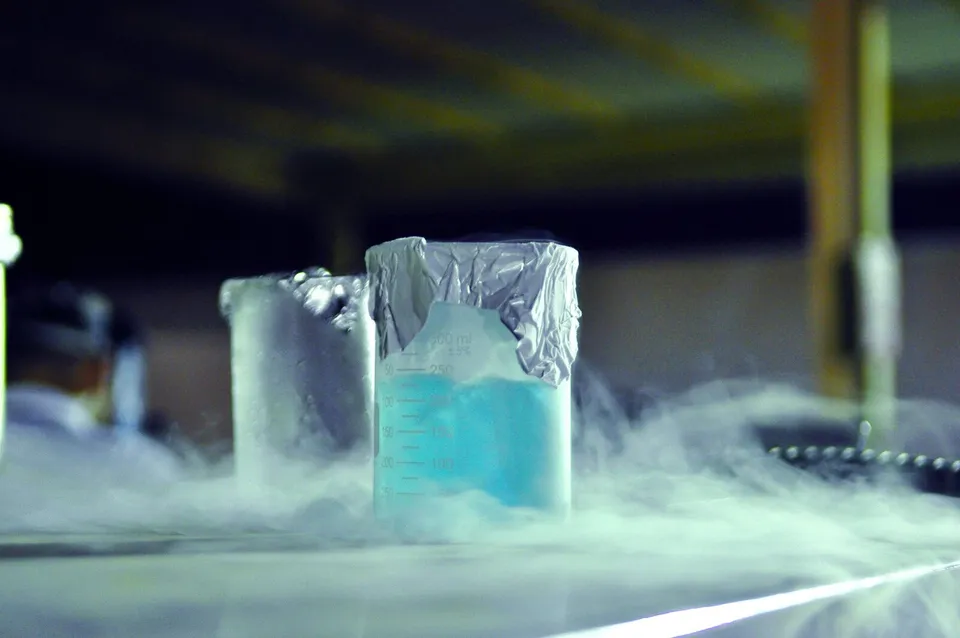

Specimen
- Atomic number
- 8
- Atomic mass
- 15.999
- State at room temperature
- Gas
- Melting point
- -218.8 °C
- Boiling point
- -183 °C
- Density
- 0.001429 g/cm³
- Discovered
- 1774
Can I eat it?
- In food and water
- Your body needs it. Oxygen is the most common element in the human body. It is in water and in food molecules such as glucose. 7
- As the pure element
- Allowed in food. Oxygen is a gas at room temperature. The EU allows it in all foods as additive E 948, with no fixed maximum amount (quantum satis). Pure oxygen makes fires start and burn more easily. ICSC says that very high levels irritate the airways and can affect the lungs and the nervous system. 89
Learn about oxygen
- 01 How much there is And how much of that can we reach? Oxygen is the most common element in the Earth's crust and in seawater, and oxygen gas is about 21% of dry air. Industry takes its oxygen from the air, which holds about 1.2 million billion tonnes of it. Supply depends on plants and electricity, not on deposits. Read →
- 02 Where it is found What is it found in, and where on Earth? Oxygen is in almost every rock, mostly in silicates, oxides and carbonates. The oxygen gas in the air comes from photosynthesis, which built it up over the last 2.4 billion years. Air has the same oxygen content everywhere, so there are no deposits to find. Read →
- 03 How we get it How much do we make each year, and how? No agency counts world oxygen production. A German research institute gives about 500 million tonnes a year, without a method. An older trade estimate gives 440 million tonnes for 2006. Air separation plants make almost all of it from liquid air. The main cost is electricity. Read →
- 04 What we use it for Where does it go, and why this element? About half of industrial oxygen goes into steelmaking, where it burns carbon and other impurities out of molten iron. Chemical plants and refineries use about a fifth. Hospitals use a small part, but medical oxygen has no substitute. Read →
- 05 What it costs What does it cost, and how is it bought and sold? Oxygen has no exchange and no public reference price. Much of it is made at or near the user and sold under supply contracts. Exported oxygen had a value of about $0.13 to 0.45 per kg in 2024. Transport costs keep markets local. Read →
- 06 Who controls it Who controls the supply, and who depends on it? No country controls oxygen supply, because any country with electricity can take it from the air. Large multinational gas companies sell much of the oxygen that is traded. Hospitals are small buyers next to steel and chemical plants. Read →
- 07 Social and political problems What problems does it cause between people, and who carries them? Authorities in Europe, Brazil and Peru fined gas companies for oxygen cartels. Brazilian courts later annulled the Brazilian fine. Oxygen fires have killed astronauts and patients. A 2025 Lancet commission estimated that 5 billion people lack affordable medical oxygen. Read →
- 08 History How did our relationship with it begin and change? Carl Wilhelm Scheele made oxygen in 1771, and Joseph Priestley isolated it in 1774. Antoine Lavoisier named it. Industrial production started with Linde's air separation plant in 1902. Steelmaking with pure oxygen started in 1952, and steel was the largest use in 2006. Read →
Worth knowing
-
Before Covid-19, India made about 6,900 tonnes of oxygen a day, and about 1,000 tonnes of it was available for medical use. In May 2021, hospitals needed almost 9,000 tonnes a day. 10
Social and political problems → -
In 2025, the authors of a Lancet commission estimated that 5 billion people, 60% of the world's population, had no access to affordable, high-quality medical oxygen. 11
Social and political problems → -
Doctors have used oxygen since 1885, but the WHO added it to its Essential Medicines List only in 2017. 11
History → -
Scripps scientists estimate that burning fossil fuels removed about 0.1% of the oxygen in the air from the start of the industrial era to 2005. They measure a loss of 19 in every million oxygen molecules each year. 12
How much there is → -
In 2010, Brazil's competition authority fined five gas companies BRL 2.94 billion for a cartel, the largest fine in its history. In 2015, a federal judge annulled the fine against the largest of them, White Martins. 13
Social and political problems → -
In 2018, Air Liquide started what it called the world's largest oxygen production unit. It makes 5,000 tonnes a day for Sasol in South Africa, which uses the oxygen to make fuels and chemicals. 14
How we get it →
The atom
Electrons
| Shell | Electrons |
|---|---|
| 1 (K) | 2 |
| 2 (L) outermost | 6 |
| Total | 8 |
Configuration [He] 2s² 2p⁴
2s ↑ ↓
2p ↑ ↓ ↑ ↑
Nucleus
| Protons | 8 |
|---|---|
| Neutrons | 8 |
| Mass number | 16 |
Related elements
New articles by e-mail
Sources
- 1
M. Cioli, K.M. Schure and D. van Dam, PBL Netherlands Environmental Assessment Agency and TNO, 2021. Decarbonisation options for the Dutch industrial gases production , Summary p. 5; section 1.3; section 2.2.1 (pp. 21-23); section 3 and 3.4 (pp. 26-27).
World oxygen use and its split by sector (from Gasworld 2007), how air separation works, and its electricity use.
-
Oxygen, nitrogen and argon are typically produced on a large-scale with the cryogenic distillation process ... The process is based on the different boiling points of the air components
-
- 2
Luka Bornemann, Jelto Lange and Martin Kaltschmitt, Energy Conversion and Management 344, 120213, 2025. Oxygen production via electrolysis: A model-based assessment of its impact on a climate-neutral German energy system , Section 1, Introduction (reference 7: O. Ravkina, Dezentrale Sauerstoffproduktion, Technical Report, Fraunhofer IKTS, 2022).
World oxygen demand of about 500 Mt a year, from a Fraunhofer IKTS report. Open access (CC BY 4.0). Read with Firecrawl, because the site refuses scripts.
-
Currently, the global oxygen demand stands at approximately 500 Mt/a
-
- 3
United Nations Statistics Division (UN Comtrade), 2026. UN Comtrade: exports of oxygen (HS 280440), 2024, all reporters , Fields primaryValue (USD), netWgt (kg); reporter codes 251 France, 56 Belgium, 276 Germany, 842 United States.
Value and weight of oxygen exports by reporting country in 2024.
-
120217167.79 ... 21324842.137
-
- 4
Royal Society of Chemistry, 2026. Oxygen: element information, properties and uses , Uses; Biological role; Natural abundance; History; Supply risk (data from the British Geological Survey); podcast transcript.
Crustal abundance, production methods, uses and discovery.
-
Crustal abundance (ppm) 461000
-
- 5
IUPAC Commission on Isotopic Abundances and Atomic Weights (CIAAW), 2024. Abridged Standard Atomic Weights 2024 .
The atomic mass shown for the 84 elements that have a standard atomic weight.
- 6
National Center for Biotechnology Information (PubChem), 2026. Periodic Table of Elements .
Electron configuration, melting and boiling points, density and discovery year for all 118 elements.
- 7
OpenStax, Rice University, 2022. Anatomy and Physiology 2e, section 2.1: Elements and Atoms: The Building Blocks of Matter .
-
beginning with the most abundant: oxygen (O), carbon (C), hydrogen (H), and nitrogen (N)
-
When two hydrogen atoms each share their single electron with oxygen, covalent bonds are formed, resulting in a molecule of water
-
- 8
European Commission, 2011. Commission Regulation (EU) No 1129/2011 establishing a Union list of food additives , Annex, Parts B and E.
The text as adopted by the EU in 2011, from legislation.gov.uk. Later EU amendments are not in it.
-
Food additives permitted in all categories of foods E 290 Carbon dioxide quantum satis ... E 948 Oxygen quantum satis
-
- 9
International Labour Organization and World Health Organization (International Chemical Safety Cards), 1999. ICSC 0138 - Oxygen , Chemical dangers; Effects of short-term exposure.
-
The substance is a strong oxidant. It reacts with combustible and reducing materials. This generates fire and explosion hazard.
-
The substance at very high concentrations is irritating to the respiratory tract. The substance may cause effects on the central nervous system, lungs and eyes.
-
- 10
Moonis Mirza and others, Indian Journal of Community Medicine, 2023. India’s Multi-Sectoral Response to Oxygen Surge Demand during COVID-19 Pandemic: A Scoping Review .
Oxygen production and medical demand in India before and during the 2021 Covid-19 wave, and the government's response.
-
of the total 6900 MT of oxygen produced in India, only 1000 MT was available for medical usage ... 8943 MT in early May 2021
-
- 11
Hamish R Graham and others, The Lancet Global Health 13, 2025. Reducing global inequities in medical oxygen access: the Lancet Global Health Commission on medical oxygen security .
Medical oxygen need and access, the market for medical oxygen, the Peru case, and history.
-
5 billion people—ie, 60% of the world's population—do not have access to affordable, high-quality medical oxygen services
-
the first reported clinical use was for treating pneumonia in 1885 2 —yet it was not until 2017 that it was added to WHO's Essential Medicines List
-
- 12
Scripps O2 Program, Scripps Institution of Oceanography, UC San Diego, 2026. Frequently Asked Questions About Atmospheric Oxygen .
Rate and cause of the oxygen decline, oxygen used by fossil fuel burning, and the total oxygen in the air.
-
a loss of roughly 0.1 ... of the O2 content ... an average loss rate per year of 19 per meg
-
- 13
Mario Cesar Carvalho, Folha de S.Paulo, 2015. Justiça manda anular maior multa da história do Cade .
News report of 16 September 2015. A federal court in Brasília annuls the fine against White Martins. In Portuguese.
-
anulou a maior multa já aplicada na história do Cade ... A pena havia sido aplicada em 2010 ... foram multadas em R$ 2,94 bilhões
-
- 14
Air Liquide, 2018. South Africa: Air Liquide starts up the world’s largest oxygen production unit .
Company press release of 1 February 2018 on the Secunda unit, its cost and capacity. The page footer gives the group's 2025 revenue.
-
Air Liquide recently started the world’s largest oxygen production unit for Sasol ... total production capacity of 5,000 tonnes of oxygen per day ... supplies Sasol with large quantities of oxygen used for production of fuels and chemicals
-
- 15
National Institute of Standards and Technology (NIST), 2026. Atomic Weights and Isotopic Compositions for All Elements .
Isotopic composition of each element; the most abundant isotope sets the neutron count in the nucleus view.