Last updated 13 October 2026.
Tellurium
Element 52 · Metalloid · By-product of copper1
Tellurium is a very rare element in Earth's crust. Almost all supply comes from the slimes left by copper refineries, and China refines most of it. Most tellurium now goes into cadmium telluride solar panels. Smaller amounts go into thermoelectric coolers and steel. In 2025 China put tellurium under export licenses, and the price in Europe almost doubled.
How tellurium compares
The scales are log scales, except for the shares, which go from 0 to 100%.
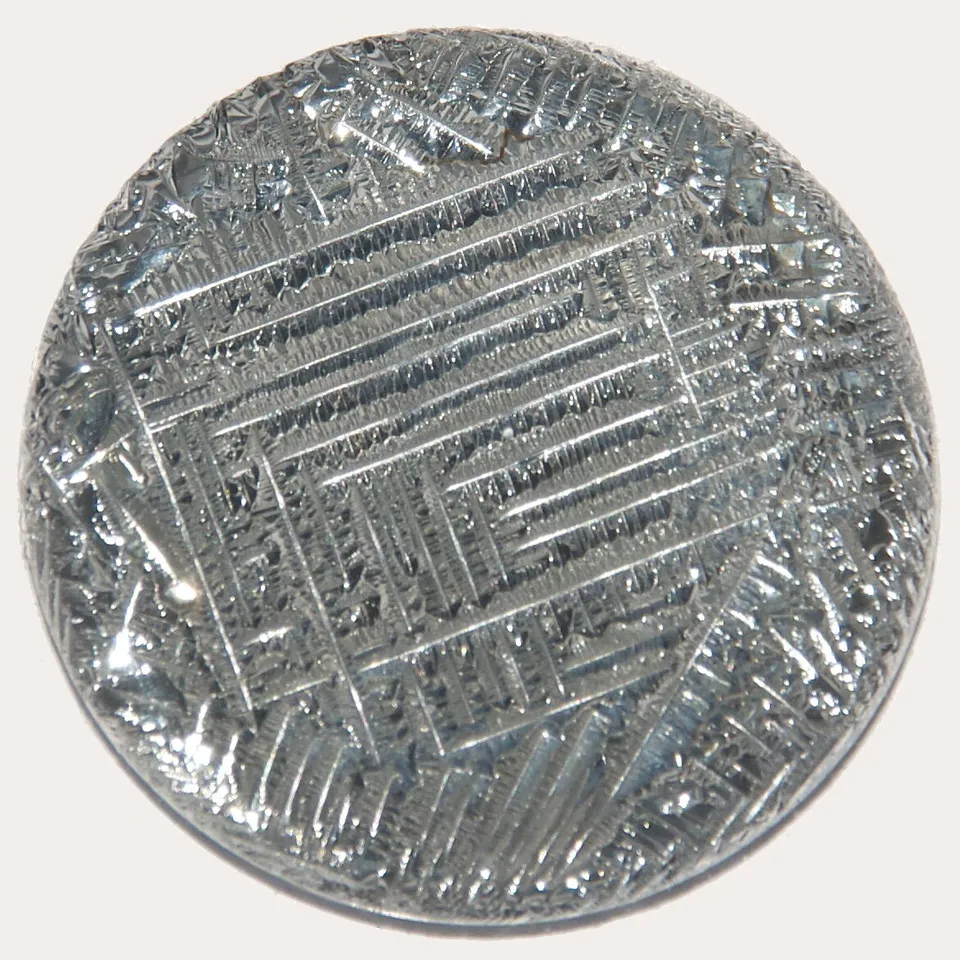

Specimen
- Atomic number
- 52
- Atomic mass
- 127.6
- State at room temperature
- Solid
- Melting point
- 449.5 °C
- Boiling point
- 987.9 °C
- Density
- 6.232 g/cm³
- Discovered
- 1782
Can I eat it?
Learn about tellurium
- 01 How much there is And how much of that can we reach? Earth's upper crust holds about 3 parts per billion of tellurium, one of the least common elements in crustal rocks. The USGS gave world reserves of 35,000 tonnes for 2024. In 2026 it said that reserves cannot be reliably quantified. Read →
- 02 Where it is found What is it found in, and where on Earth? Tellurium forms minerals with gold and silver, such as calaverite and sylvanite. Most tellurium comes from copper ores that likely hold 0.1 to 1.0 parts per million. In 2017 the USGS named only two districts that mine it as a main product: Sichuan, China, and Kankberg, Sweden. Read →
- 03 How we get it How much do we make each year, and how? The USGS estimates world refinery output at about 1,000 tonnes in 2025, without the United States. Tellurium comes from the slimes of copper refineries, and refiners recover less than half of what the slimes hold. Some is recycled from old solar panels. Read →
- 04 What we use it for Where does it go, and why this element? About 70% of tellurium goes into cadmium telluride solar cells. About 15% goes into thermoelectric coolers and generators, and 10% into steel and other alloys. Amorphous silicon and CIGS cells compete with cadmium telluride. Read →
- 05 What it costs What does it cost, and how is it bought and sold? Tellurium sold for about $120 per kg in US warehouses in 2025, and about $150 in Rotterdam. Both prices rose sharply after China required export licenses. In 2025 dollars, the US value peaked at about $512 in 2011, when solar demand grew, and then fell. Read →
- 06 Who controls it Who controls the supply, and who depends on it? China refined 80% of the world's tellurium in 2025. Russia refined about 7% and Japan about 6%. The United States and the UK list tellurium as critical. The EU does not. Read →
- 07 Social and political problems What problems does it cause between people, and who carries them? We found no war or armed group linked to tellurium. In February 2025 China required export licenses for it, citing national security, days after new US tariffs on China. In 2015 a Chinese metals exchange stopped tellurium deliveries. Its owner was arrested in 2016. Read →
- 08 History How did our relationship with it begin and change? Müller von Reichenstein found tellurium in a gold ore in 1783. Klaproth named it after the Earth in 1798. By 2014 solar cells were its largest use, and in 2025 they took 70%. Read →
Worth knowing
-
Before May 1896, miners at Kalgoorlie did not know that gold tellurides were rich ore. They threw the rock away and spread it on cart tracks and walkways. 11
History → -
Earth's upper crust holds only about 3 parts per billion of tellurium. A USGS report counts it among the least common elements in crustal rocks. 2
How much there is → -
In 2018 the slimes of the world's copper refineries held about 1,930 tonnes of tellurium. That is nearly four times the tellurium that was reported as produced. 12
How much there is → -
Workers who breathe in very small amounts of tellurium get 'tellurium breath', which smells of garlic. 13
-
Tellurium is 10% to 15% of the cost of a cadmium telluride solar module, the US Department of Energy says. 14
What we use it for → -
In a 2017 report, the USGS estimated that one company, the solar panel maker First Solar, used about 30% of the world's tellurium. 2
What we use it for →
The atom
Electrons
| Shell | Electrons |
|---|---|
| 1 (K) | 2 |
| 2 (L) | 8 |
| 3 (M) | 18 |
| 4 (N) | 18 |
| 5 (O) outermost | 6 |
| Total | 52 |
Configuration [Kr] 4d¹⁰ 5s² 5p⁴
4d ↑ ↓ ↑ ↓ ↑ ↓ ↑ ↓ ↑ ↓
5s ↑ ↓
5p ↑ ↓ ↑ ↑
Nucleus
| Protons | 52 |
|---|---|
| Neutrons | 78 |
| Mass number | 130 |
Related elements
New articles by e-mail
Sources
- 1
U.S. Geological Survey (Daniel M. Flanagan), 2026. Tellurium, in Mineral Commodity Summaries 2026 .
World refinery production and capacity by country 2024 and 2025, uses, US and European prices, Chinese export licenses, recycling, resources and substitutes.
-
Tellurium is recovered principally as a byproduct of the electrolytic refining of primary copper, where it accumulates in the residues of copper anodes
-
World total (rounded) Refinery productione, 6 2024 2025 ... 981 1,000
-
the annual average price for tellurium in U.S. warehouses increased by 60% to an estimated $120 per kilogram in 2025 from $74.77 per kilogram in 2024
-
the annual average price for tellurium in U.S. warehouses increased by 60% to an estimated $120 per kilogram in 2025
-
World total (rounded) Refinery productione, 6 2024 2025 W W 1 1 27 28 750 800 70 61 64 67 5 5 7 46 48 18 18 NA NA 9 9 981 1,000
-
- 2
U.S. Geological Survey (Richard J. Goldfarb, Byron R. Berger, Micheal W. George and Robert R. Seal II), 2017. Tellurium, chapter R of Critical Mineral Resources of the United States (Professional Paper 1802-R) .
Crustal abundance, minerals, deposit types, primary tellurium mines, recovery from copper, reserves, sea-floor crusts and health.
-
Li and Schoonmaker (2003) estimate an average upper crustal abundance value of 3 ppb tellurium, which is about eight times less than that for gold
-
estimate an average upper crustal abundance value of 3 ppb tellurium, which is about eight times less than that for gold and makes tellurium one of the least common elements in crustal rocks
-
an estimated 30 percent of the world’s produced tellurium is used by First Solar Inc., which in 2016 continued to be the world’s leading producer of cadmium-tellurium solar panels
-
- 3
UK Critical Minerals Intelligence Centre, British Geological Survey, 2024. UK 2024 Criticality Assessment , Table of results; end-of-life recycling rates by end use.
The UK critical minerals list of 2024, with end uses and end-of-life recycling rates.
-
Tellurium (Te) 36
-
- 4
UNEP International Resource Panel (T.E. Graedel et al.), 2011. Recycling Rates of Metals: A Status Report , Table F1, p. 36 (page 38 of the PDF).
In the PDF text the row for Te runs into the row for Ba and the page number 36. On the printed page the EOL-RR of Te is <1.
-
Te Ba 36 <1
-
- 5
IUPAC Commission on Isotopic Abundances and Atomic Weights (CIAAW), 2024. Abridged Standard Atomic Weights 2024 .
The atomic mass shown for the 84 elements that have a standard atomic weight.
- 6
National Center for Biotechnology Information (PubChem), 2026. Periodic Table of Elements .
Electron configuration, melting and boiling points, density and discovery year for all 118 elements.
- 7
Sári D, Ferroudj A, Semsey D, et al. (Nanomaterials), 2024. Tellurium and Nano-Tellurium: Medicine or Poison? .
-
Ingesting significant amounts of Te causes symptoms like vomiting, nausea, a metallic taste in the mouth ... and a distinctive garlic-like odor on the breath.
-
Median lethal dose (LD 50 )—oral K 2 TeO 3 caused complete toxicity at 12.5 mg kg −1 in mice
-
In the case of elemental Te, the oral LD 50 is >5000 mg kg ... in rats
-
- 8
Royal Society of Chemistry, 2026. Tellurium - Element information, properties and uses .
-
Tellurium has no known biological role. It is very toxic and teratogenic
-
- 9
International Labour Organization and World Health Organization (International Chemical Safety Cards), 2000. ICSC 0986 - Tellurium , Ingestion; Chemical dangers; Effects of short-term exposure.
-
Ingestion Abdominal pain. Constipation. Vomiting.
-
- 10
National Center for Biotechnology Information (PubChem), with the EU harmonised classification (Regulation (EC) No 1272/2008), 2026. Tellurium (CID 6327182), GHS classification , GHS Classification; Regulation (EC) No 1272/2008.
-
H360Df: May damage the unborn child; Suspected of damaging fertility [Danger Reproductive toxicity]
-
- 11
Western Australian Museum, 2024. Streets Paved with Gold! .
Gold tellurides at Kalgoorlie and their identification in 1896.
-
rocks containing tellurides were not recognised as rich gold ores, looking somewhat like pyrite (or fool’s gold)-bearing waste, and were discarded, strewn on cart tracks and walkways, and also used as building stone
-
- 12
N.T. Nassar, H. Kim, M. Frenzel, M.S. Moats and S.M. Hayes, Resources, Conservation & Recycling 184, 2022. Global tellurium supply potential from electrolytic copper refining , Abstract.
Tellurium in the anode slimes of copper refineries in 2018, and the potential of China.
-
For 2018, the results indicate that 1930 (1500-2700, 95% confidence interval) metric tons of tellurium were contained in anode slimes globally. This is nearly quadruple the reported tellurium production for that year
-
- 13
Royal Society of Chemistry, 2026. Tellurium - Element information, properties and uses .
Discovery, name, minerals, uses, biological role and tellurium breath.
-
Workers exposed to very small quantities of tellurium in the air develop ‘tellurium breath’, which has a garlic-like odour
-
- 14
U.S. Department of Energy, Solar Energy Technologies Office, 2025. Cadmium Telluride Photovoltaics Perspective Paper , Section 3.2.1, Enhancing Tellurium Availability.
The share of tellurium in the cost of a module, and the limits and potential of supply.
-
Tellurium (Te) is a chemical element that makes up 10 to 15% of the cost of a CdTe PV module
-
- 15
National Institute of Standards and Technology (NIST), 2026. Atomic Weights and Isotopic Compositions for All Elements .
Isotopic composition of each element; the most abundant isotope sets the neutron count in the nucleus view.