Last updated 11 November 2026.
Lutetium
Element 71 · Lanthanide · Mined for itself1
Lutetium is the last of the lanthanides and one of the rarest rare earths. No agency counts its world output. By the EU count, China did all of its processing in 2016 to 2020. Its uses are small: crystals that detect radiation in PET scanners, catalysts for oil refining, optical glass and research. Its radioactive isotope lutetium-177 is used in cancer drugs. Lutetium oxide cost about $888 per kilogram in 2025. In April 2025, China put its exports under license.
How lutetium compares
Price ~ $888 per kg of lutetium oxide, at least 99.99% pure 2 Not on the scale: this is the price of lutetium oxide, at least 99.99% pure, not of lutetium. What it costs →
The scales are log scales, except for the shares, which go from 0 to 100%.
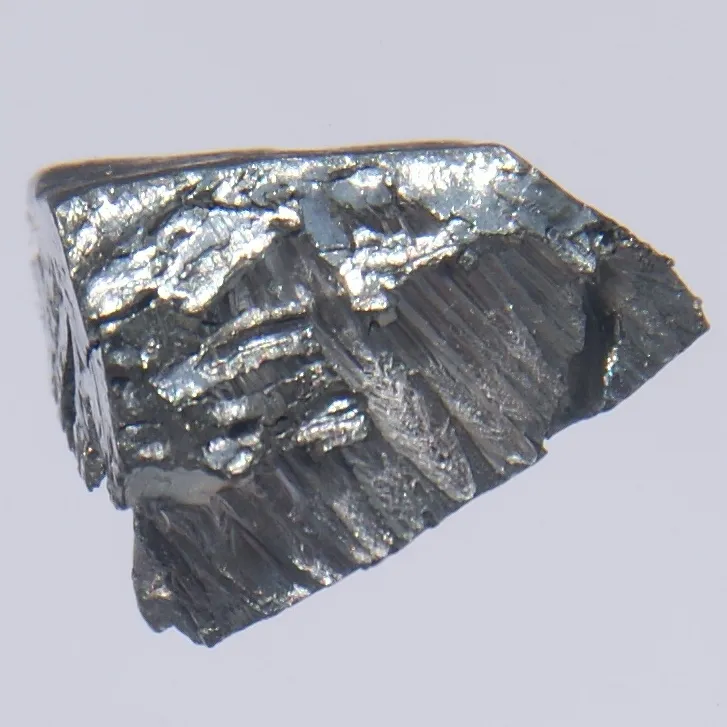

Specimen
- Atomic number
- 71
- Atomic mass
- 174.97
- State at room temperature
- Solid
- Melting point
- 1,663 °C
- Boiling point
- 3,402 °C
- Density
- 9.84 g/cm³
- Discovered
- 1907
Can I eat it?
- In food and water
- Not needed, little studied. Lutetium has no known function in the body. A 1999 TERA review for a US agency found only a few animal studies for each lanthanide. By mouth, half the test animals died at 7.1 g of lutetium chloride per kg of body weight. 910
- As the pure element
- Little studied. A 1999 TERA review for a US agency found no data on how the gut takes up insoluble lanthanides. It found only a few animal studies of each lanthanide. 9
Learn about lutetium
- 01 How much there is And how much of that can we reach? Lutetium makes up about 0.3 to 0.8 parts per million of the crust, by different counts. It is one of the rarest rare earths. USGS gives no reserve for lutetium alone. The limit to supply is the few ores rich in heavy rare earths, and the plants that separate them. Read →
- 02 Where it is found What is it found in, and where on Earth? Lutetium comes from rare earth minerals, among them xenotime, euxenite, monazite and the ion-adsorption clays of southern China. The clays are the main source of the heavy rare earths. Lutetium is always mined with the other rare earths. Read →
- 03 How we get it How much do we make each year, and how? No agency gives a world figure for lutetium alone. The EU estimates about 660 tonnes a year of holmium, thulium, lutetium and ytterbium oxides together. China did all of the processing of lutetium in 2016 to 2020, by the EU count. Almost none is recycled. Read →
- 04 What we use it for Where does it go, and why this element? Lutetium has a few small uses: crystals that detect radiation in PET scanners, catalysts for oil refining, optical glass, phosphors and research. No agency gives shares by use. Its isotope lutetium-177 is in cancer drugs. One supplier says most of it is now made from ytterbium. Read →
- 05 What it costs What does it cost, and how is it bought and sold? Lutetium oxide sold for about $888 per kilogram in 2025, free on board. From 2021 to 2025, the yearly average was between $780 and $888. Of the heavy rare earth oxides in the USGS table, only terbium oxide cost more. Companies sell it in private deals, not on an exchange. Read →
- 06 Who controls it Who controls the supply, and who depends on it? China did all of the processing of lutetium in 2016 to 2020, by the EU count. Since April 2025, exports of lutetium from China need a license. The US lists lutetium as critical. The EU and the UK list the rare earth group that it belongs to. Read →
- 08 History How did our relationship with it begin and change? Georges Urbain in Paris separated lutetium from ytterbium in 1907, and named it after the Roman name for Paris. Two other chemists found it at about the same time. Pure lutetium metal was first made in 1953. Since 1999, lutetium crystals for PET have been made at large scale. Read →
Not covered: Social and political problems. Lutetium comes from the same mines and plants as the other rare earths. By the EU count, China did all of its processing in 2016 to 2020. Its social issues are those of the group, on the rare earths page.
Lutetium is one of the rare earth elements. How they are mined, separated, sold and controlled →
Worth knowing
-
Lutetium was the last stable lanthanide to be found, in 1907. Simon Cotton, a chemist, says that it is rare, and that its compounds have no color, so chemists could overlook it. 11
History → -
Three chemists found lutetium at about the same time, in France, Austria and the United States. Georges Urbain reported it first and named it after Paris. 11
History → -
Natural lutetium is slightly radioactive. Its isotope lutetium-176 has a half-life of about 37 billion years, and scientists use it to find the age of rocks and meteorites. 12
How much there is → -
The cancer drugs Lutathera and Pluvicto carry lutetium-177. By the account of Kinectrics, a company that makes the raw material, most lutetium-177 is now made from ytterbium, not from lutetium. 13
What we use it for → -
Crystals of lutetium oxyorthosilicate detect gamma rays in PET scanners. In 2000, Charles Melcher, who described the crystal with Joel Schweitzer in 1992, said that it had the best combination of properties for PET of any scintillator then known. 14
What we use it for → -
Lutetium is one of the rarest rare earths. Even so, Simon Cotton, a chemist, says that the earth holds more lutetium than silver, gold or the platinum metals. 11
How much there is →
The atom
Electrons
| Shell | Electrons |
|---|---|
| 1 (K) | 2 |
| 2 (L) | 8 |
| 3 (M) | 18 |
| 4 (N) | 32 |
| 5 (O) | 9 |
| 6 (P) outermost | 2 |
| Total | 71 |
Configuration [Xe] 4f¹⁴ 5d¹ 6s²
4f ↑ ↓ ↑ ↓ ↑ ↓ ↑ ↓ ↑ ↓ ↑ ↓ ↑ ↓
5d ↑
6s ↑ ↓
Nucleus
| Protons | 71 |
|---|---|
| Neutrons | 104 |
| Mass number | 175 |
Related elements
New articles by e-mail
Sources
- 1
U.S. Geological Survey (Bradley S. Van Gosen, Philip L. Verplanck, Robert R. Seal II, Keith R. Long and Joseph Gambogi), 2017. Rare-earth elements, chapter O of Critical mineral resources of the United States (Professional Paper 1802-O) , Table O1 (crustal abundance); Uses and applications (glass); Sources and production; Ion-adsorption clay deposits.
Crustal abundance of lutetium after Lide (2004), its use in optical glass for immersion lithography, and the ion-adsorption clays of southern China.
-
REE-bearing ion-adsorption clays are mined in various locations in the southeastern Provinces. In contrast to bastnaesite ores, ion-adsorption clays are valued for their medium REE and HREE content.
-
- 2
U.S. Geological Survey (Shelby N. Johnston), 2026. Rare earths (heavy), in Mineral Commodity Summaries 2026 , Domestic production and use; salient statistics (prices 2021-2025); import sources; events, trends and issues; world resources; substitutes.
Prices of lutetium oxide from 2021 to 2025, US import sources of lutetium, China's export controls of 2025, a planned plant in Malaysia, and uses of the heavy rare earths.
-
Lutetium oxide, 99.99% minimum, ... 811 ... 814 ... 829 ... 780 ... 888
-
- 3
European Commission (M. Grohol and C. Veeh), 2023. Study on the Critical Raw Materials for the EU 2023: Final Report , Table A, major global supplier countries (row 26, lutetium); list of heavy rare earths.
China's share of world lutetium supply at the processing stage, 2016-2020, and lutetium among the heavy rare earths.
-
26 lutetium P China 100%
-
- 4
Theodore Gray, periodictable.com (data from Wolfram ElementData), 2026. Technical data for Lutetium (from Wolfram ElementData) , Abundances.
Abundance in the universe and the crust, as mass fractions. It gives no value for the human body.
-
% in Earth's Crust 0.000057%
-
- 5
UNEP International Resource Panel (T.E. Graedel et al.), 2011. Recycling Rates of Metals: A Status Report , Appendix table of OSR, RC and EOL-RR by metal (Lu row); list of uses (Lu).
End-of-life recycling rate and recycled content below 1% for lutetium, and its use as a scintillator.
-
Lu <1 <1
-
- 6
UK Critical Minerals Intelligence Centre, British Geological Survey, 2024. UK 2024 Criticality Assessment , Table 2, candidate materials; Appendix 6, end-of-life recycling rates (REE row and REE table by use).
The UK assessed lutetium with the other rare earths as one group, which it found critical. Recycling rates of 0% for every use of the rare earths.
-
Rare earth elements (REE) 0 Magnesite 52
-
- 7
IUPAC Commission on Isotopic Abundances and Atomic Weights (CIAAW), 2024. Abridged Standard Atomic Weights 2024 .
The atomic mass shown for the 84 elements that have a standard atomic weight.
- 8
National Center for Biotechnology Information (PubChem), 2026. Periodic Table of Elements .
Electron configuration, melting and boiling points, density and discovery year for all 118 elements.
- 9
Toxicology Excellence for Risk Assessment (TERA), for the US Bureau of Land Management, 1999. Development of Reference Doses and Reference Concentrations for Lanthanides , Section 2.4 (oral toxicity data in experimental animals).
-
the available animal toxicity data are limited to only a few studies for each of the several lanthanides
-
7100 mg/kg for lutetium chloride
-
No data on insoluble or chelated lanthanide absorption were identified.
-
- 10
Royal Society of Chemistry, 2026. Lutetium - Element information, properties and uses .
-
Lutetium has no known biological role.
-
- 11
Royal Society of Chemistry, 2026. Lutetium - Element information, properties and uses , Sections Uses and properties, Biological role, Natural abundance, History; podcast transcript (Simon Cotton).
Discovery, name, first pure metal, uses, biological role, minerals, metal production, and Simon Cotton's account of why lutetium was found last.
-
it is spectroscopically rather transparent and it does not form coloured compounds, and so it is quite easy to overlook
-
The honour of discovering lutetium went to Georges Urbain at the Sorbonne in Paris, because he was the first to report it
-
it is more abundant in the earth than elements like silver or gold, or the platinum metals
-
- 12
Takehito Hayakawa, Toshiyuki Shizuma, Tsuyoshi Iizuka and others, Communications Physics 6, 2023. Half-life of the nuclear cosmochronometer 176Lu measured with a windowless 4π solid angle scintillation detector , Abstract; Introduction.
Measured half-life of lutetium-176, 3.719 × 10^10 years, the spread of earlier values, and the different values from meteorites and from rocks of the Earth.
-
The measured half-life of (3.719 ± 0.007) × 1010 yr
-
- 13
Allan Jarvine (Kinectrics Canada), abstract for the 20th International Conference on Electromagnetic Isotope Separators and Related Topics (EMIS XX), TRIUMF, 2025. Enrichment of stable isotope ytterbium-176: the Kinectrics Canada experience , Description (abstract).
Lutetium-177 made from lutetium-176 in the past and now mostly from ytterbium-176, and the reasons. A conference abstract by a company that sells ytterbium-176; only the abstract was read.
-
Increasingly, lutetium-177 is now predominantly produced by neutron irradiation of the stable isotope ytterbium-176
-
- 14
Charles L. Melcher (CTI, Inc.), Journal of Nuclear Medicine 41(6): 1051-1055, 2000. Scintillation Crystals for PET , Section on LSO; references 5, 13 and 18.
Properties of cerium-doped lutetium oxyorthosilicate (LSO) for PET, its natural radioactivity, and the start of large-scale production in 1999. The author described LSO in 1992, with Joel Schweitzer, and worked for CTI, Inc.
-
LSO offers the best combination of properties for PET of any scintillator known today
-
- 15
National Institute of Standards and Technology (NIST), 2026. Atomic Weights and Isotopic Compositions for All Elements .
Isotopic composition of each element; the most abundant isotope sets the neutron count in the nucleus view.