Last updated 14 October 2026.
Hafnium
Element 72 · Transition metal · By-product of zirconium1
Hafnium is not mined for itself. It occurs in zircon, at about one part hafnium to 34 to 50 parts zirconium. It is separated only when nuclear reactors need zirconium without hafnium. The European Commission estimated world output at about 70 tonnes a year in 2012 to 2016, mostly from France and the United States. Most hafnium goes into nickel superalloys for jet engines and gas turbines. Hafnium also absorbs neutrons in control rods, and hafnium oxide insulates the transistors of computer chips.
How hafnium compares
The scales are log scales, except for the shares, which go from 0 to 100%.
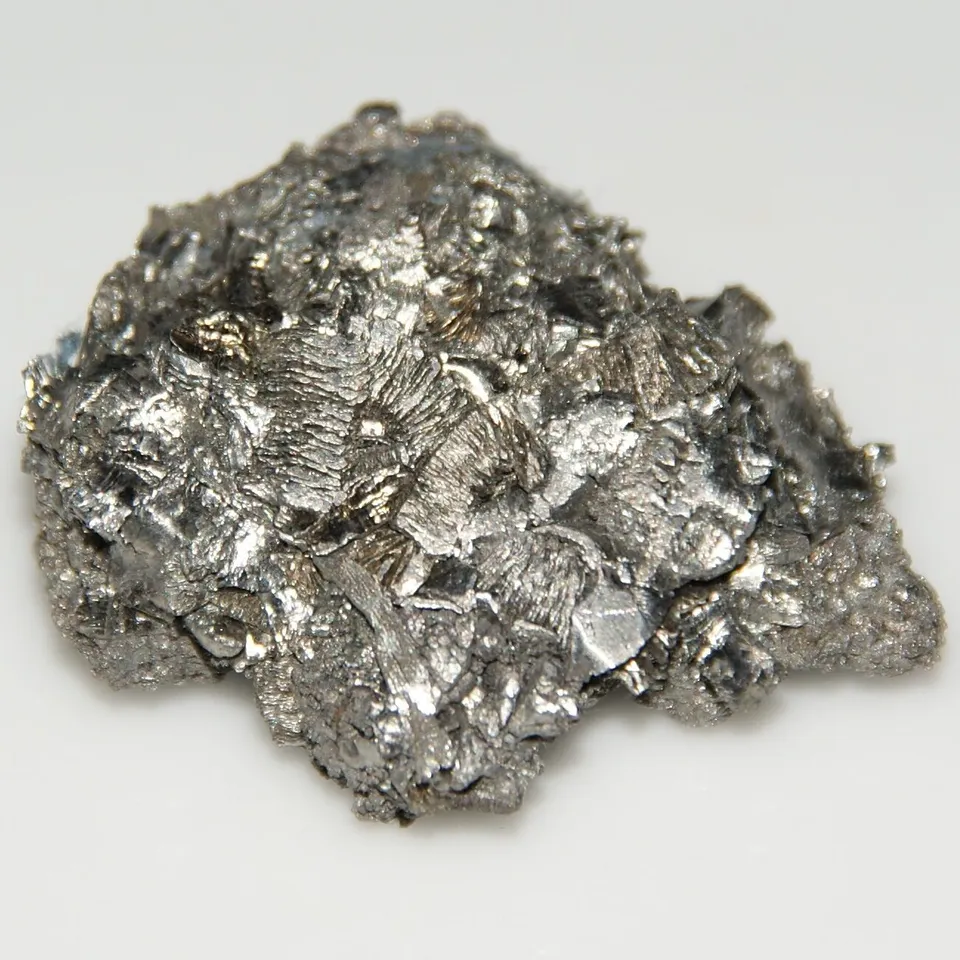

Specimen
- Atomic number
- 72
- Atomic mass
- 178.49
- State at room temperature
- Solid
- Melting point
- 2,233 °C
- Boiling point
- 4,603 °C
- Density
- 13.3 g/cm³
- Discovered
- 1923
Can I eat it?
- In food and water
- Not needed, little studied. The USGS says that hafnium is likely not essential for health and is generally considered of low toxicity. But ATSDR and the WHO have not reviewed its toxicity, and the US EPA has not investigated it. 10
- As the pure element
- Little studied. The USGS says that ATSDR, the WHO and the US EPA have not reviewed the toxicity of hafnium. The USGS also says that the main risks come from breathing it in or skin contact at work. 10
Learn about hafnium
- 01 How much there is And how much of that can we reach? Hafnium is about 3 parts per million of Earth's crust. It almost always comes with zirconium, at about one part hafnium to 34 to 50 parts zirconium. USGS publishes no estimate of hafnium reserves or resources. Supply depends on how much zirconium is refined to nuclear grade. Read →
- 02 Where it is found What is it found in, and where on Earth? Hafnium has almost the same ion size and charge as zirconium, so it occurs in zirconium minerals. Zircon, from beach and dune sands, is the main source. Most zircon has about one part hafnium to 34 to 50 parts zirconium. Hafnon is a rare mineral with more hafnium than zirconium. Read →
- 03 How we get it How much do we make each year, and how? No government publishes hafnium output. The European Commission estimated about 70 tonnes a year for 2012 to 2016. Other estimates range from 64 tonnes (2012) to 120 to 140 tonnes (2026). France and the United States made more than 90% in 2012 to 2016. Recycling rates differ. Read →
- 04 What we use it for Where does it go, and why this element? In 2016, 61% of hafnium went into nickel superalloys for jet engines and gas turbines. The rest went into plasma cutting tips, nuclear control rods, catalysts, optical coatings and computer chips. Hafnium absorbs neutrons and resists heat, and its oxide insulates transistors. Read →
- 05 What it costs What does it cost, and how is it bought and sold? Unwrought hafnium cost about $3,800 per kilogram in 2025, by the Argus annual average. The average rose about eightfold from 2021 to 2023. Public quotes passed $14,000 per kilogram in June 2026. Reuters and Argus linked the rises to demand from aircraft, turbine and chip makers. Read →
- 06 Who controls it Who controls the supply, and who depends on it? France and the United States refined more than 90% of the world's hafnium in 2012 to 2016. Makers of jet engines, gas turbines, reactors and chips depend on it. The EU, the United States and the United Kingdom list hafnium as critical. Russia and China control exports. Read →
- 07 Social and political problems What problems does it cause between people, and who carries them? Few public disputes involve hafnium. The best-known was about a hafnium bomb. From 1999, a group claimed that X-rays could release energy stored in a hafnium isomer. Several well-known nuclear physicists doubted it, and US funding was cut. Little is published about workers. Read →
- 08 History How did our relationship with it begin and change? Dirk Coster and George de Hevesy found hafnium in Copenhagen in 1923. It is named after the city. Industry began to separate it from zirconium in the 1950s, for nuclear reactors. Later, makers of superalloys for jet engines used it, and from 2007 chip makers used it too. Read →
Worth knowing
-
The name hafnium comes from Hafnia, the Latin name for Copenhagen, where the element was found. 11
History → -
Nobody mines hafnium. It is a by-product of nuclear-grade zirconium, which must be free of hafnium. 2
How we get it → -
Zirconium and hafnium have almost the same charge and size of ion, so they always occur together and are hard to separate. 1
Where it is found → -
The superalloy MAR-M 247, used for turbine blades, contains 1.5% hafnium. 2
What we use it for → -
In 2007, Intel began to sell processors with hafnium in their transistors. Intel co-founder Gordon Moore called the change the biggest transistor advance in 40 years. 12
What we use it for → -
In February 2023, Reuters reported a 400% rise in hafnium prices. Traders gave $4,500 to $5,000 per kg, against $1,200 to $1,400 a year before. By these prices, the rise was about 220% to 320% (4,500 ÷ 1,400 and 5,000 ÷ 1,200), less than the 400% that Reuters reported. 13
What it costs → -
In 2003 the physicist Carl Collins said that a golf ball of the hafnium isomer would hold the energy of 10 tons of explosive. A number of well-known nuclear physicists called the claims unproven. 14
Social and political problems →
The atom
Electrons
| Shell | Electrons |
|---|---|
| 1 (K) | 2 |
| 2 (L) | 8 |
| 3 (M) | 18 |
| 4 (N) | 32 |
| 5 (O) | 10 |
| 6 (P) outermost | 2 |
| Total | 72 |
Configuration [Xe] 4f¹⁴ 5d² 6s²
4f ↑ ↓ ↑ ↓ ↑ ↓ ↑ ↓ ↑ ↓ ↑ ↓ ↑ ↓
5d ↑ ↑
6s ↑ ↓
Nucleus
| Protons | 72 |
|---|---|
| Neutrons | 108 |
| Mass number | 180 |
Related elements
New articles by e-mail
Sources
- 1
U.S. Geological Survey (James V. Jones III, Nadine M. Piatak and George M. Bedinger), 2017. Zirconium and Hafnium, chapter V of Critical Mineral Resources of the United States (Professional Paper 1802) , Pp. V1-V26: summary, uses, supply and demand, geochemistry, deposit types, environmental considerations, health.
Crustal abundance, the zirconium to hafnium ratio, separation, uses, recycling, toxicity and the environment.
-
hafnium is recovered as a byproduct during zirconium extraction
-
Less than 1 percent of discarded zirconium and hafnium metal or alloy is recycled or reused worldwide
-
Zirconium and hafnium are refractory lithophile elements that have nearly identical charge, ionic radii, and ionic potentials
-
- 2
European Commission (G.A. Blengini and others), 2020. Study on the EU's list of Critical Raw Materials (2020): Factsheets on Critical Raw Materials , Chapter 12, Hafnium (pp. 253-266).
World production 2012-2016, producers, uses, recycling, prices, trade measures, the name.
-
Global production of hafnium between 2012 and 2016 amounted on average to . 70 tonnes per year
-
This is because hafnium is recovered solely as by-product at the zirconium metal purification (high grade separation of zirconium and hafnium). This purified zirconium metal is demanded by the nuclear industry.
-
MAR-M 247 alloy contains 1.5% hafnium
-
- 3
U.S. Geological Survey (Shelby N. Johnston), 2026. Zirconium and Hafnium, in Mineral Commodity Summaries 2026 , Pp. 1-2: production and use, salient statistics (hafnium rows), events, world production and reserves, resources, substitutes, footnote 6.
Hafnium prices from 2021 to 2025, US trade in hafnium, import sources, recycling, substitutes, and the statement that world data are not available.
-
Hafnium, unwrought,6 dollars per kilogram ... 781 ... 1,590 ... 6,130 ... 4,560 ... 3,800 ... Source: Argus Media group, Argus Non-Ferrous Markets, annual average.
-
- 4
European Commission (M. Grohol and C. Veeh), 2023. Study on the Critical Raw Materials for the EU 2023: Final Report , Tables of end uses and of global supply shares at the processing stage (hafnium rows); text on EU processing.
Shares of world processing and of uses of hafnium.
-
hafnium P France 49% ... 1.0% 49.3% 43.7% 2.8% 2.8% 1.4% 55.8%
-
- 5
periodictable.com (Theodore Gray), data from Wolfram ElementData, 2026. Technical data for the element Hafnium , Abundances.
Mass fractions of hafnium in the universe, the crust and the oceans. No value for the human body.
-
% in Earth's Crust 0.00033%
-
- 6
UK Critical Minerals Intelligence Centre, British Geological Survey, 2024. UK 2024 Criticality Assessment , Table 1 (criticality results); appendix tables of end uses (Hafnium, SCRREEN 2023), end-of-life recycling rates (Hafnium) and the recycling indicator.
The UK critical minerals list of 2024, with end uses and end-of-life recycling rates.
-
Hafnium (Hf) 28 Uranium (U) 7
-
- 7
UNEP International Resource Panel (T.E. Graedel et al.), 2011. Recycling Rates of Metals: A Status Report , Table F1, specialty metals (Hf row) and Appendix F text.
End-of-life recycling rates, recycled content and old scrap ratios for 60 metals.
-
Lu <1 <1 Hf Table F1. 37 <1 Ta
-
- 8
IUPAC Commission on Isotopic Abundances and Atomic Weights (CIAAW), 2024. Abridged Standard Atomic Weights 2024 .
The atomic mass shown for the 84 elements that have a standard atomic weight.
- 9
National Center for Biotechnology Information (PubChem), 2026. Periodic Table of Elements .
Electron configuration, melting and boiling points, density and discovery year for all 118 elements.
- 10
US Geological Survey, 2017. Zirconium and Hafnium, chapter V of Critical Mineral Resources of the United States (Professional Paper 1802-V) , Abstract; Environmental Considerations, Human Health Concerns.
-
Zirconium and hafnium are likely not essential for human health and generally are considered elements of low toxicity to humans
-
their toxicities have not been reviewed by the Agency for Toxic Substances and Disease Registry (ATSDR) or the World Health Organization (WHO)
-
The EPA has not conducted a comparable investigation on hafnium toxicity.
-
The main exposure risks are associated with industrial inhalation and dermal exposure.
-
- 11
Royal Society of Chemistry, 2026. Hafnium - Element information, properties and uses , Sections Uses and properties, Biological role, Natural abundance, History.
Discovery, name, first pure metal, uses, biological role.
-
The name is derived from the Latin name for Copenhagen, 'Hafnia'
-
- 12
Intel Corporation, 2007. Intel Launches Hafnium-based 45nm Processors (press release) .
The first processors with a hafnium-based high-k metal gate.
-
Called the biggest transistor advancements in 40 years by Intel Co-Founder Gordon Moore
-
- 13
Reuters (Seher Dareen), republished by Kitco, 2023. Aerospace, electronic demand drive hafnium's 400% record surge .
The price rise of 2022, traders' estimates of supply, Russian export licences, chip demand.
-
fueled a 400% rise in hafnium prices ... have shot up to $4,500-$5,000 a kg from $1,200-$1,400 a kg a year ago, traders said
-
- 14
Physics Today (Bertram M. Schwarzschild), 2004. Conflicting results on a long-lived nuclear isomer of hafnium have wider implications .
The hafnium-178m2 isomer, the claims of a weapon, the doubts of physicists, and the DARPA budget cut.
-
publicly characterize Collins’s claims as quite implausible a priori and completely unproven ... a golf ball filled with the isomer would have the energy content of 10 tons of explosive
-
- 15
National Institute of Standards and Technology (NIST), 2026. Atomic Weights and Isotopic Compositions for All Elements .
Isotopic composition of each element; the most abundant isotope sets the neutron count in the nucleus view.