Last updated 10 October 2026.
Titanium
Element 22 · Transition metal · Mined for itself1
Most mined titanium never becomes metal. USGS estimates that about 93% of it is made into titanium dioxide, the white pigment in paint, plastics and paper. Mines produced about 9.8 million tonnes of titanium dioxide in mineral concentrates in 2025, most of it in ilmenite. China made about 70% of the world's titanium sponge, the first form of the metal. The metal is as strong as steel but 45% lighter.
How titanium compares
The scales are log scales, except for the shares, which go from 0 to 100%.
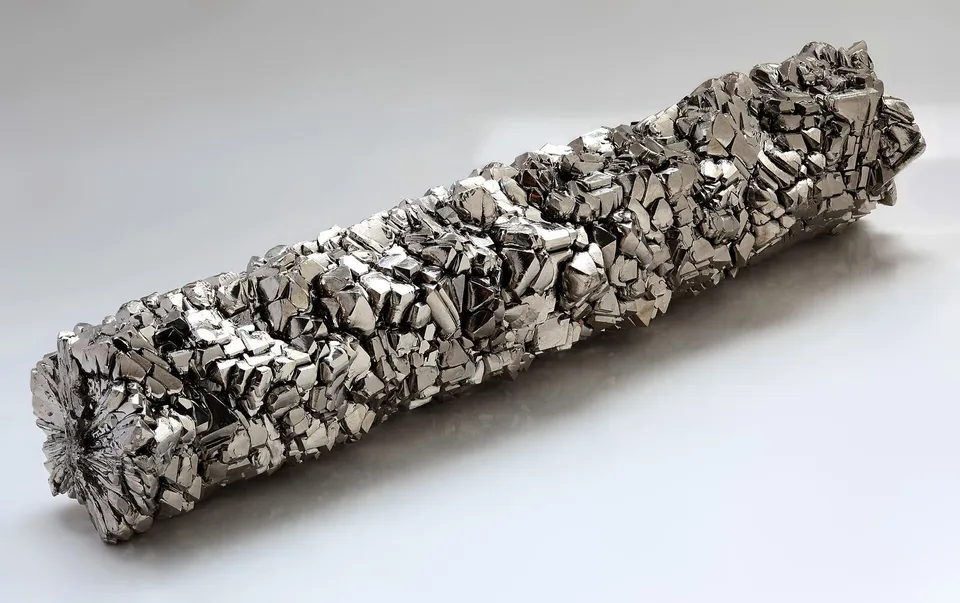

Specimen
- Atomic number
- 22
- Atomic mass
- 47.867
- State at room temperature
- Solid
- Melting point
- 1,668 °C
- Boiling point
- 3,287 °C
- Density
- 4.5 g/cm³
- Discovered
- 1791
Can I eat it?
- In food and water
- Allowed in food. Titanium dioxide is a white food color (E 171). In 2021, EFSA said it is no longer safe as a food additive, because it could not exclude damage to DNA. The EU withdrew it from food in 2022. The US FDA still allows it, up to 1% of the food weight. 91011
- As the pure element
- Little studied. In 2010, the US EPA searched the literature for titanium metal. It found no human or animal studies useful for setting a safe dose. Titanium is used in surgical implants, and HSDB reports a lack of toxicity on contact with tissues. Fine titanium dust can catch fire. 121314
Learn about titanium
- 01 How much there is And how much of that can we reach? Titanium is the ninth most common element in the Earth's crust, at about 0.4% to 0.7% by mass. USGS counts more than 540 million tonnes of titanium dioxide in reserves, about 55 years of mining at the 2025 rate. USGS says the high cost of making the metal limits its wider use. Read →
- 02 Where it is found What is it found in, and where on Earth? Titanium is mined from ilmenite and rutile. Much of it comes from heavy-mineral sands on coasts, as in South Africa and Australia. Some comes from hard rock, as in China, Norway and Quebec. Zircon and monazite are often mined with it. Read →
- 03 How we get it How much do we make each year, and how? Mines produced about 9.8 million tonnes of titanium dioxide in ore in 2025. Most becomes white pigment. A small stream becomes metal: 370,000 tonnes of sponge. Pigment is not recycled; much titanium metal scrap is. Read →
- 04 What we use it for Where does it go, and why this element? Most titanium becomes titanium dioxide, a white pigment for paint, plastics and paper. The metal is a small share, valued because it is strong, light and resists corrosion. In the United States, USGS estimated that 80% of titanium metal went into aerospace in 2019. Read →
- 05 What it costs What does it cost, and how is it bought and sold? In 2025, titanium sponge imported into the United States was worth about $12 per kg. Imported pigment was worth about $3,200 a tonne and Australian rutile about $1,140. After inflation, the 2020 sponge value was about a tenth of the 1948 value. We found no exchange price. Read →
- 06 Who controls it Who controls the supply, and who depends on it? Mining is spread over many countries. China mines about a third of the ilmenite, makes 70% of the sponge and has 61% of pigment capacity. The United States makes no sponge and buys most of it from Japan. The US and the UK list titanium as critical. The EU lists titanium metal. Read →
- 07 Social and political problems What problems does it cause between people, and who carries them? Titanium dioxide is part of trade disputes between China and other countries. The EU banned it in food; Canada did not. A US court jailed a man for selling DuPont's pigment secrets to Chinese state companies. Plans for sand mines led to disputes about land and water. Read →
- 08 History How did our relationship with it begin and change? William Gregor found titanium in a Cornish sand in 1791, and Klaproth named it after the Titans in 1795. Pure metal came in 1910. The pigment industry grew from 1916 and the metal industry from 1948. Read →
Worth knowing
-
Titanium dioxide replaced lead compounds as the white in US paint because it is much less toxic to people. 15
History → -
In 2014 a US court sentenced the businessman Walter Liew to 15 years in prison. He and others had sold DuPont's titanium dioxide trade secrets to the Pangang Group in China for more than $20 million. 16
Social and political problems → -
In March 2022, the Wall Street Journal reported that Boeing got about a third of its titanium from Russia. 17
Who controls it → -
In the 1980s, a titanium mine at Tellnes, Norway, put about 2 million tonnes of tailings a year into a local fjord. 15
Social and political problems →
The atom
Electrons
| Shell | Electrons |
|---|---|
| 1 (K) | 2 |
| 2 (L) | 8 |
| 3 (M) | 10 |
| 4 (N) outermost | 2 |
| Total | 22 |
Configuration [Ar] 3d² 4s²
3d ↑ ↑
4s ↑ ↓
Nucleus
| Protons | 22 |
|---|---|
| Neutrons | 26 |
| Mass number | 48 |
Related elements
New articles by e-mail
Sources
- 1
U.S. Geological Survey (J. Gambogi), 2025. Titanium, in 2022 Minerals Yearbook (advance release) , pp. 79.1 to 79.6, introduction, Production, Consumption, World Review, Outlook.
Processes, uses, world production by stage, company and country events, outlook.
-
Dredging and dry surface mining techniques usually are used for the recovery of heavy minerals, including titanium minerals
-
- 2
U.S. Geological Survey (S.M. Ewing), 2026. Titanium Mineral Concentrates, in Mineral Commodity Summaries 2026 , p. 1, Domestic Production and Use, Salient Statistics, Events; p. 2, World Mine Production and Reserves, World Resources, Substitutes, footnotes.
World mine production and reserves of ilmenite and rutile, resources, prices, US imports, China's role.
-
Data in thousand metric tons, titanium dioxide (TiO2) content ... World total (ilmenite and rutile, rounded) ... 9,680 ... 9,800
-
Data in thousand metric tons, titanium dioxide (TiO2) content ... World total (ilmenite, rounded) ... World total (rutile, rounded) ... World total (ilmenite and rutile, rounded) ... 9,400 ... 9,680 ... 9,800
-
- 3
U.S. Geological Survey (S.M. Ewing), 2026. Titanium and Titanium Dioxide, in Mineral Commodity Summaries 2026 , p. 1, Domestic Production and Use, Salient Statistics, Import Sources, Tariff; p. 2, Government Stockpile, Events, World Sponge Metal Production and Sponge and Pigment Capacity, Substitutes.
World sponge production, sponge and pigment capacity, US sponge plants, imports, prices and uses.
-
Price, dollars per kilogram4 ... 11.10 ... 12.30 ... 13.30 ... 12 ... Landed duty-paid value based on U.S. imports for consumption
-
- 4
Theodore Gray (periodictable.com), data from Wolfram Research ElementData, 2026. Technical data for the element Titanium , Abundances.
Abundance of titanium in the universe, crust and oceans, as mass fractions.
-
% in Earth's Crust 0.66%
-
- 5
UK Critical Minerals Intelligence Centre, British Geological Survey, 2024. UK 2024 Criticality Assessment , Table 1 (UK critical minerals list 2024); appendix tables of end uses and end-of-life recycling rates (Titanium); trade concentration table.
Titanium on the UK critical list; world end-use shares and recycling rates from Graedel et al. (2022).
-
Titanium (Ti) Paints 54 0 ... Polymers 24 0 Aerospace 8 80 Medical equipment 6 30 Automotive 3 30 Alloys 2 30 Hand-held objects 2 30 Others 1 0 ... Total 172 10.3
-
- 6
UNEP International Resource Panel (T.E. Graedel et al.), 2011. Recycling Rates of Metals: A Status Report , Appendix D, Table D1, p. 30, and footnote q.
Old scrap ratio, recycled content and end-of-life recycling rate of titanium metal (US data, Goonan 2010).
-
Tiq 11m 52m 91m
-
- 7
IUPAC Commission on Isotopic Abundances and Atomic Weights (CIAAW), 2024. Abridged Standard Atomic Weights 2024 .
The atomic mass shown for the 84 elements that have a standard atomic weight.
- 8
National Center for Biotechnology Information (PubChem), 2026. Periodic Table of Elements .
Electron configuration, melting and boiling points, density and discovery year for all 118 elements.
- 9
European Food Safety Authority (EFSA), 2021. Titanium dioxide: E171 no longer considered safe when used as a food additive .
-
the Panel concluded that titanium dioxide can no longer be considered safe as a food additive. A critical element in reaching this conclusion is that we could not exclude
-
- 10
European Commission, 2023. Re-evaluation of food additives (with questions and answers on titanium dioxide) .
-
The European Commission has adopted, on 14 January 2022, Regulation (EU) 2022/63 withdrawing the authorisation to use a food additive Titanium dioxide (TiO2 also known as E171) in food products
-
- 11
U.S. Food and Drug Administration, 2025. Titanium Dioxide as a Color Additive in Foods .
-
The FDA allows for the safe use of TiO 2 as a color additive in foods according to the specifications and conditions, including that the quantity of titanium does not exceed 1% by weight of the food
-
- 12
US Environmental Protection Agency, Superfund Health Risk Technical Support Center, 2010. Provisional Peer-Reviewed Toxicity Values for Titanium (CASRN 7440-32-6) , Review of potentially relevant data, page 3.
-
the literature search revealed no human or animal studies, acute, short term, or chronic, that are useful for developing toxicity values for titanium
-
- 13
National Center for Biotechnology Information (PubChem), with text from HSDB, 2026. Titanium (CID 23963), compound summary , Toxicity, Human Toxicity Excerpts.
-
LACK OF TOXICITY ... BY CONTACT WITH SKIN & TISSUES HAS BEEN ... DEMONSTRATED BY ITS USE IN THERAPY OF SKIN DISORDERS & IN SURGICAL APPLIANCES.
-
- 14
ESPI Metals (supplier), 2015. Titanium, safety data sheet , Sections 5 and 11.
-
Small chips, fine turnings and dust from processing may be readily ignitable.
-
- 15
U.S. Geological Survey (L.G. Woodruff, G.M. Bedinger, N.M. Piatak), 2017. Titanium, chap. T of Critical mineral resources of the United States (Professional Paper 1802) , Abstract; Introduction; Uses and Applications; Geology; Resources and Production; Environmental Considerations.
Uses, minerals, deposit types, history of processes, health and environment, recycling.
-
TiO2 replaced lead carbonate and lead oxide as the whiteners in paints in the United States because of its low toxicity to humans
-
At Tellnes, about 2 million metric tons per year of tailings were deposited into a local fjord throughout the 1980s
-
- 16
U.S. Attorney's Office, Northern District of California (press release, 11 July 2014), 2014. Walter Liew Sentenced To Fifteen Years In Prison For Economic Espionage .
The conviction and sentence for selling DuPont's chloride-route TiO2 technology to Chinese state-owned companies.
-
Liew, Maegerle, and USAPTI obtained and sold DuPont's TiO2 trade secrets to the Pangang Group companies for more than $20 million
-
- 17
Forecast International (Flight Plan, 7 March 2022), 2022. Boeing Halts Russian Titanium Buys .
Boeing's suspension of Russian titanium purchases and its earlier dependence on VSMPO-AVISMA, as reported by the Wall Street Journal.
-
According to the WSJ report, Boeing gets about a third of its titanium supply from Russia
-
- 18
National Institute of Standards and Technology (NIST), 2026. Atomic Weights and Isotopic Compositions for All Elements .
Isotopic composition of each element; the most abundant isotope sets the neutron count in the nucleus view.