Last updated 11 November 2026.
Lithium
Element 3 · Alkali metal · Mined for itself1
Lithium is the lightest metal. Most of it comes from hard rock in Australia and from salt-flat brines in Chile, Argentina and China. Mines outside the United States produced about 290,000 tonnes in 2025, about 20 times the output of 2000. Until the mid-2010s, glass, ceramics and grease together took more lithium than batteries. Now 88% goes into batteries, mostly for electric cars. China makes about three quarters of the world's lithium chemicals. The price rose more than fivefold from 2021 to 2022 and fell back by 2025. New mines have met opposition in Serbia, Nevada and Zimbabwe.
How lithium compares
Contract price $9,000 per tonne of lithium carbonate, battery grade 1 Not on the scale: this is the price of lithium carbonate, battery grade, not of lithium. What it costs →
The scales are log scales, except for the shares, which go from 0 to 100%.
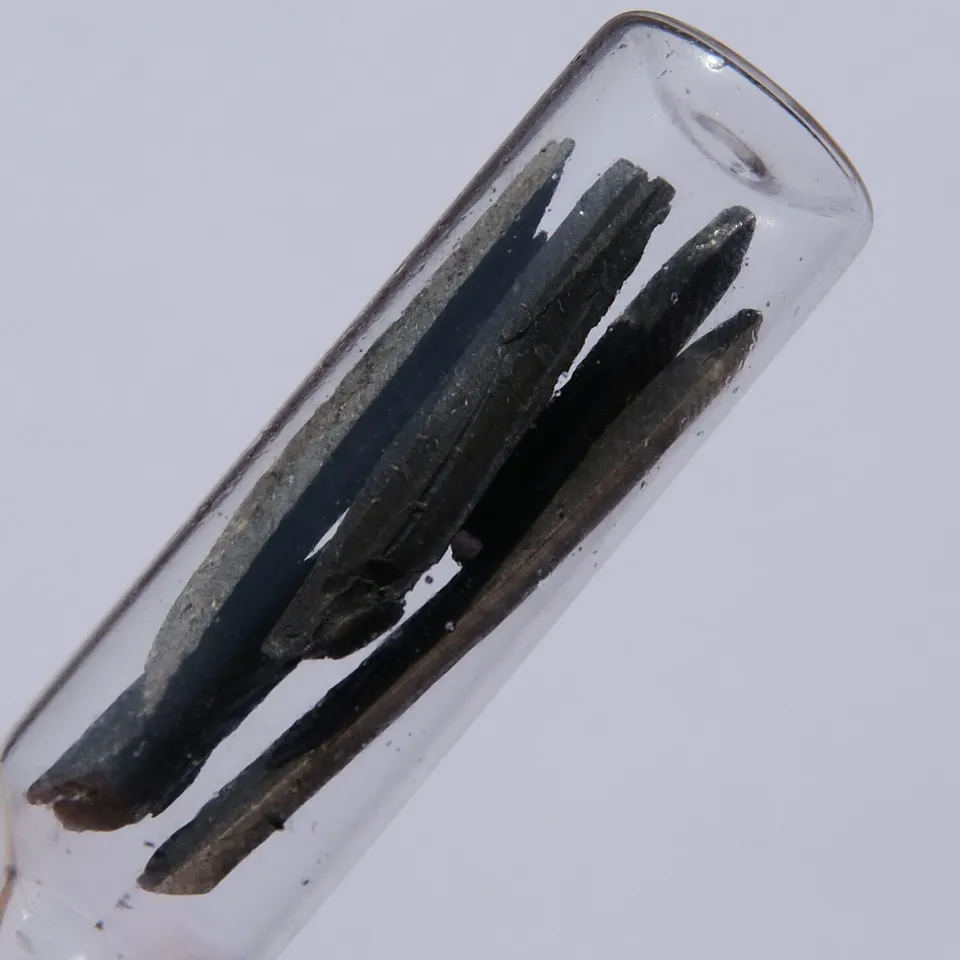

Specimen
- Atomic number
- 3
- Atomic mass
- 6.94
- State at room temperature
- Solid
- Melting point
- 180.5 °C
- Boiling point
- 1,342 °C
- Density
- 0.534 g/cm³
- Discovered
- 1817
Can I eat it?
- In food and water
- Harmful. Lithium is in drinking water and some foods. The US EPA uses a health reference level of 10 µg per liter of water. It based this level on harm in patients who take lithium as a medicine. 8
- As the pure element
- Reacts violently or burns tissue. Lithium metal reacts violently with water. The reaction makes hydrogen gas and lithium hydroxide, which is corrosive. ICSC calls it corrosive if a person swallows it. ICSC lists stomach pain, a burning feeling, vomiting and collapse. 9
Learn about lithium
- 01 How much there is And how much of that can we reach? Lithium makes up about 20 parts per million of the upper crust. USGS put world reserves at 37 million tonnes in 2025, about 130 years of 2025 mine output, and resources at about 150 million tonnes. Read →
- 02 Where it is found What is it found in, and where on Earth? Lithium is mined from two main kinds of deposit: salty brines under dry salt flats, and pegmatite rocks rich in the mineral spodumene. Brines in South America and China and pegmatites in Australia supply most of the world. Read →
- 03 How we get it How much do we make each year, and how? Mines outside the United States produced about 290,000 tonnes of lithium in 2025, 31% more than in 2024. Australia mines the most, from hard rock. Chile and Argentina pump brine. China turns most of the ore into chemicals. Read →
- 04 What we use it for Where does it go, and why this element? USGS estimates that 88% of lithium went into batteries in 2025, mostly for electric cars. The rest goes into glass and ceramics, grease, air treatment, steel casting and medicine. In 2013 glass and ceramics were the largest use. Read →
- 05 What it costs What does it cost, and how is it bought and sold? Lithium is sold mostly as lithium carbonate, lithium hydroxide or concentrate. US contracts for battery-grade lithium carbonate averaged $9,000 a tonne in 2025. A year's mine output was worth roughly $14 billion. The price rose more than fivefold from 2021 to 2022 and then fell. Read →
- 06 Who controls it Who controls the supply, and who depends on it? Australia, China and Chile mined about 72% of the world's lithium in 2025. China made about three quarters of the lithium chemicals. Chile, Mexico and Zimbabwe have given the state a larger role. China announced export controls on battery materials in 2025, then suspended them. Read →
- 07 Social and political problems What problems does it cause between people, and who carries them? New lithium mines have met strong opposition. Serbia stopped the Jadar project after protests in 2022. A court reversed that in 2024, and Rio Tinto later put the project on hold. Tribes sued over Thacker Pass in Nevada. Families in Zimbabwe say mines took their land and water. Read →
- 08 History How did our relationship with it begin and change? Johan August Arfwedson found lithium in 1817, and Berzelius named it after the Greek word for stone. In the 20th century it went into grease, glass, medicine and hydrogen bombs. Since 1991 lithium-ion batteries have made it a major industrial metal. Read →
Worth knowing
-
Lithium metal is so light that it floats in oil. It reacts so strongly that it cannot be stored in air or water. 10
-
The largest spodumene crystal found so far, from South Dakota, is 14 meters long. Spodumene is the main lithium ore mined in Australia. 10
Where it is found → -
At Clayton Valley, Nevada, brine stays in evaporation ponds for nearly two years before it is rich enough for a chemical plant. 10
How we get it → -
Separating lithium isotopes for hydrogen bombs at Oak Ridge released about 240,000 pounds of mercury into a nearby creek from 1950 to 1982. 11
History → -
The US weapons program took so much lithium-6 out of its lithium stockpile that the measured atomic weight of lithium changed in many standard chemicals. 12
History → -
An electric car battery holds about 10 to 22 kilograms of lithium, depending on its design. 10
What we use it for → -
When prices peaked, the Chilean producer SQM sold almost nine times as much by value in 2022 as in 2021: $8.2 billion against $0.9 billion. 13
What it costs →
The atom
Electrons
| Shell | Electrons |
|---|---|
| 1 (K) | 2 |
| 2 (L) outermost | 1 |
| Total | 3 |
Configuration [He] 2s¹
2s ↑
Nucleus
| Protons | 3 |
|---|---|
| Neutrons | 4 |
| Mass number | 7 |
Related elements
New articles by e-mail
Sources
- 1
B.W. Jaskula, U.S. Geological Survey, 2026. Lithium, in Mineral Commodity Summaries 2026 , World Mine Production and Reserves; Events, Trends, and Issues.
World mine production, reserves, resources, end uses, US prices and events for 2025.
-
Four brine operations in Argentina, seven mineral operations in Australia, one mineral operation in Brazil, two mineral operations in Canada, two brine operations Chile, nine mineral and six brine operations in China
-
Excluding U.S. production, worldwide lithium production in 2025 increased by 31% to approximately 290,000 tons from 222,000 tons in 2024
-
For fixed contracts, the annual average U.S. lithium carbonate price was $9,000 per ton in 2025, a decrease of 31% from that in 2024
-
approximately 290,000 tons ... the annual average U.S. lithium carbonate price was $9,000 per ton in 2025
-
13,800 23,000 82,700 92,000 10,200 12,000 4,820 5,600 ... 48,900 56,000 41,400 62,000 770 9,400 380 380 20,000 28,000 ... 222,000 290,000
-
- 2
Theodore Gray, periodictable.com (data from Wolfram ElementData), 2026. Technical data for Lithium (from Wolfram ElementData) , Abundances.
Abundance in the universe, crust, oceans and human body, as mass fractions.
-
% in Earth's Crust 0.0017%
-
- 3
UK Critical Minerals Intelligence Centre, British Geological Survey, 2024. UK 2024 Criticality Assessment , Table 1, p. 9.
Lithium is on the UK critical minerals list of 2024.
-
Lithium (Li) 3
-
- 4
UNEP International Resource Panel (T.E. Graedel et al.), 2011. Recycling Rates of Metals: A Status Report , Appendix F, table F1, p. 36.
End-of-life recycling rate and recycled content for lithium, both below 1%.
-
Li <1 <1 <1
-
- 5
International Energy Agency, 2026. Global Critical Minerals Outlook 2026 , Chapter 2, lithium section; export restriction tables; Annex, lithium tables.
Demand, prices, refining shares, recycling, export controls and the STEPS outlook for lithium.
-
For lithium and nickel, recycling remains at an early stage, with current rates below 5%
-
- 6
IUPAC Commission on Isotopic Abundances and Atomic Weights (CIAAW), 2024. Abridged Standard Atomic Weights 2024 .
The atomic mass shown for the 84 elements that have a standard atomic weight.
- 7
National Center for Biotechnology Information (PubChem), 2026. Periodic Table of Elements .
Electron configuration, melting and boiling points, density and discovery year for all 118 elements.
- 8
U.S. Environmental Protection Agency, Office of Water, 2023. Technical Fact Sheet: Lithium in Drinking Water (UCMR 5) , Pages 1 and 2.
-
Lithium is likely present in a variety of foods ... Health Reference Level (HRL) of 10 µg/L is based on the p-RfD
-
The provisional value for lithium is based on adverse effects observed in patients administered lithium therapeutically
-
- 9
International Labour Organization and World Health Organization (International Chemical Safety Cards), 1999. ICSC 0710 - Lithium , Chemical dangers; Ingestion; Effects of short-term exposure.
-
Reacts violently with water. This produces highly flammable hydrogen gas and corrosive fumes of lithium hydroxide.
-
The substance is corrosive to the eyes, skin and respiratory tract. Corrosive on ingestion.
-
Abdominal cramps. Abdominal pain. Burning sensation. Nausea. Shock or collapse. Vomiting. Weakness.
-
- 10
D.C. Bradley, L.L. Stillings, B.W. Jaskula, L. Munk and A.D. McCauley, U.S. Geological Survey, 2017. Lithium, chap. K of Critical Mineral Resources of the United States (Professional Paper 1802-K) , pp. K1-K21.
Geology, deposit types, minerals, brine processing, health and the history of uses.
-
Lithium metal is so light that it floats in oil, and so reactive that it cannot be stored in air or water
-
The largest spodumene crystal yet found is 14 meters (m) long (from South Dakota)
-
It takes nearly 2 years to achieve a concentrate that is both enriched in lithium (to 5,000 ppm)
-
Various battery configurations in electric vehicles use between about 10 and 22 kilograms of lithium
-
- 11
U.S. Department of Energy, Oak Ridge Office of Environmental Management, 2019. Y-12 National Security Complex (fact sheet) .
Lithium isotope separation from 1953 and the mercury released from 1950 to 1982.
-
An estimated 240,000 pounds of mercury were released from Y-12 directly to Upper East Fork Poplar Creek (UEFPC) from 1950 to 1982
-
- 12
Wikipedia contributors, 2026. Lithium , History.
Discovery, isolation, first commercial production and the US lithium-6 stockpile.
-
The stockpiled lithium was depleted in lithium-6 by 75%, which was enough to affect the measured atomic weight in many standardized chemicals
-
- 13
B.W. Jaskula, U.S. Geological Survey, 2025. Lithium, in 2022 Minerals Yearbook (advance release) , pp. 44.1-44.4.
World production and consumption in 2022, producers by country, prices, uses and company results.
-
SQM’s value of sales increased nearly ninefold to $8,153 million in 2022 from $936 million in 2021 owing to much higher lithium prices
-
- 14
National Institute of Standards and Technology (NIST), 2026. Atomic Weights and Isotopic Compositions for All Elements .
Isotopic composition of each element; the most abundant isotope sets the neutron count in the nucleus view.