Last updated 10 October 2026.
Molybdenum
Element 42 · Transition metal · By-product of copper1
Most molybdenum goes into steel. Small amounts make stainless steel resist corrosion and make engineering and tool steels harder and stronger when hot. USGS estimates that mines produced about 260,000 tonnes of molybdenum in 2025. Only China and the United States have primary mines, which are mined for molybdenum alone. Elsewhere, molybdenum comes from copper mines as a by-product. Plants and animals need it in small amounts.
How molybdenum compares
The scales are log scales, except for the shares, which go from 0 to 100%.
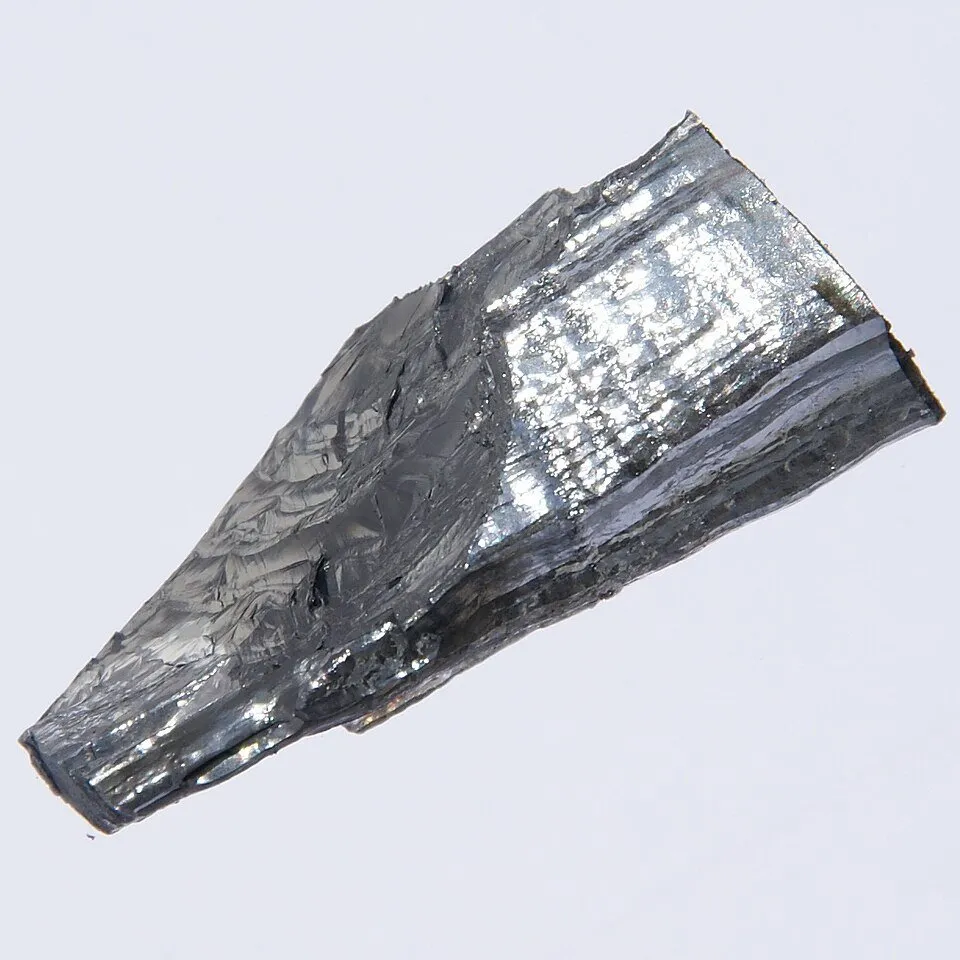

Specimen
- Atomic number
- 42
- Atomic mass
- 95.95
- State at room temperature
- Solid
- Melting point
- 2,623 °C
- Boiling point
- 4,639 °C
- Density
- 10.2 g/cm³
- Discovered
- 1778
Can I eat it?
- In food and water
- Your body needs it. Molybdenum, as molybdate in food, is a nutrient that some enzymes need. EFSA sets an adequate intake of 65 micrograms a day for adults. The RSC says larger amounts are toxic. 78
- As the pure element
- Little studied. Molybdenum is a hard gray metal. The ILO and WHO safety card says its health effects are not well studied. A fine dust of molybdenum in air can explode. 9
Learn about molybdenum
- 01 How much there is And how much of that can we reach? Molybdenum is rare: about one gram in every tonne of the Earth's crust. USGS estimates world reserves at 17 million tonnes, about 65 years of mine output at the 2025 rate. USGS says that resources are adequate for the foreseeable future. Read →
- 02 Where it is found What is it found in, and where on Earth? Almost all molybdenum comes from molybdenite, a sulfide mineral. It forms in large, low-grade porphyry deposits, where hot fluids from cooling magma left it in the rock. Some deposits are mined for molybdenum alone; in many more, molybdenite comes with copper. Read →
- 03 How we get it How much do we make each year, and how? Mines produced about 260,000 tonnes of molybdenum in 2025, by USGS estimate. China mined the most. Most of the rest came from copper mines in Chile, Peru, Mexico and the United States. Plants roast the concentrate to an oxide; much of it becomes ferromolybdenum for steelmakers. Read →
- 04 What we use it for Where does it go, and why this element? Most molybdenum goes into steel and cast iron. By IMOA's figures for 2025, engineering steels took 38% of new molybdenum and stainless steels 26%. Chemicals took 13%, mostly as catalysts that remove sulfur from fuels. There is little substitute for it in steel. Read →
- 05 What it costs What does it cost, and how is it bought and sold? Molybdenum is sold mostly as roasted concentrate (technical oxide) and as ferromolybdenum, at prices that trade journals publish. The US oxide price averaged about $51 per kg of molybdenum in 2025, by USGS estimate. In 1979 the price more than doubled for one year. Read →
- 06 Who controls it Who controls the supply, and who depends on it? Five countries mined 90% of the world's molybdenum in 2025: China, Chile, the United States, Peru and Mexico. China alone mined about 37%. It is not on the EU, US or UK lists of critical materials, but Canada lists it. China put export controls on molybdenum powders in 2025. Read →
- 07 Social and political problems What problems does it cause between people, and who carries them? Wars raised demand for molybdenum, for armor and aircraft. Today the main disputes concern mine waste and water. The US government lists the closed Questa mine in New Mexico as a Superfund site. In Armenia, a copper and molybdenum company reports that it is the largest taxpayer. Read →
- 08 History How did our relationship with it begin and change? Molybdenite was long taken for a lead ore or for graphite. Scheele showed in 1778 that it was neither, and Hjelm made the metal in 1781. Steelmakers began to use it in the 1890s. Two world wars, then cars, aircraft, stainless steel and oil refining made it a common alloy metal. Read →
Worth knowing
-
In the 1890s, people at Knaben in Norway valued a pound of molybdenite at a pound of butter. During the First World War it rose to three pounds of butter. 10
History → -
Plants and animals use about 50 different enzymes that contain molybdenum. One of them lets bacteria in the roots of beans and peas take nitrogen from the air. 11
How much there is → -
At US copper mines, USGS reports, all the cost of mining is put on copper. Molybdenum carries none of it. 12
How we get it → -
Only China and the United States have mines that are dug mainly for molybdenum. Chile, Peru, Mexico and the others get it from copper mines. 1
Who controls it →
The atom
Electrons
| Shell | Electrons |
|---|---|
| 1 (K) | 2 |
| 2 (L) | 8 |
| 3 (M) | 18 |
| 4 (N) | 13 |
| 5 (O) outermost | 1 |
| Total | 42 |
Configuration [Kr] 4d⁵ 5s¹
4d ↑ ↑ ↑ ↑ ↑
5s ↑
Nucleus
| Protons | 42 |
|---|---|
| Neutrons | 56 |
| Mass number | 98 |
Related elements
New articles by e-mail
Sources
- 1
U.S. Geological Survey (D.E. Polyak), 2026. Molybdenum, in Mineral Commodity Summaries 2026 , p. 1, Domestic Production and Use, Salient Statistics, Recycling, Import Sources; p. 2, Events, World Mine Production and Reserves, World Resources, Substitutes, footnotes.
World production and reserves by country, US production, prices, recycling, China's export controls, substitutes.
-
Only China and the United States produced molybdenum from both primary molybdenum mines and byproduct copper mines; the other countries relied on byproduct copper production
-
World total (rounded) ... 256,000 260,000
-
Price, average, dollars per kilogram4 ... 35.62 ... 41.72 ... 54.32 ... 47.72 ... 51 ... U.S. molybdic oxide (MoO3) price, 57% molybdenum content. Source: Argus Media group, Argus Non-Ferrous Markets
-
World total (rounded) ... 256,000 260,000 ... Price, average, dollars per kilogram4 ... 51
-
Mine production 2024 2025e 34,000 40,000 e 8,200 5,300 600 1,000 1,540 2,200 38,500 42,000 e 100,000 97,000 e 2,900 3,300 4,080 4,300 e 800 800 340 500 16,200 17,000 3,110 4,200 41,900 39,000 e 1,500 1,300 e 2,100 2,000
-
- 2
Theodore Gray (periodictable.com), data from Wolfram Research ElementData, 2026. Technical data for the element Molybdenum , Abundances.
Abundance of molybdenum in the universe, crust, oceans and human body, as mass fractions.
-
% in Earth's Crust 0.00011%
-
- 3
UK Critical Minerals Intelligence Centre, British Geological Survey, 2024. UK 2024 Criticality Assessment , Criticality scores table; appendix table of end uses and end-of-life recycling rates (Molybdenum); synthesized EoLRR table.
Molybdenum is non-critical for the UK in 2024 and 2021; world end uses and an end-of-life recycling rate of 44%.
-
Molybdenum (Mo) 44
-
- 4
UNEP International Resource Panel (T.E. Graedel et al.), 2011. Recycling Rates of Metals: A Status Report , Table C1 (ferrous metals), Mo row.
End-of-life recycling rate (30%) and recycled content (33%) of molybdenum.
-
Mo 33a, 67k 33k 30k
-
- 5
IUPAC Commission on Isotopic Abundances and Atomic Weights (CIAAW), 2024. Abridged Standard Atomic Weights 2024 .
The atomic mass shown for the 84 elements that have a standard atomic weight.
- 6
National Center for Biotechnology Information (PubChem), 2026. Periodic Table of Elements .
Electron configuration, melting and boiling points, density and discovery year for all 118 elements.
- 7
European Food Safety Authority (EFSA), 2017. Dietary Reference Values for nutrients. Summary report , Section 4.5 (iodine) and 4.9 (molybdenum).
-
Molybdenum is an essential component of certain enzymes ... An AI of 65 µg/day is proposed for adult men and women
-
- 8
Royal Society of Chemistry, 2026. Molybdenum - Element information, properties and uses .
-
Although it is toxic in anything other than small quantities, molybdenum is an essential element for animals and plants.
-
- 9
International Labour Organization and World Health Organization (International Chemical Safety Cards), 2006. ICSC 1003 - Molybdenum , Fire and explosion; Notes.
-
Health effects of exposure to the substance have not been investigated adequately.
-
Finely dispersed particles form explosive mixtures in air.
-
- 10
International Molybdenum Association (IMOA), 2026. A brief history of molybdenum .
Scheele and Hjelm, the first use in steel, Knaben, the First World War, the Gray Goose car, Type 316 stainless steel, later uses. An industry association.
-
one pound of molybdenite for a pound of butter ... a pound of molybdenum for three pounds of butter
-
- 11
Royal Society of Chemistry, 2026. Molybdenum (Periodic Table) , Key facts; Uses and properties; Biological role; Natural abundance; History.
Discovery, name, uses, enzymes, toxicity.
-
There are about 50 different enzymes used by plants and animals that contain molybdenum. One of these is nitrogenase ... Leguminous plants have root nodules that contain these nitrogen-fixing bacteria
-
- 12
U.S. Geological Survey (D.E. Polyak), 2021. Molybdenum, in 2019 Minerals Yearbook (advance release) , Production; Consumption; Prices; World Review (Chile, China, Armenia).
US mines, the cost allocation at copper mines, Climax, Thompson Creek, Rosemont, producers in Chile and China, uses of chemicals, prices.
-
all mining costs associated with molybdenum concentrate production were allocated to the primary metal (copper)
-
- 13
National Institute of Standards and Technology (NIST), 2026. Atomic Weights and Isotopic Compositions for All Elements .
Isotopic composition of each element; the most abundant isotope sets the neutron count in the nucleus view.