Last updated 10 October 2026.
Niobium
Element 41 · Transition metal · Mined for itself1
Most niobium goes into steel. A tenth of a percent or less makes steel for buildings, cars and gas pipelines stronger. Smaller amounts go into jet-engine alloys and the superconducting magnets of MRI scanners and particle accelerators. USGS estimates that mines produced about 112,000 tonnes of niobium in 2025. Brazil produced 93% of it, most from one mine at Araxá. The United States has had no significant niobium mine production since 1959.
How niobium compares
Unit value ~ $26 per kg of ferroniobium (gross weight) 2 Not on the scale: this is the price of ferroniobium (gross weight), not of niobium. What it costs →
The scales are log scales, except for the shares, which go from 0 to 100%.
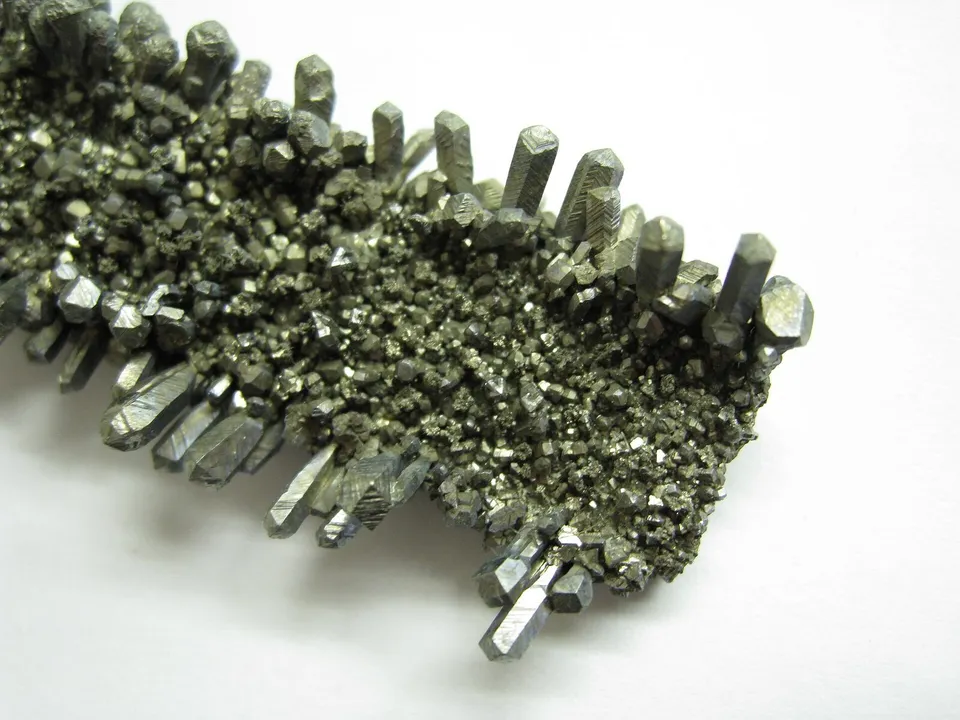

Specimen
- Atomic number
- 41
- Atomic mass
- 92.906
- State at room temperature
- Solid
- Melting point
- 2,477 °C
- Boiling point
- 4,744 °C
- Density
- 8.57 g/cm³
- Discovered
- 1801
Can I eat it?
Learn about niobium
- 01 How much there is And how much of that can we reach? Niobium is a trace element. USGS gives 8 parts per million for the crust, and other sources give up to 20. USGS puts world reserves at more than 21 million tonnes, about 190 years of mining at the 2025 rate. Most of the reserves are in Brazil. Read →
- 02 Where it is found What is it found in, and where on Earth? Most niobium comes from pyrochlore, a mineral found in carbonatites. These are rare igneous rocks rich in carbonate minerals. At Araxá in Brazil, weathering left a thick soil rich in pyrochlore. Smaller amounts come from columbite-tantalite ores and as a byproduct of tin. Read →
- 03 How we get it How much do we make each year, and how? Mines produced about 112,000 tonnes of niobium in 2025, by USGS estimate. USGS changed its recent figures a lot between editions, with no reason given. Producers make ferroniobium at the mine. Niobium in old steel goes back into new steel, but little is recovered as niobium. Read →
- 04 What we use it for Where does it go, and why this element? About 89% of the world's niobium went into steel in 2022, for buildings, cars, ships and pipelines. Small amounts make steel stronger and tougher. The rest goes mostly into superalloys for jet engines and gas turbines, and into superconducting magnets. Read →
- 05 What it costs What does it cost, and how is it bought and sold? Niobium is not traded on an exchange and has no public price. Producers sell it under private contracts, mostly as ferroniobium. The unit value of US ferroniobium trade was about $26 per kg in 2025. China bought about half of Brazil's ferroniobium exports in 2024. Read →
- 06 Who controls it Who controls the supply, and who depends on it? One Brazilian company, CBMM, sells most of the world's niobium. China is the largest buyer, and the United States relies on imports. The US, the EU and the UK list niobium as critical. Read →
- 07 Social and political problems What problems does it cause between people, and who carries them? Most niobium comes from a few large mines in Brazil and Canada, not from conflict areas. Some comes from artisanal coltan mining in central Africa, where workers can receive high doses of radiation. In Brazil, CBMM and the state of Minas Gerais share the profits of Araxá. Read →
- 08 History How did our relationship with it begin and change? Charles Hatchett found niobium in 1801 and named it columbium. Chemists took more than 40 years to tell it apart from tantalum. Niobium became an industrial metal after the 1950s, when large pyrochlore deposits were found in Brazil and Canada. Steel then became its main use. Read →
Worth knowing
-
CBMM, the largest producer, says that 0.02% of niobium in steel makes the steel more resistant. 10
What we use it for → -
The magnets of the Large Hadron Collider at CERN are made with niobium-titanium alloy. They are cooled to 1.9 kelvin, less than two degrees above absolute zero. 11
What we use it for → -
In the United States, niobium was called columbium, with the symbol Cb, until the middle of the 20th century. 11
History → -
The state of Minas Gerais takes 25% of the net profit from the Araxá niobium mine, through a partnership with CBMM that dates from 1972. 12
Social and political problems →
The atom
Electrons
| Shell | Electrons |
|---|---|
| 1 (K) | 2 |
| 2 (L) | 8 |
| 3 (M) | 18 |
| 4 (N) | 12 |
| 5 (O) outermost | 1 |
| Total | 41 |
Configuration [Kr] 4d⁴ 5s¹
4d ↑ ↑ ↑ ↑
5s ↑
Nucleus
| Protons | 41 |
|---|---|
| Neutrons | 52 |
| Mass number | 93 |
Related elements
New articles by e-mail
Sources
- 1
U.S. Geological Survey (C.A. Friedline), 2026. Niobium, in 2022 Minerals Yearbook (advance release) , pp. 52.1 to 52.3: Government Actions, Production, Consumption, Prices, World Review, Outlook; tables 2, 4 and 5.
World end uses, producers and owners, CBMM, Niobec, China's imports, ferroniobium production by country, stockpile history, prices.
-
Globally, pyrochlore was the leading mineral mined for niobium
-
- 2
U.S. Geological Survey (C.A. Friedline), 2026. Niobium (Columbium), in Mineral Commodity Summaries 2026 , p. 1, Domestic Production and Use, Salient Statistics, Recycling, Import Sources; p. 2, Events, World Mine Production and Reserves, World Resources, Substitutes, footnotes.
World production and reserves by country, US imports, prices, end uses, recycling, Brazil's exports, substitutes.
-
World total (rounded) ... 104,000 104,000 ... 112,000 112,000
-
Price, average unit value, ferroniobium, dollars per kilogram5 ... 9,900 6,700 26 100
-
104,000 104,000 e 6,900 6,000 e 44 40 e 930 970 300 300 e 210 200
-
- 3
Theodore Gray (periodictable.com), data from Wolfram Research ElementData, 2026. Technical data for the element Niobium , Abundances.
Abundance of niobium in the universe, crust and oceans, as mass fractions.
-
% in Earth's Crust 0.0017%
-
- 4
UK Critical Minerals Intelligence Centre, British Geological Survey, 2024. UK 2024 Criticality Assessment , Table 1 (UK critical minerals list 2024); criticality scores table; appendix tables of end uses and end-of-life recycling rates (Niobium); synthesized EoLRR table.
Niobium on the UK critical list; world end uses and an end-of-life recycling rate of 9%.
-
Niobium (Nb) 9
-
- 5
IUPAC Commission on Isotopic Abundances and Atomic Weights (CIAAW), 2024. Abridged Standard Atomic Weights 2024 .
The atomic mass shown for the 84 elements that have a standard atomic weight.
- 6
National Center for Biotechnology Information (PubChem), 2026. Periodic Table of Elements .
Electron configuration, melting and boiling points, density and discovery year for all 118 elements.
- 7
Royal Society of Chemistry, 2026. Niobium - Element information, properties and uses .
-
Niobium has no known biological role.
-
- 8
Khalid MU, Rudokaite A, Hakme da Silva AM, et al. (Nanomaterials), 2025. A Comprehensive Review of Niobium Nanoparticles: Synthesis, Characterization, Applications in Health Sciences, and Future Challenges .
-
It is crucial to continue in vivo studies, as there is a lack of them, to further elucidate the biocompatibility and cytotoxicity of niobium in living organisms
-
Niobium, due to its excellent biocompatibility, low toxicity, and ability to form stable oxide layers
-
- 9
Ted Pella, Inc. (supplier safety data sheet), 2017. Safety Data Sheet, Niobium Products (29-41, 8079, 91580, 9573) , Section 2 (Ingestion).
-
Metallic niobium has a low order of toxicity due to poor absorption from stomach and intestine.
-
- 10
Companhia Brasileira de Metalurgia e Mineração (CBMM), 2023. Sustainability Report 2022 , CEO message; 2022 highlights; The CBMM; The Niobium; Waste and dams.
CBMM's founding year, revenue, emissions per tonne, tailings dams, and its claim about niobium in steel.
-
0.02% of Niobium in steel makes it more resistant
-
- 11
Royal Society of Chemistry, 2026. Niobium (Periodic Table) , Uses and properties; History; podcast transcript (Jon Steed).
Discovery, the names columbium and niobium, uses, superconducting magnets, coins.
-
the Large Hadron Collider, where the niobium-containing magnets are cooled to 1.9 Kelvin
-
In the US niobium was called columbium, symbol Cb
-
- 12
O Fator (Lucas Ragazzi), 30 October 2025, 2025. Codemig e CBMM renovam acordo para exploração do nióbio de Araxá (Codemig and CBMM renew the agreement to mine Araxá niobium) .
The partnership of Codemig and CBMM since 1972, the 75/25 split of net profit, and the renewal of 2025.
-
a CBMM fica com 75% dos lucros líquidos e a Codemig, com 25%
-
- 13
National Institute of Standards and Technology (NIST), 2026. Atomic Weights and Isotopic Compositions for All Elements .
Isotopic composition of each element; the most abundant isotope sets the neutron count in the nucleus view.