Last updated 11 November 2026.
Bismuth
Element 83 · Post-transition metal · By-product of lead and tungsten1
Bismuth is a heavy, brittle metal that is rarely mined for its own sake. Most of it comes as a by-product of lead and tungsten ores, and China refined about 88% of the world's bismuth in 2025. People use it in stomach medicines, cosmetics, low-melting alloys for fire sprinklers, and as a nontoxic replacement for lead in brass and solders. In 2025 China put bismuth under export control. The annual average price that year was the highest on record, before adjustment for inflation.
How bismuth compares
The scales are log scales, except for the shares, which go from 0 to 100%.
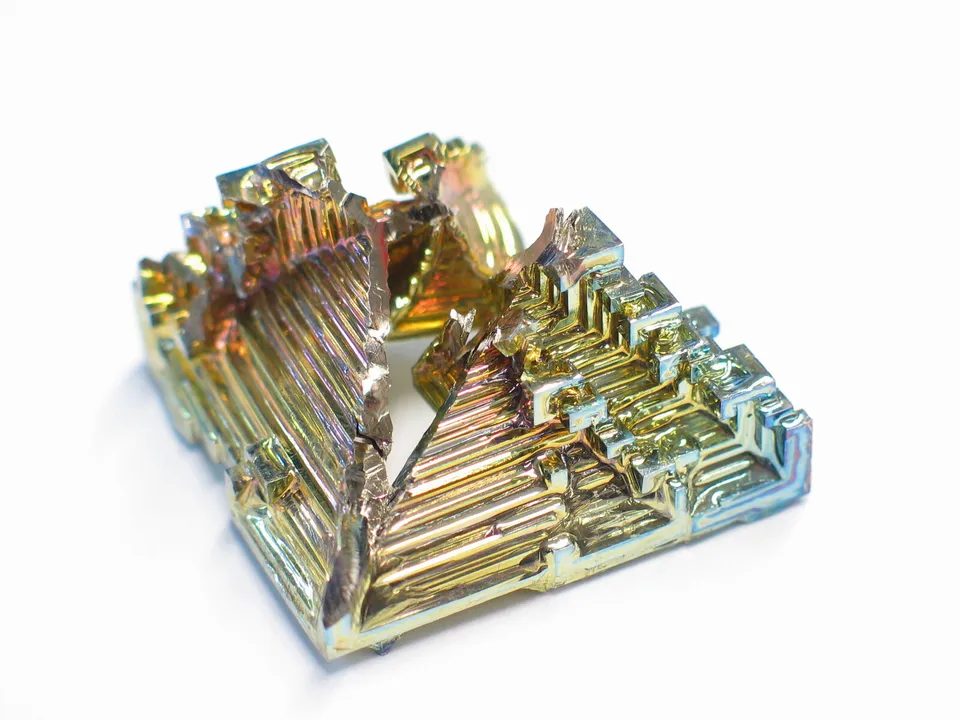

Specimen
- Atomic number
- 83
- Atomic mass
- 208.98
- State at room temperature
- Solid
- Melting point
- 271.4 °C
- Boiling point
- 1,564 °C
- Density
- 9.807 g/cm³
- Discovered
- 1753
Can I eat it?
- In food and water
- Not needed, little harm known. Bismuth compounds do not dissolve well in body fluids. A 2024 review calls them relatively non-toxic, and doctors use them for stomach ulcers. Overdoses harm the brain and the kidneys. In France, patients who took 5 to 20 g a day for weeks or years got a brain disorder (encephalopathy). 8
- As the pure element
- Little harm known. A 2024 review reports rat studies of bismuth metal by mouth, with no abnormal signs after one dose or after 28 days. Ducks that swallowed shot of 97 parts bismuth and 3 parts tin had no toxic effects. The US Fish and Wildlife Service approved this shot as nontoxic in 1997. 89
Learn about bismuth
- 01 How much there is And how much of that can we reach? Bismuth is rare in Earth's crust. Published estimates go from 0.008 to about 0.2 parts per million. The last USGS estimate of world reserves was 370,000 tonnes in 2016. Supply depends on how much lead and tungsten ore is processed. Read →
- 02 Where it is found What is it found in, and where on Earth? Bismuth occurs as native metal, in bismuthinite, and in galena in place of lead. The most common sources are tungsten and lead skarns. Supply depends on Asia, for example Nui Phao (Vietnam) and Shizhuyuan (China). It comes with lead, tungsten, tin, copper, zinc and fluorspar. Read →
- 03 How we get it How much do we make each year, and how? The USGS estimates world refinery output at 16,000 tonnes in 2025. Refiners recover most bismuth from lead bullion, or from tungsten and zinc ores. Almost none is recycled, because most uses spread it thinly in medicines, pigments and cosmetics. Read →
- 04 What we use it for Where does it go, and why this element? The EU estimates that 62% of bismuth goes into medicines, animal feed and other chemicals, and 28% into low-melting alloys. The rest goes into metal additives, pigments and other uses. Bismuth melts at a low temperature, expands when it freezes and is less toxic than lead. Read →
- 05 What it costs What does it cost, and how is it bought and sold? In 2025 bismuth cost about $44 per kg in Rotterdam, almost four times the 2024 price and, before adjustment for inflation, a record. Chinese policy and speculation have moved the price several times. Prices come from private deals, not from a major metals exchange. Read →
- 06 Who controls it Who controls the supply, and who depends on it? China refined about 88% of the world's bismuth in 2025. Korea, Japan and Laos refined most of the rest. Net imports were 92% of US use in 2025. Since February 2025 Chinese exporters of bismuth need permission. The EU, the United States and the UK list it as critical. Read →
- 07 Social and political problems What problems does it cause between people, and who carries them? We found no war or armed group linked to bismuth. It is part of a US-China trade dispute, with US tariffs from 2018 and Chinese export controls from 2025. In 2015 a Chinese metals exchange that held bismuth collapsed. More than 220,000 investors had bought one of its products. Read →
- 08 History How did our relationship with it begin and change? People used bismuth from about 1400, but for centuries confused it with lead, tin and antimony. Chemists accepted it as a separate metal in the mid-1700s. It went into printing type and medicines. Since the 1990s it has also replaced lead in pipes and solders. Read →
Worth knowing
-
When the Fanya Metal Exchange in China collapsed in 2015, more than 220,000 investors had reportedly bought its Ri Jin Bao product. Its warehouses reportedly held about 19,000 tonnes of bismuth. 10
What it costs → -
Natural bismuth is very slightly radioactive. Its half-life is about 1.9 × 10¹⁹ years. 11
History → -
Between 1973 and 1980, doctors in France reported about 1,000 cases of brain damage from bismuth medicines. Of 942 patients, 72 died. 12
-
Medieval miners thought bismuth was a stage in the growth of silver. They were dismayed when they found a vein of it, because they thought they had stopped the process. 13
History → -
Copper smelters charge a penalty for bismuth. A seller pays it when a copper concentrate holds more than 500 ppm of bismuth. 14
How we get it → -
Bismuth expands by 3.3% when it freezes, as water does. For this reason it is part of type-metal alloys, which make clean castings. 13
What we use it for →
The atom
Electrons
| Shell | Electrons |
|---|---|
| 1 (K) | 2 |
| 2 (L) | 8 |
| 3 (M) | 18 |
| 4 (N) | 32 |
| 5 (O) | 18 |
| 6 (P) outermost | 5 |
| Total | 83 |
Configuration [Xe] 4f¹⁴ 5d¹⁰ 6s² 6p³
4f ↑ ↓ ↑ ↓ ↑ ↓ ↑ ↓ ↑ ↓ ↑ ↓ ↑ ↓
5d ↑ ↓ ↑ ↓ ↑ ↓ ↑ ↓ ↑ ↓
6s ↑ ↓
6p ↑ ↑ ↑
Nucleus
| Protons | 83 |
|---|---|
| Neutrons | 126 |
| Mass number | 209 |
Related elements
New articles by e-mail
Sources
- 1
U.S. Geological Survey (Amy C. Tolcin), 2025. Bismuth, in Minerals Yearbook 2022 .
World refinery shares, host ores by country, the US critical mineral lists, Chinese exports and the sale of the Tilly plant.
-
Bismuth was produced principally as a byproduct of the smelting of lead concentrates; however, it was also a byproduct of fluorspar, tin, and tungsten-ore processing in China
-
- 2
U.S. Geological Survey (Kateryna Klochko), 2026. Bismuth, in Mineral Commodity Summaries 2026 .
World refinery production by country 2024 and 2025, US uses, imports and import reliance, prices, recycling, resources and substitutes.
-
Estimated world production of bismuth was 16,000 tons in 2025
-
The estimated annual average price in 2025 was $20 per pound, almost four times the price in 2024 and the highest annual average price on record
-
Estimated world production of bismuth was 16,000 tons in 2025 ... The estimated annual average price in 2025 was $20 per pound
-
Refinery productione 2024 2025 — — 50 50 48 50 14,000 14,000 500 500 180 180 1,000 1,000 7 492 500 16,300 16,000
-
- 3
Theodore Gray, periodictable.com (Wolfram ElementData), 2026. Technical data for Bismuth .
Abundance in the universe and the crust.
-
% in Earth's Crust 2.5×10⁻⁶
-
- 4
UK Critical Minerals Intelligence Centre, British Geological Survey, 2024. UK 2024 Criticality Assessment , Table of results; end-of-life recycling rates by end use.
The UK critical minerals list of 2024, with end uses and end-of-life recycling rates.
-
Bismuth (Bi) 0
-
- 5
UNEP International Resource Panel (T.E. Graedel et al.), 2011. Recycling Rates of Metals: A Status Report , Table F1.
End-of-life recycling rates, recycled content and old scrap ratios for 60 metals.
-
Bi <1 <1
-
- 6
IUPAC Commission on Isotopic Abundances and Atomic Weights (CIAAW), 2024. Abridged Standard Atomic Weights 2024 .
The atomic mass shown for the 84 elements that have a standard atomic weight.
- 7
National Center for Biotechnology Information (PubChem), 2026. Periodic Table of Elements .
Electron configuration, melting and boiling points, density and discovery year for all 118 elements.
- 8
Gonçalves Â, Matias M, Salvador JAR, Silvestre S. International Journal of Molecular Sciences 25(3):1600, 2024. Bioactive Bismuth Compounds: Is Their Toxicity a Barrier to Therapeutic Use? .
-
Bismuth compounds are considered relatively non-toxic, with their low solubility in aqueous solutions (e.g., biological fluids) being the major contributing factor to this property. Bismuth derivatives are widely used for the treatment of peptic ulcers
-
bismuth toxicity may mainly be developed due to ingestion in extreme doses, or incorrect use when taken in large quantities and for an extended period of time ... The reported toxic effects that were reported as caused by an overdose of bismuth compounds comprise encephalopathy, nephropathy
-
The most notorious situation of bismuth toxicity in man is probably the French outbreak of bismuth encephalopathy. ... All of the patients in the study had been treated with bismuth subnitrate between 5 and 20 g/daily, over a period of 4 weeks to 30 years.
-
The acute and chronic (28-days) oral toxicity of elemental bismuth were investigated by Sano et al. [ 93 ] in rats and no abnormal clinical signs were found in either dose regimen. Therefore, the authors suggested a good safety profile for the elemental bismuth present.
-
- 9
US Fish and Wildlife Service. Federal Register 62 FR 4874, 1997. Migratory Bird Hunting; Approval of Bismuth-Tin Shot as Nontoxic for Hunting Waterfowl and Coots .
-
Acute, chronic, and reproductive toxicity studies, undertaken for the Bismuth Cartridge Company, indicate that bismuth-tin shot is nontoxic when ingested by waterfowl (captive-reared mallards).
-
nominally, 97 parts bismuth and 3 parts tin
-
- 10
U.S. Geological Survey, 2017. Bismuth, in Minerals Yearbook 2015 .
The collapse of the Fanya Metal Exchange, its bismuth stocks, the Nui Phao mine and the 2006 price rise.
-
Reportedly, more than 220,000 investors had purchased the Ri Jin Bao product ... In November, when FME’s Web site was shut down, warehouses reportedly still contained 19,228 t of bismuth
-
- 11
Pierre de Marcillac and others (Nature 422, 876–878), 2003. Experimental detection of α-particles from the radioactive decay of natural bismuth .
The half-life of bismuth-209. Abstract only.
-
We measure an energy release of 3,137 ± 1 (statistical) ± 2 (systematic) keV and a half-life of (1.9 ± 0.2) × 1019 yr
-
- 12
Cláudia Borbinha and others (BMC Neurology 19, 212), 2019. Bismuth encephalopathy- a rare complication of long-standing use of bismuth subsalicylate .
The French cases of 1973 to 1980 and the history of Pepto-Bismol. Fetched with Firecrawl because the site refused a script.
-
Between 1973 and 1980, about 1000 cases of bismuth-related neurotoxicity were reported in France (among 942 patients, there were 72 deaths)
-
- 13
R. Thomas Sanderson, Encyclopaedia Britannica, 2026. Bismuth .
History and name, occurrence, refining processes, uses, properties and toxicity. Fetched with Firecrawl because the site refused a script.
-
Miners during the Middle Ages apparently believed bismuth to be a stage in the development of silver from baser metals and were dismayed when they uncovered a vein of the metal thinking they had interrupted the process
-
expansion on solidification (like water and antimony). Bismuth is thus a useful component of type-metal alloys, which make neat, clean castings ... It undergoes a 3.3 percent expansion when it solidifies from the molten state
-
- 14
Eimear Deady and others, British Geological Survey (Ore Geology Reviews 143, 104722), 2022. Bismuth: Economic geology and value chains .
Crustal abundance, minerals, deposit types, the Nui Phao and Tasna mines, mine production, reserves, uses, recycling and smelter penalties. Open access copy in the NERC archive.
-
a Bi content exceeding 500 ppm in a saleable copper concentrate incurs a penalty
-
- 15
National Institute of Standards and Technology (NIST), 2026. Atomic Weights and Isotopic Compositions for All Elements .
Isotopic composition of each element; the most abundant isotope sets the neutron count in the nucleus view.