Last updated 14 October 2026.
Mercury
Element 80 · Transition metal · Mined for itself1
Mercury is a heavy metal that is liquid at room temperature. Most new mercury comes from cinnabar, a red ore that gives up its metal when heated. For centuries mercury was used to take silver and gold out of ore. Small-scale gold miners still use it, and they are now its largest users. Mercury is also a poison. In Japan, waste from a chemical plant caused Minamata disease. The Minamata Convention of 2013 limits mercury mining, trade and use.
How mercury compares
The scales are log scales, except for the shares, which go from 0 to 100%.
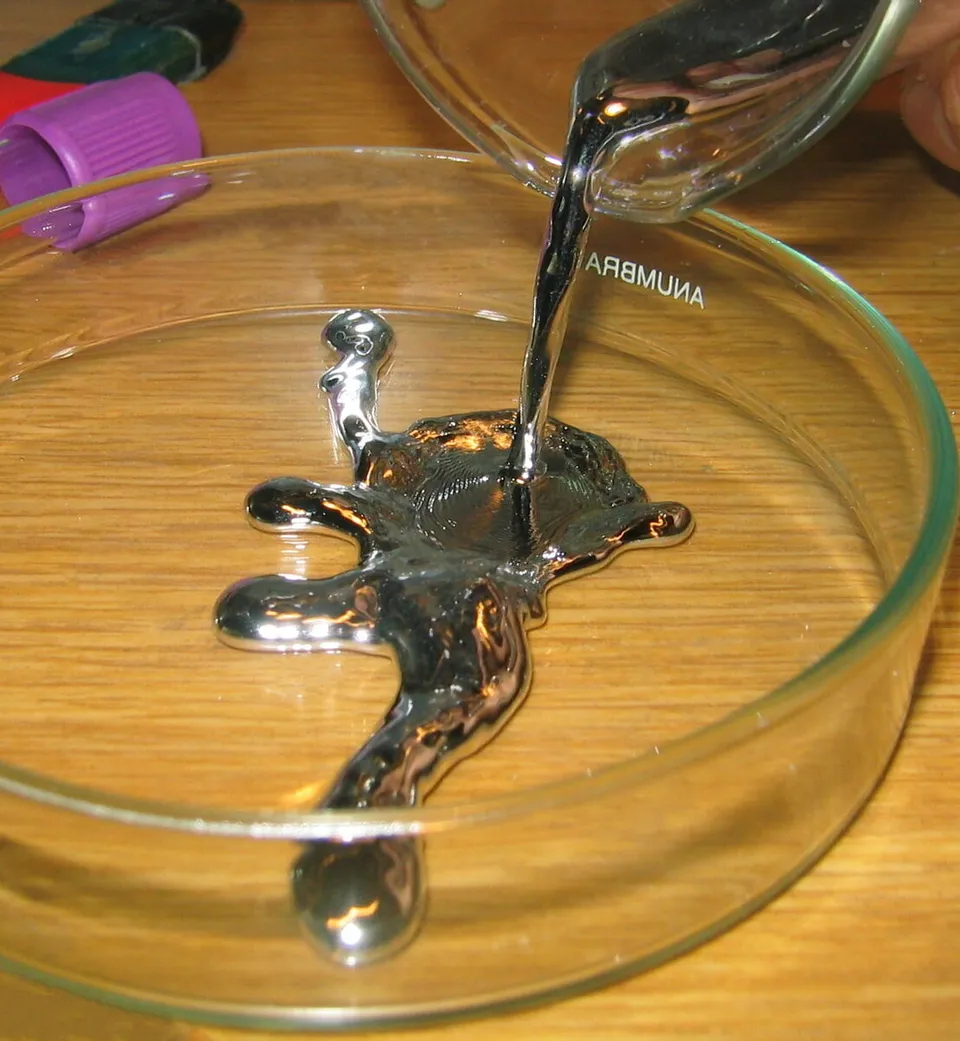

Specimen
- Atomic number
- 80
- Atomic mass
- 200.59
- State at room temperature
- Liquid
- Melting point
- -38.83 °C
- Boiling point
- 356.7 °C
- Density
- 13.53 g/cm³
- Discovered
- Ancient
Can I eat it?
- In food and water
- Poison. People take in mercury mostly as methylmercury in fish and shellfish. It damages the kidneys and the nervous system, and an unborn child is at most risk. The WHO says that even small amounts can cause serious health problems. 9
Learn about mercury
- 01 How much there is And how much of that can we reach? Mercury is rare in the crust, about 0.07 parts per million, but its ores hold 0.2 to 20%. USGS gives no reserve figure. It estimates resources at 600,000 tonnes, enough for centuries of use. Law, not geology, now limits supply. Read →
- 02 Where it is found What is it found in, and where on Earth? Almost all mercury ore is cinnabar, mercury sulfide. It forms where hot water rises near volcanoes or along faults. The largest single deposit is Almadén in Spain. Gold and zinc ores also hold some mercury, and some gold mines recover it. Read →
- 03 How we get it How much do we make each year, and how? How much mercury is mined is not clear. For 2024, USGS now counts about 210 tonnes and BGS counts 1,500 tonnes. Both put China first. Production peaked at 10,400 tonnes in 1971. Mercury is made by heating cinnabar and condensing the vapor. Read →
- 04 What we use it for Where does it go, and why this element? By UNEP's estimate, small-scale gold mining used over a third of the world's mercury in 2015. Making vinyl chloride for PVC in China used about a quarter. Products such as lamps, batteries and dental fillings used most of the rest. Most of these products are being phased out. Read →
- 05 What it costs What does it cost, and how is it bought and sold? Mercury has no single world price. The US import unit value was about 50 dollars a kilogram in 2024. In 1998 dollars, the US price peaked in 1965 and fell to about 4 dollars a kilogram in the 1990s. It rose again from 2004 to a spike in 2013. Export bans split the market in two. Read →
- 06 Who controls it Who controls the supply, and who depends on it? Supply is concentrated. USGS puts about 95% of mine output in China; BGS puts two thirds in China and one third in Tajikistan. The EU, the US and the UK do not count mercury as a critical mineral. The Minamata Convention, with 154 parties, limits mining and trade instead. Read →
- 07 Social and political problems What problems does it cause between people, and who carries them? Minamata disease led to decades of lawsuits in Japan. By 2024, 3,000 people were recognized as patients. Over 15 million people work in small-scale gold mining, the largest use of mercury. UNEP reports that illegal trade grew as legal trade came under more control. Read →
- 08 History How did our relationship with it begin and change? People have known mercury since ancient times. It is named after the planet Mercury. From the 1500s it was used to take silver out of ore in the Americas. Later it went into chlor-alkali plants, batteries and lamps. The Minamata Convention of 2013 phases out most of these uses. Read →
Worth knowing
-
Liquid mercury is 13 times denser than water. It is dense enough to hold up a man of average build. 12
-
Under Spanish rule, men from the villages near Huancavelica, Peru, had to work two months in its mercury mine. In 1604 an advocate for the native people wrote of a cough there, 'the illness of Huancavelica'. 13
Social and political problems → -
From 1550 to 1800, Latin American mines made about 136,000 tonnes of silver, about 80% of the world's output. By one estimate, up to 196,000 tonnes of mercury escaped in the process. 13
History → -
Dental amalgam, a common filling for teeth, is about half mercury. 14
What we use it for → -
Japan has recognized 3,000 people as Minamata disease patients. At the end of 2024, 304 of them were alive. 15
Social and political problems → -
The New Almaden mine in California, the largest mercury mine in North America, produced about four million flasks of mercury. 16
Where it is found →
The atom
Electrons
| Shell | Electrons |
|---|---|
| 1 (K) | 2 |
| 2 (L) | 8 |
| 3 (M) | 18 |
| 4 (N) | 32 |
| 5 (O) | 18 |
| 6 (P) outermost | 2 |
| Total | 80 |
Configuration [Xe] 4f¹⁴ 5d¹⁰ 6s²
4f ↑ ↓ ↑ ↓ ↑ ↓ ↑ ↓ ↑ ↓ ↑ ↓ ↑ ↓
5d ↑ ↓ ↑ ↓ ↑ ↓ ↑ ↓ ↑ ↓
6s ↑ ↓
Nucleus
| Protons | 80 |
|---|---|
| Neutrons | 122 |
| Mass number | 202 |
Related elements
New articles by e-mail
Sources
- 1
P. Nuss and M.J. Eckelman (PLOS ONE), 2014. Life Cycle Assessment of Metals: A Scientific Synthesis , Supporting Information S1, Hg rows.
Cradle-to-gate energy and greenhouse gas figures for mercury from cinnabar.
-
In 2000, global mercury production per route was approximately 68.5% (from its own ore), 30.2% (as by-product and recycling) and 1.4% (artisanal mining)
-
- 2
British Geological Survey (N.E. Idoine and others), 2026. World Mineral Production 2020-24 , Production of mercury; introduction.
World mercury production by country, 2020 to 2024, in kilograms. An independent check of the USGS figures.
-
World total 2 300 000 1 700 000 1 400 000 1 500 000 1 500 000
-
- 3
K.N. Sheaffer, U.S. Geological Survey, 2026. Mercury, in Mineral Commodity Summaries 2026 , pp. 118-119.
World mine production, resources, US uses, trade, the export ban, substitutes and events for 2025.
-
World total (rounded)5 Mine productione 2024 2025 NA NA 200 200 5 5 2 2 1 1 NA NA 4 4 212 210
-
2021 103 1 — 13 29 NA 2022 NA 2 — NA 33 NA 2023 NA 4 — NA 22 NA 2024 NA 2 — NA 50 NA
-
- 4
U.S. Geological Survey, 2025. Mercury, in Mineral Commodity Summaries 2025 , World Mine Production and Reserves table.
World mine production of 1,200 t in 2024, with 1,000 t from China and 100 t from Tajikistan.
-
World total (rounded)4 Mine productione 2023 2024 NA NA 1,000 1,000 6 6 2 2 20 20 NA 30 100 100 1,130 1,200
-
- 5
Theodore Gray, periodictable.com (data from Wolfram ElementData), 2026. Technical data for Mercury (from Wolfram ElementData) , Abundances.
Abundance in the universe, crust and oceans, as mass fractions. No figure for the human body.
-
% in Earth's Crust 6.7×10⁻⁶%
-
- 6
UNEP International Resource Panel (T.E. Graedel et al.), 2011. Recycling Rates of Metals: A Status Report , Appendix F, table F1; section on Hg.
End-of-life recycling rate and recycled content for mercury.
-
Hg 97g 25 –50 1 –10, 62g
-
- 7
IUPAC Commission on Isotopic Abundances and Atomic Weights (CIAAW), 2024. Abridged Standard Atomic Weights 2024 .
The atomic mass shown for the 84 elements that have a standard atomic weight.
- 8
National Center for Biotechnology Information (PubChem), 2026. Periodic Table of Elements .
Electron configuration, melting and boiling points, density and discovery year for all 118 elements.
- 9
World Health Organization, 2024. Mercury .
-
Exposure to mercury ... even small amounts ... may cause serious health problems, and is a threat to the development of the child in utero and early in life.
-
The health impacts of mercury are numerous including kidney and nervous system damage
-
People are mainly exposed to methylmercury, an organic compound, when they eat fish and shellfish that contain the compound.
-
- 10
World Health Organization (International Programme on Chemical Safety), 2003. Concise International Chemical Assessment Document 50 - Elemental mercury and inorganic mercury compounds - human health aspects , Section 7.1.1 (elemental mercury, absorption).
-
only 0.01% of elemental mercury is absorbed through the gastrointestinal tract
-
Approximately 80% of inhaled elemental mercury is absorbed through the lungs by rapid diffusion.
-
- 11
International Labour Organization and World Health Organization (International Chemical Safety Cards), 2019. ICSC 0056 - Mercury , Inhalation risk; Effects of long-term or repeated exposure.
-
A harmful contamination of the air can be reached very quickly on evaporation of this substance at 20°C. ... The substance may have effects on the central nervous system and kidneys.
-
- 12
Royal Society of Chemistry, 2026. Mercury, in Periodic Table , History; Uses and properties; Podcast.
History of cinnabar and mercury mines, uses, the source of the name, and density.
-
Elemental mercury, a liquid at room temperature, is 13 times denser than water. Enough it turns out to support a man of average build
-
- 13
N.A. Robins and N.A. Hagan (Environmental Health Perspectives 120: 627-631), 2012. Mercury Production and Use in Colonial Andean Silver Production: Emissions and Health Implications .
Mercury mining at Huancavelica, silver refining at Potosí, the mita labor draft and estimated mercury emissions 1564 to 1810.
-
required to work 2 months in Huancavelica and 12 months in Potosí ... In 1604, an advocate for the natives, Damían de Jeria, described how the vapors, dust, and candle smoke in the mine led to a ... cough and a certain illness . . . called the illness of Huancavelica
-
Between 1550 and 1800, miners and refiners produced approximately 136,000 metric tons of silver in Latin America, or about 80% of global production during this time, releasing up to 196,000 metric tons of mercury
-
- 14
United Nations Environment Programme, 2017. Global mercury supply, trade and demand: Executive Summary .
Supply, trade and demand of mercury in 2015: new mining in Mexico and Indonesia, two price levels, trade hubs, smuggling, demand in 2015 and the 2015 flow chart.
-
The use of dental amalgams, which contain about 50 per cent mercury, is also widespread
-
- 15
National Institute for Minamata Disease, Ministry of the Environment, Japan, 2025. Countermeasures against Minamata disease (questions and answers) .
Recognized patients to December 2024, the 1995 political solution, the 2004 Supreme Court decision, the 2009 act and state support for Chisso.
-
there have been 3,000 recognized Minamata disease patients (1,791 in Kumamoto, 493 in Kagoshima and 716 in Niigata), among which 304 patients are alive
-
- 16
J.J. Rytuba, U.S. Geological Survey, 2002. Mercury geoenvironmental models (Open-File Report 02-195, chapter J) .
Types of mercury deposits, ore grades, the Almaden deposit and by-product mercury from gold mines.
-
The New Almaden mine in central California is the largest mercury mine in North America having produced about four million flasks
-
- 17
National Institute of Standards and Technology (NIST), 2026. Atomic Weights and Isotopic Compositions for All Elements .
Isotopic composition of each element; the most abundant isotope sets the neutron count in the nucleus view.