Last updated 10 October 2026.
Strontium
Element 38 · Alkaline earth metal · Mined for itself1
Strontium is a soft alkaline earth metal. Companies mine it as celestite, a strontium sulfate mineral, mostly in Iran, Spain, China and Mexico. The USGS estimates world output at 450,000 tonnes of celestite in 2025. In the United States most strontium goes into drilling mud, ceramic magnets and the red color of fireworks and flares. Until about 2006 its main use was the glass of television picture tubes. Radioactive strontium-90 from nuclear weapons tests and reactor accidents collects in bones and teeth.
How strontium compares
The scales are log scales, except for the shares, which go from 0 to 100%.
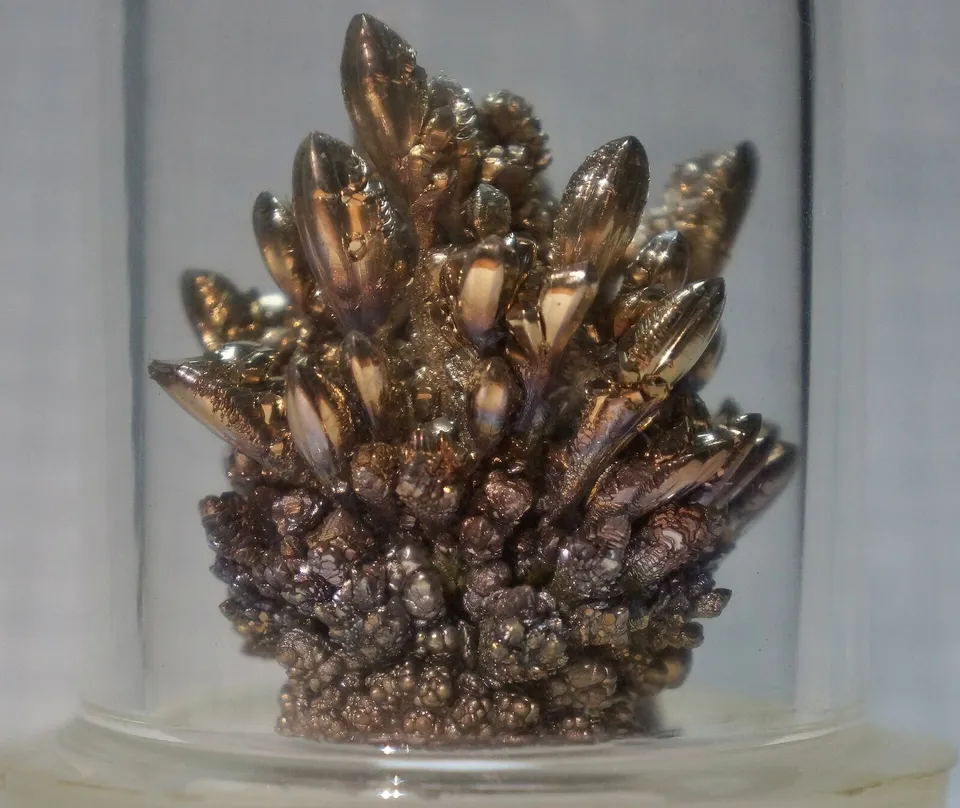

Specimen
- Atomic number
- 38
- Atomic mass
- 87.62
- State at room temperature
- Solid
- Melting point
- 776.9 °C
- Boiling point
- 1,382 °C
- Density
- 2.64 g/cm³
- Discovered
- 1790
Can I eat it?
- In food and water
- Harmful. Food and water contain stable strontium. ATSDR says low levels have not been shown to harm adults. High levels can slow bone growth in children. The US EPA limits strontium in drinking water to 4 mg per liter. 8
Learn about strontium
- 01 How much there is And how much of that can we reach? By a USGS estimate, strontium is the 17th most common element in the Earth's continental crust. The USGS calls world reserves of celestite large. Most producers need ore with at least 90% strontium sulfate to make a profit. Read →
- 02 Where it is found What is it found in, and where on Earth? Two minerals hold enough strontium to mine: celestite, a strontium sulfate, and strontianite, a strontium carbonate. Celestite is the one mined today, from sedimentary deposits in Iran, Spain, China and Mexico. Read →
- 03 How we get it How much do we make each year, and how? Mines produced about 450,000 tonnes of celestite in 2025, by a USGS estimate. That is about 197,000 tonnes of strontium. Iran mined more than half of it. The USGS reports no recycling. Read →
- 04 What we use it for Where does it go, and why this element? In the United States in 2025, about 65% of strontium went into drilling mud, as ground celestite. Ceramic magnets and fireworks and flares took 14% each. Until about 2006 the main use was the glass of television picture tubes. Read →
- 05 What it costs What does it cost, and how is it bought and sold? Strontium has no exchange price. The best public figure is the value of US imports: about $1.67 per kg of contained strontium in 2022. Most strontium is sold as celestite or as strontium carbonate. Read →
- 06 Who controls it Who controls the supply, and who depends on it? Four countries mine almost all celestite, and Iran mined more than half of it in 2025, by USGS estimates. The United States imports all its strontium. The EU gets 99.7% of its supply from Spain and lists strontium as critical. Read →
- 07 Social and political problems What problems does it cause between people, and who carries them? The best documented social case is the strontianite rush in Germany's Münsterland in the 1870s and 1880s. The number of miners rose to more than 2,200, then most lost their jobs when cheaper celestite took over. For today's celestite mines we found little public record. Read →
- 08 History How did our relationship with it begin and change? Strontium is named after Strontian, a village in Scotland, where a new mineral came from a lead mine in the 1780s. Humphry Davy isolated the metal in 1808. Its main use moved from sugar refining to television glass, and then to drilling mud, magnets and fireworks. Read →
Worth knowing
-
The name comes from Strontian, a village in the Scottish Highlands, where the first samples of the mineral came from a lead mine. 11
History → -
Strontium nitrate gives the bright red color of fireworks and signal flares. 2
What we use it for → -
Color television picture tubes had about 8% strontium oxide in the front glass, to block X-rays. 12
What we use it for → -
In the Baby Tooth Survey of St. Louis, children born in 1958 had more than 30 times more strontium-90 in their teeth than children born in 1947. 13
-
For a short time in the late 19th century, more than 700 strontianite mines were in operation in the Münsterland in Germany. People at the time compared the rush with the California gold rush. 14
History → -
In 2025 a strontium optical lattice clock went on sale in Japan for $3.3 million. 2
What we use it for →
The atom
Electrons
| Shell | Electrons |
|---|---|
| 1 (K) | 2 |
| 2 (L) | 8 |
| 3 (M) | 18 |
| 4 (N) | 8 |
| 5 (O) outermost | 2 |
| Total | 38 |
Configuration [Kr] 5s²
5s ↑ ↓
Nucleus
| Protons | 38 |
|---|---|
| Neutrons | 50 |
| Mass number | 88 |
Related elements
New articles by e-mail
Sources
- 1
U.S. Geological Survey (Joyce A. Ober), 2024. Strontium, in Minerals Yearbook 2019 .
Geology, ore processing, uses, the 2018 US critical minerals list, US tariffs and antidumping duties, world production by country 2015 to 2019.
-
For ore processing, hand sorting and some washing were all that was necessary at many strontium mines
-
- 2
U.S. Geological Survey (Ashley K. Hatfield), 2026. Strontium, in Mineral Commodity Summaries 2026 .
World production and reserves, US uses, imports, unit values, tariffs, substitutes and events of 2025.
-
Mine productione 2024 2025 — — 700 700 80,000 80,000 200,000 250,000 8 19,000 20,000 100,000 100,000 400,000 450,000
-
Recycling: None.
-
Strontium nitrate, the second most traded strontium compound, contributes a brilliant red color to fireworks and signal flares
-
a strontium optical lattice clock went on sale for $3.3 million in Japan
-
- 3
U.S. Geological Survey (D.A. Buckingham, J.A. Ober, D.E. Polyak, M.A. Angulo, S.A. Singerling and A.K. Hatfield), 2023. Strontium statistics, in Historical statistics for mineral and material commodities in the United States (Data Series 140) .
US imports, apparent consumption and unit values from 1900, world celestite production from 1951.
-
2022 0 0 13100 15 NA 13000 1670 930 514000
-
- 4
Theodore Gray, periodictable.com (Wolfram ElementData), 2026. Technical data for Strontium .
Abundance in the crust, the universe and the human body.
-
% in Earth's Crust 0.036%
-
- 5
UK Critical Minerals Intelligence Centre, British Geological Survey, 2024. UK 2024 Criticality Assessment , Criticality results table; recycling rates table; Appendix 6 (end uses and recycling).
UK criticality scores and recycling rates for strontium.
-
Natural Graphite 16 Strontium (Sr) 2 Chromium (Cr) 77
-
- 6
IUPAC Commission on Isotopic Abundances and Atomic Weights (CIAAW), 2024. Abridged Standard Atomic Weights 2024 .
The atomic mass shown for the 84 elements that have a standard atomic weight.
- 7
National Center for Biotechnology Information (PubChem), 2026. Periodic Table of Elements .
Electron configuration, melting and boiling points, density and discovery year for all 118 elements.
- 8
Agency for Toxic Substances and Disease Registry (ATSDR), 2004. ToxFAQs for Strontium .
-
Exposure to low levels of stable strontium has not been shown to affect adult health ... In children, high levels of stable strontium can impair bone growth ... EPA has set a limit of 4000 micrograms strontium per liter of drinking water
-
- 9
International Labour Organization and World Health Organization (International Chemical Safety Cards), 2021. ICSC 1534 - Strontium , Acute hazards; Exposure and health effects; Notes.
-
Not combustible but forms flammable gas on contact with water or damp air.
-
Reacts with water. This produces flammable/explosive gas (hydrogen
-
- 10
National Center for Biotechnology Information (PubChem), with notifications from the ECHA C&L Inventory, 2026. Strontium (CID 5359327), GHS classification , Safety and Hazards, GHS Classification.
-
H314 (52.3%): Causes severe skin burns and eye damage
-
- 11
Royal Society of Chemistry, 2026. Strontium - Element information, properties and uses .
Discovery, uses, strontium-90 and the biological role.
-
In 1787, an unusual rock which had been found in a lead mine at Strontian, Scotland
-
- 12
U.S. Geological Survey (Joyce A. Ober), 2007. Strontium, in Minerals Yearbook 2006 .
The end of US strontium carbonate production and of US television glass, strontium oxide in picture tubes, the stockpile and unit values.
-
about 8% strontium oxide in their glass faceplate material
-
- 13
Weisskopf Lab, Harvard T.H. Chan School of Public Health, 2025. St. Louis Baby Tooth - Later Life Health Study: Overview .
The Baby Tooth Survey of 1958 to 1970 and its strontium-90 results.
-
children born in 1958 had levels of strontium 90 – a radioactive by-product of bomb fallout – more than 30 times higher than children born in 1947
-
- 14
Martin Gesing (Der Anschnitt 48, 1996, no. 4), 1996. Strontianitbergbau im Münsterland .
In German. Strontianite mining for the sugar industry in Westphalia, 1871 to 1945, with its miners, accidents and conflicts with landowners.
-
Goldrausches in Kalifornien verglichen ... mehr als 700 Strontianitbergwerke in Betrieb
-
- 15
National Institute of Standards and Technology (NIST), 2026. Atomic Weights and Isotopic Compositions for All Elements .
Isotopic composition of each element; the most abundant isotope sets the neutron count in the nucleus view.