Last updated 14 October 2026.
Radium
Element 88 · Alkaline earth metal · Made in reactors or accelerators1
Radium is a radioactive metal that Marie and Pierre Curie found in uranium ore in 1898. In 1921, one gram took 500 tons of ore. Radium went into cancer treatment, glowing paint and quack medicines, and it killed many of the women who painted watch dials. Today the radium in use comes mostly from old stocks. Old medical sources are collected and recycled to make new cancer drugs, such as radium-223.
How radium compares
Produced each year ~ Below 0.0001 tonnes a year 2 The source gives no year Not on the scale: the source gives only an upper limit. How we get it →
The scales are log scales, except for the shares, which go from 0 to 100%.
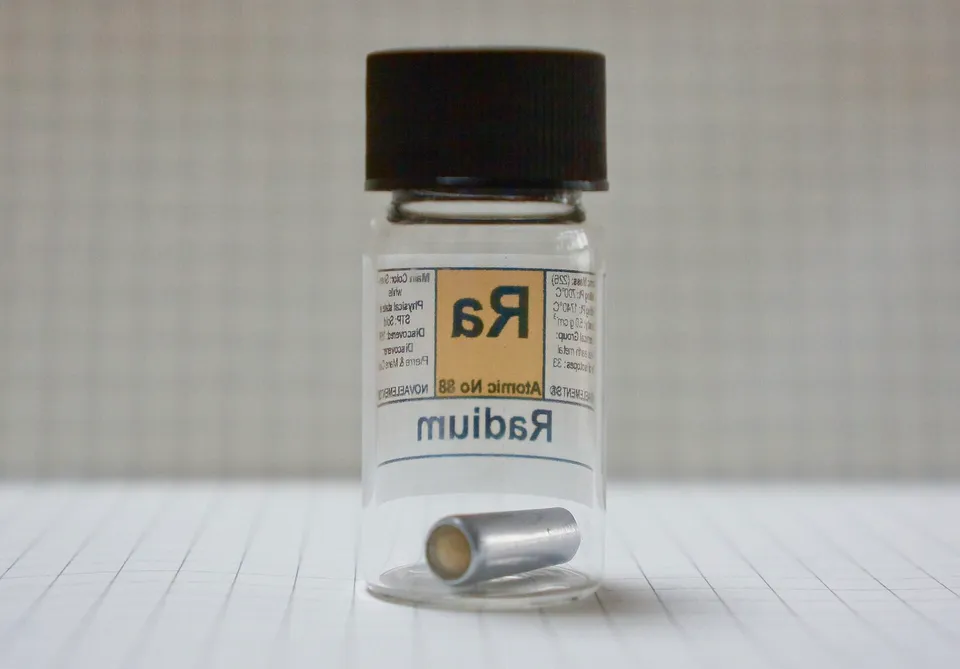

Specimen
- Atomic number
- 88
- Atomic mass
- [226]
- State at room temperature
- Solid
- Melting point
- 699.9 °C
- Boiling point
- 1,140 °C
- Density
- 5 g/cm³
- Discovered
- 1898
Can I eat it?
- In food and water
- Radioactive. Food and water contain low levels of radium, and some well water contains more. High exposure causes bone, liver and breast cancer. The US EPA sets a limit for radium in drinking water. 7
- As the pure element
- Radioactive. Radium is a soft, silvery, radioactive metal. The Royal Society of Chemistry says it is toxic because of its radiation. 8
Learn about radium
- 01 How much there is And how much of that can we reach? Very little. Radium forms all the time when uranium and thorium decay. But uranium ore holds only about one part of radium in 3 million parts of uranium. No agency reports reserves of radium. Read →
- 02 Where it is found What is it found in, and where on Earth? Radium forms no ore of its own. It occurs in every uranium ore, because uranium decays to radium. The radium of the past came from pitchblende in Bohemia, the Congo and Canada, and from carnotite in Colorado and Utah. Read →
- 03 How we get it How much do we make each year, and how? Very little, and mostly from old stocks. The Royal Society of Chemistry gives fewer than 100 grams a year, with no year and no source. We found no agency that counts it. Old radium-226 is recycled in reactors to make actinium, which decays to radium-223 for a cancer drug. Read →
- 04 What we use it for Where does it go, and why this element? Today radium-223 treats prostate cancer that has spread to the bones, and old radium-226 is a raw material for other medical isotopes. In the past, radium treated cancer and made watch dials glow. Read →
- 05 What it costs What does it cost, and how is it bought and sold? Radium has no public price today. The US Department of Energy sells radium-226 by the millicurie, at a price it gives on request. In 1913 a gram sold for $120,000. By 1936 it cost $33,000. Read →
- 06 Who controls it Who controls the supply, and who depends on it? Few organizations supply radium today. Bayer in Norway makes the radium-223 for the drug Xofigo from actinium that Oak Ridge National Laboratory sends from the United States. Radium-226 comes from old stocks. No government lists radium as a critical raw material. Read →
- 07 Social and political problems What problems does it cause between people, and who carries them? The best-known case is the radium dial painters of New Jersey. They swallowed radium paint at work, and many became ill with jaw necrosis and anemia. Most got no compensation. Radium and uranium refining left waste in Port Hope, Canada, and Jáchymov, Czech Republic. Read →
- 08 History How did our relationship with it begin and change? Pierre and Marie Curie announced radium on 26 December 1898. For much of the 20th century it was used to treat cancer, until cobalt-60 and other sources largely replaced it. Read →
Worth knowing
-
The curie, a unit of radioactivity, is the decay rate of one gram of radium-226. 3
History → -
To make the gram of radium that American women gave Marie Curie in 1921, Standard Chemical Company processed 500 tons of ore over six months. 9
How we get it → -
Dial painters took in radium when they shaped their brushes to a point with their lips. 10
Social and political problems → -
Over 400,000 bottles of Radithor, a radium water, were sold at one dollar each, according to Roger Macklis, as cited by the ORAU museum. 11
What it costs → -
Radium-226 from old medical devices is now collected and irradiated to make actinium-227, the source of the radium-223 in a prostate cancer drug. 1
What we use it for → -
In Jáchymov, Czech Republic, some houses have plaster made with residues from uranium processing. The ORAU museum, citing a 1993 study, writes that the radium in the walls is too high for people to be allowed to live there. 12
Social and political problems →
The atom
Electrons
| Shell | Electrons |
|---|---|
| 1 (K) | 2 |
| 2 (L) | 8 |
| 3 (M) | 18 |
| 4 (N) | 32 |
| 5 (O) | 18 |
| 6 (P) | 8 |
| 7 (Q) outermost | 2 |
| Total | 88 |
Configuration [Rn] 7s²
7s ↑ ↓
Nucleus
| Protons | 88 |
|---|---|
| Neutrons | 138 |
| Mass number | 226 |
Related elements
New articles by e-mail
Sources
- 1
Oak Ridge National Laboratory, 2018. ORNL ramps up production of key radioisotope for cancer-fighting drug .
Radium-226 from old medical devices, irradiated to make actinium-227 for Bayer, which extracts radium-223 in Norway. Read with Firecrawl.
-
Bayer’s team periodically extracts the Ra-223 that grows into the ORNL-supplied Ac-227, via radioactive decay process
-
The new production process for Ac-227 begins with recovering radium-226 (Ra-226) from legacy medical devices
-
- 2
Royal Society of Chemistry, 2025. Radium, in the Periodic Table .
Crustal abundance, production of fewer than 100 grams a year, uses, history and the podcast by Brian Clegg.
-
Annual production of this element is fewer than 100 grams per year.
-
Crustal abundance (ppm) 0.0000009
-
- 3
Argonne National Laboratory, EVS, 2005. Radium, Human Health Fact Sheet , Radium fact sheet (August 2005), in the collected Argonne fact sheets.
Abundance, radium in uranium ore, uses, the environment, the body and health effects.
-
occurs naturally in very low concentrations (about one part per trillion) in the earth’s crust
-
One curie of activity equals the rate of radioactive decay of one gram (g) of radium-226.
-
- 4
Theodore Gray, periodictable.com (Wolfram ElementData), 2025. Technical data for Radium .
Concentration in the crust, the oceans and the human body.
-
% in Earth's Crust 1×10⁻¹¹%
-
- 5
IUPAC Commission on Isotopic Abundances and Atomic Weights (CIAAW), 2024. Radioactive Elements .
Mass number and half-life of the longest-lived isotope of the 34 elements with no standard atomic weight.
- 6
National Center for Biotechnology Information (PubChem), 2026. Periodic Table of Elements .
Electron configuration, melting and boiling points, density and discovery year for all 118 elements.
- 7
Agency for Toxic Substances and Disease Registry (ATSDR), 1990. Radium | ToxFAQs .
-
Everyone is exposed to low levels of radium in the air, water, and food. ... It may be found at higher levels in drinking water from wells.
-
Exposure to high levels of radium results in an increased incidence of bone, liver, and breast cancer.
-
The EPA has set a drinking water limit of 5 picocuries per liter (5 pCi/L) for radium-226 and radium-228 (combined).
-
- 8
Royal Society of Chemistry, Periodic Table, 2026. Radium - Element information, properties and uses .
Reference page; its Appearance, Biological role and Natural abundance sections are quoted.
-
A soft, shiny and silvery radioactive metal.
-
Radium has no known biological role. It is toxic due to its radioactivity.
-
- 9
Sam Kean, Science History Institute (Distillations), 2019. Marie Curie, Marie Meloney, and the Significance of a Gram of Radium .
The price of radium in 1920, the fund of 1921 and the work at Standard Chemical Company to make one gram.
-
Scientists there spent six months on the job, using industrial-scale processes to whittle down 500 tons of ore into a gram of silvery grey powder.
-
- 10
Zachary Dabbs, U.S. National Archives (The Text Message blog), 2018. The Radium Girls at the National Archives .
The Orange plant, lip pointing, the illnesses, the lawsuits, the 1928 settlement, the LaPorte ruling and the Superfund cleanup.
-
To keep a fine point on the brush the painters used a technique known as lip pointing, placing the brush between their lips
-
- 11
Paul Frame, ORAU Museum of Radiation and Radioactivity, 2025. Radithor (ca. 1928) .
Radithor, its radium content and sales, the death of Eben Byers and the order of the Federal Trade Commission.
-
Over 400,000 bottles were sold at one dollar each and a profit margin of approximately 400%.
-
- 12
ORAU Museum of Radiation and Radioactivity, 2025. Jáchymov: Cradle of the Atomic Age .
Jáchymov as a source of radium ore, the price of over $100,000 per gram, and houses with radium in the plaster.
-
The homes’ builders had incorporated residues from the uranium extraction process into the plaster walls. The radium content of these walls often ranges from 400 to 3400 pCi g&1 (Thomas 1993), too high to permit occupancy.
-