Last updated 10 October 2026.
Calcium
Element 20 · Alkaline earth metal · Mined for itself1
Calcium is in limestone and in the lime, cement and plaster that people make from limestone and gypsum. People have burned limestone to make lime for thousands of years. By mass, cement is the largest use of calcium. In 2025, the world made about 3.8 billion tonnes of cement and 420 million tonnes of lime. Making cement releases carbon dioxide from the limestone itself. With fuel and power, the cement industry may cause up to 8% of world carbon dioxide emissions.
How calcium compares
Unit value $260 per tonne of quicklime 2 Not on the scale: this is the price of quicklime, not of calcium. What it costs →
The scales are log scales, except for the shares, which go from 0 to 100%.
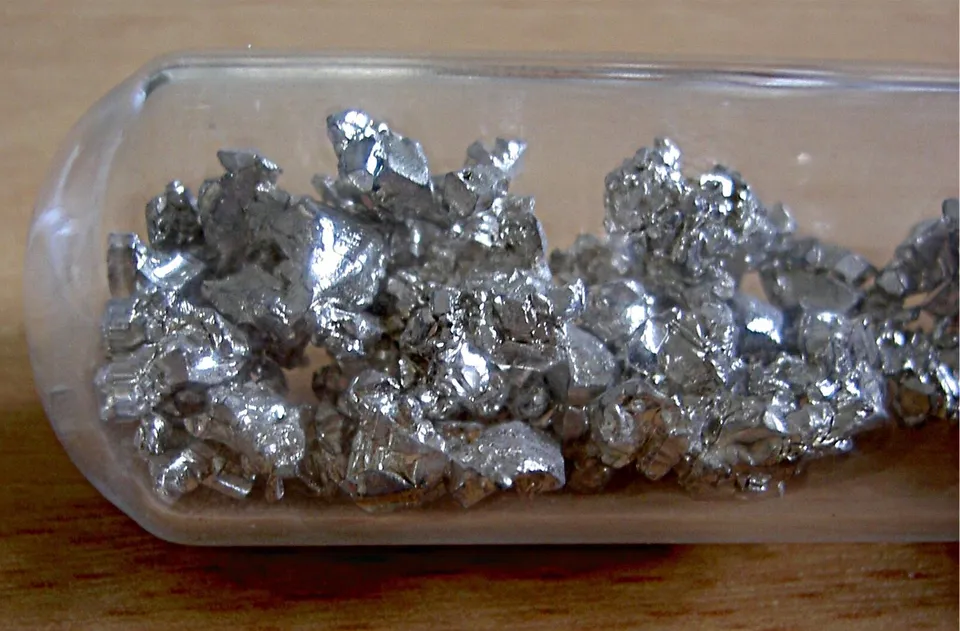

Specimen
- Atomic number
- 20
- Atomic mass
- 40.078
- State at room temperature
- Solid
- Melting point
- 841.9 °C
- Boiling point
- 1,484 °C
- Density
- 1.54 g/cm³
- Discovered
- Ancient
Can I eat it?
- In food and water
- Your body needs it. Calcium is a nutrient. About 99% of the calcium in the body is in bones and teeth. When the diet has too little calcium, the body takes it from bone. 6
- As the pure element
- Reacts violently or burns tissue. Calcium metal reacts with water and makes hydrogen and calcium hydroxide, an alkali (pH 12.4). The ICSC calls calcium powder corrosive to eyes, skin and airways, and lists burning and vomiting if swallowed. A Japanese government GHS class calls the metal corrosive to skin and eyes for the same reason. 78
Learn about calcium
- 01 How much there is And how much of that can we reach? There is very much. Calcium is about 4 to 5% of the Earth's crust, mostly in limestone. USGS calls the world's resources of limestone for lime "very large" and gives no number. Cost, distance and local rules limit supply, not the amount in the ground. Read →
- 02 Where it is found What is it found in, and where on Earth? Most calcium that people use comes from limestone, a rock made mostly of the shells and skeletons of sea life. Gypsum, from evaporated sea and lake water, is another source. Limestone occurs in most countries, and gypsum is mined in many. Read →
- 03 How we get it How much do we make each year, and how? In 2025, the world made about 420 million tonnes of lime and 3.8 billion tonnes of cement. By our estimates, the lime holds up to 300 million tonnes of calcium and the cement about four times as much. Cement is not recycled. Read →
- 04 What we use it for Where does it go, and why this element? Most calcium goes into buildings, as cement, concrete, lime and plaster. Lime also cleans steel, flue gas and water. In the United States in 2023, steelmaking took about 39% of lime. Very little calcium is used as a metal. Read →
- 05 What it costs What does it cost, and how is it bought and sold? Calcium products are cheap. In the United States in 2025, quicklime cost about $260 a tonne at the plant and cement about $160. The US value of quicklime almost doubled from 2021 to 2024. Lime is heavy and low in value, so most of it is sold near where it is made. Read →
- 06 Who controls it Who controls the supply, and who depends on it? China made about 74% of the world's lime and 45% of its cement in 2025. But limestone occurs in most countries, and most lime is used close to where it is made. No government list of critical materials in the EU, the United States or the United Kingdom includes calcium. Read →
- 07 Social and political problems What problems does it cause between people, and who carries them? The largest disputes are about cement companies. Lafarge paid armed groups, including ISIS, to keep a cement plant in Syria open. It pleaded guilty in the United States in 2022, and a French court convicted it in 2026. India fined 11 cement makers for a price cartel in 2012. Read →
- 08 History How did our relationship with it begin and change? People used lime plaster about 9,000 years ago, long before anyone knew of calcium. Humphry Davy isolated the metal in 1808 and named it after the Latin word for lime. Portland cement, patented in 1824, is now the largest use of calcium. Read →
Worth knowing
-
People have made lime in kilns for at least 4,500 years. The oldest dated lime kiln is from about 2500 BC, in Mesopotamia. 9
History → -
In 2008, the world made about 307 million t of quicklime. Output of calcium metal at about that time was about 32,000 t a year. 10
How we get it → -
World cement production grew more than 30-fold from 1950 to 2018. 74% of the growth since 1990 was in China. 11
How we get it → -
Burning limestone for cement releases carbon dioxide from the rock itself, before any fuel is counted. In 2018 this was about 4% of the carbon dioxide from fossil fuels. 11
How we get it → -
USGS states that gypsum has no practical substitute in the manufacture of Portland cement. 12
What we use it for → -
The average person holds about 1 kg of calcium. Calcium phosphate is the main component of bone. 13
How much there is → -
The US Justice Department says that Lafarge and its Syrian subsidiary paid ISIS and al-Nusrah Front about $5.92 million from August 2013 to October 2014. 14
Social and political problems →
The atom
Electrons
| Shell | Electrons |
|---|---|
| 1 (K) | 2 |
| 2 (L) | 8 |
| 3 (M) | 8 |
| 4 (N) outermost | 2 |
| Total | 20 |
Configuration [Ar] 4s²
4s ↑ ↓
Nucleus
| Protons | 20 |
|---|---|
| Neutrons | 20 |
| Mass number | 40 |
Related elements
New articles by e-mail
Sources
- 1
Minor Metals Trade Association, 2016. Calcium (Ca) .
Producers of calcium metal by country and process.
-
its ores are abundant and the major mined ores are calcite, dolomite, gypsum and anhydrite
-
- 2
U.S. Geological Survey (JohnRyan MacGregor), 2026. Lime, in Mineral Commodity Summaries 2026 , Pp. 1-2: production and use, salient statistics, recycling, world lime production and limestone reserves, resources, substitutes.
World and US lime production, US companies, plants, uses, prices and trade, reserves, resources and substitutes for 2025.
-
World total (rounded) ... 421,000 420,000
-
Price, average value, dollars per metric ton at plant: ... 261.4 274.2 <1 260 280
-
World Lime Production and Limestone Reserves ... 310,000 310,000 ... 17,000 17,000 ... 15,000 15,000 ... 11,800 12,000 ... 421,000 420,000
-
- 3
Theodore Gray, periodictable.com (data from Wolfram ElementData), 2026. Technical data for Calcium (from Wolfram ElementData) , Abundances.
Abundance in the universe, crust and human body, as mass fractions. Its value for the oceans is not used.
-
% in Earth's Crust 5%
-
- 4
IUPAC Commission on Isotopic Abundances and Atomic Weights (CIAAW), 2024. Abridged Standard Atomic Weights 2024 .
The atomic mass shown for the 84 elements that have a standard atomic weight.
- 5
National Center for Biotechnology Information (PubChem), 2026. Periodic Table of Elements .
Electron configuration, melting and boiling points, density and discovery year for all 118 elements.
- 6
European Food Safety Authority (EFSA), 2017. Dietary Reference Values for nutrients. Summary report (amended 2019) .
Summaries of the EFSA NDA Panel opinions on each vitamin and mineral, section 4 (minerals) and section 5 (cobalamin).
-
approximately 99% of total body calcium is found in bones and teeth
-
If the dietary supply of calcium is insufficient to meet physiological requirements, calcium is resorbed from the skeleton
-
- 7
International Labour Organization and World Health Organization (International Chemical Safety Cards), 2019. ICSC 1192 - Calcium powder (pyrophoric) , Symptoms (Ingestion); Chemical dangers; Effects of short-term exposure.
-
Reacts with moisture, water, alcohols, halogens and many other substances. This produces flammable/explosive gas (hydrogen - see ICSC 0001). ... The substance is corrosive to the eyes, skin and respiratory tract.
-
Ingestion Burning sensation. Abdominal pain. Abdominal cramps. Vomiting.
-
- 8
National Institute of Technology and Evaluation (NITE), Japan, for the Ministry of Health, Labour and Welfare, 2008. GHS classification result, calcium (FY2008) , Health hazards, Skin corrosion/irritation.
-
metallic calcium in contact with water reacts with water to produce Ca(OH)2 (pH = 12.4 (saturated water solution at 25degC)), which causes inflammation of the skin and eyes
-
- 9
Wikipedia contributors, 2026. Calcium , Sections History, Occurrence and production, Applications.
Early uses of lime and gypsum, producers of calcium metal, uses of the metal.
-
The first dated lime kiln dates back to 2500 BC and was found in Khafajah , Mesopotamia
-
- 10
P. Nuss and M.J. Eckelman (PLOS ONE), 2014. Life Cycle Assessment of Metals: A Scientific Synthesis , S1, section on calcium (Z=20), Table S5 and Table S38.
World production of quicklime and calcium metal in 2008, calcium metal by country in 2005, and cradle-to-gate energy and greenhouse gas values for calcium metal.
-
In 2008, global production of quicklime equaled 307 ... This compares to roughly 32,000 metric tons of calcium metal produced annually (0.01%)
-
- 11
Robbie M. Andrew, Earth System Science Data 11, 1675-1710, 2019. Global CO2 emissions from cement production, 1928-2018 , Abstract; section 1 (introduction); section 2 (CaO content of cement); section on China.
Cement process emissions, growth of cement production, China's share, the chemistry of calcination and the CaO content of cement.
-
Global cement production has increased more than 30-fold since 1950 ... 74 % of global growth in cement production since 1990 occurred in China
-
Global process emissions in 2018 were 1.50 ± 0.12 Gt CO2 , equivalent to about 4 % of emissions from fossil fuels
-
- 12
U.S. Geological Survey (Rob Crangle), 2026. Gypsum, in Mineral Commodity Summaries 2026 , Pp. 1-2: production and use, salient statistics, recycling, world mine production and reserves, resources, substitutes.
World and US gypsum production, reserves, prices, recycling, synthetic gypsum and substitutes for 2025.
-
Gypsum has no practical substitute in the manufacturing of portland cement
-
- 13
Royal Society of Chemistry, 2026. Calcium - Element information, properties and uses , Sections History, Uses and properties, Biological role, Natural abundance.
Discovery, name, uses, calcium in the body, crust abundance and minerals.
-
Calcium phosphate is the main component of bone. The average human contains about 1 kilogram of calcium
-
- 14
U.S. Department of Justice, Office of Public Affairs (18 October 2022), 2022. Lafarge Pleads Guilty to Conspiring to Provide Material Support to Foreign Terrorist Organizations .
The US guilty plea of Lafarge and its Syrian subsidiary, the payments to ISIS and al-Nusrah Front, and the $778 million in fines and forfeiture. Read with Firecrawl; the site gave a script an empty page.
-
From August 2013 through October 2014, Lafarge and LCS paid ISIS and ANF, through intermediaries, the equivalent of approximately $5.92 million
-
- 15
National Institute of Standards and Technology (NIST), 2026. Atomic Weights and Isotopic Compositions for All Elements .
Isotopic composition of each element; the most abundant isotope sets the neutron count in the nucleus view.