Last updated 11 November 2026.
Terbium
Element 65 · Lanthanide · Mined for itself1
Terbium is one of the scarcer rare earths, at about 1 part per million of the crust. In 2008, most of it went into the green light of fluorescent lamps and TV screens. Now magnet makers add small amounts to neodymium magnets so that they keep their strength when hot, in electric car motors and wind turbines. The world used about 600 tonnes in 2024. Terbium oxide sold for about $1,010 per kilogram in 2025, free on board. Buyers outside China paid $5,000 to $8,000 per kilogram in October 2026. China separates almost all of it, and it put terbium under export controls in April 2025.
How terbium compares
Price ~ $1,010 per kg of terbium oxide, at least 99.99% pure 2 Not on the scale: this is the price of terbium oxide, at least 99.99% pure, not of terbium. What it costs →
The scales are log scales, except for the shares, which go from 0 to 100%.
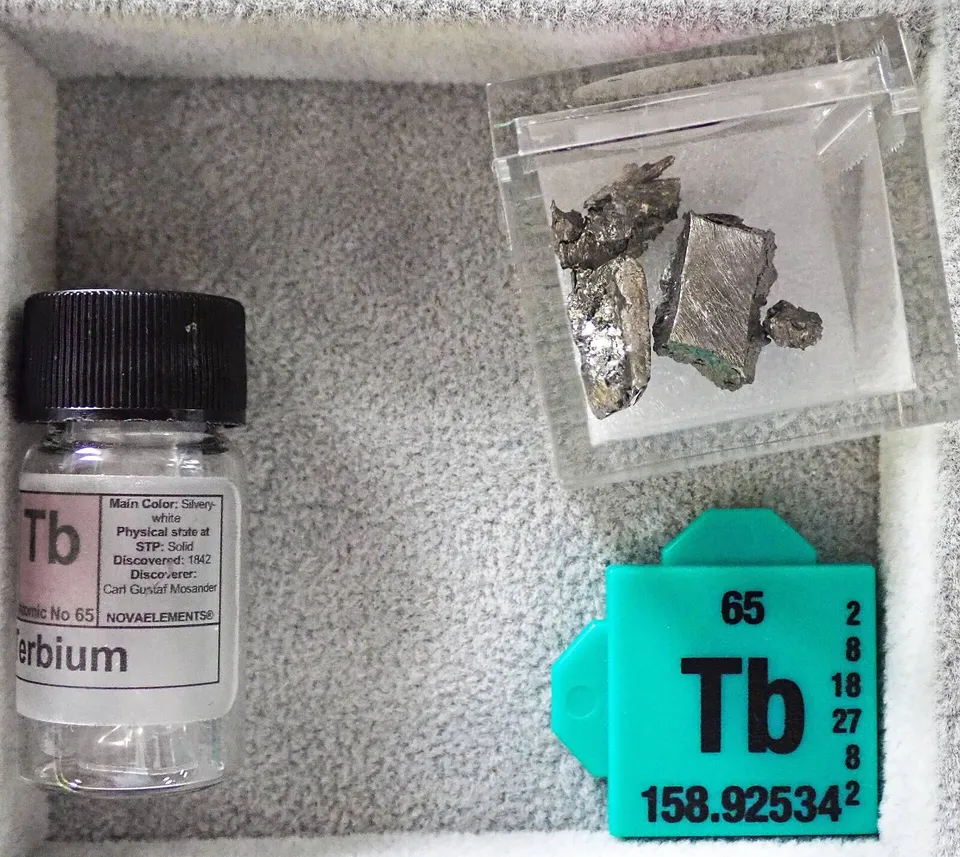

Specimen
- Atomic number
- 65
- Atomic mass
- 158.93
- State at room temperature
- Solid
- Melting point
- 1,356 °C
- Boiling point
- 3,230 °C
- Density
- 8.23 g/cm³
- Discovered
- 1843
Can I eat it?
- In food and water
- Not needed, little studied. Terbium has no known function in the body. In one animal test, 5.1 g of terbium chloride per kg of body weight killed half the animals. TERA found only a few animal studies per lanthanide, and too little human data to set a safe daily dose. 910
- As the pure element
- Little studied. Terbium is a silvery metal. Ames Laboratory does not class the metal as hazardous, but has no data on how toxic it is. Ames says the toxic properties of the metal are not fully known. 11
Learn about terbium
- 01 How much there is And how much of that can we reach? Terbium makes up about 1 part per million of the crust by mass, one of the lowest values among the rare earths. USGS gives no reserve for terbium alone. Ores rich in heavy rare earths are few, and China did all of the world's processing of terbium in 2016 to 2020, by EU estimate. Read →
- 02 Where it is found What is it found in, and where on Earth? Terbium occurs with the other rare earths, mainly in xenotime, monazite, bastnaesite and ion-adsorption clays. It is about 0.1% of the rare earths at the big bastnaesite mines, and about 1% in some xenotime and clays. Clays in southern China and Myanmar are the main source. Read →
- 03 How we get it How much do we make each year, and how? We found no world production figure for terbium alone. The IEA puts world demand at about 600 tonnes in 2024. China separates almost all of it. In June 2025, Lynas made its first separated terbium oxide, in Malaysia. Almost none is recycled. Read →
- 04 What we use it for Where does it go, and why this element? Terbium went mostly into green phosphors for lamps and screens: 89% of world use in 2008. By IEA figures, magnets took at least 55% of terbium demand in 2024. Small additions keep neodymium magnets strong when hot, as in electric car motors. Dysprosium can replace it in magnets. Read →
- 05 What it costs What does it cost, and how is it bought and sold? Terbium oxide sold for about $1,010 per kilogram in 2025, free on board. From 2021 to 2025, the yearly average was between $812 and $2,050. Outside China, it cost $5,000 to $8,000 per kilogram in October 2026. There is no exchange price; prices are agreed in private deals. Read →
- 06 Who controls it Who controls the supply, and who depends on it? China did all of the world's processing of terbium in 2016 to 2020, by EU estimate. Myanmar mined about 45% of the heavy rare earths in 2024. The EU, the United States and the UK all list terbium as critical. In April 2025, China put export controls on terbium. Read →
- 07 Social and political problems What problems does it cause between people, and who carries them? Much terbium ore comes from Kachin State in Myanmar, where an armed group took a major rare earth mining town in 2024. China separates almost all of it. We found no dispute about terbium alone; the general issues of rare earth mining are on the rare earths page. Read →
- 08 History How did our relationship with it begin and change? Carl Gustaf Mosander found terbium in 1843, in yttria from a mineral of Ytterby, Sweden. Later, the names of terbium and erbium switched. Pure compounds came only in 1905. Terbium was then used in green phosphors, in the alloy Terfenol-D, and now mainly in magnets. Read →
Terbium is one of the rare earth elements. How they are mined, separated, sold and controlled →
Worth knowing
-
Terbium and erbium swapped names. Mosander called a rose-colored salt terbium in 1843. In 1862 Marc Delafontaine gave the name to a yellow oxide, and the rose one became erbium. 12
History → -
Terbium is one of four elements named after Ytterby, a village in Sweden. Yttrium, erbium and ytterbium are the others. 13
History → -
Magnet makers use terbium in very small amounts. But the IEA says it makes up about 10% of the value of a permanent magnet, because its price is over ten times that of neodymium-praseodymium. 14
What it costs → -
Terfenol-D, an alloy of terbium, iron and dysprosium, changes shape in a magnetic field. A speaker made with it, the SoundBug, turns a table or a window into a loudspeaker. 13
What we use it for → -
Some terbium compounds give off green light when their crystals break. Chemist Louise Natrajan says this has been proposed to monitor stress in aircraft wings. 13
What we use it for → -
From 2021 to 2024, all terbium compounds and metals that the United States imported came from China, by USGS estimate from shipping records. 2
Who controls it →
The atom
Electrons
| Shell | Electrons |
|---|---|
| 1 (K) | 2 |
| 2 (L) | 8 |
| 3 (M) | 18 |
| 4 (N) | 27 |
| 5 (O) | 8 |
| 6 (P) outermost | 2 |
| Total | 65 |
Configuration [Xe] 4f⁹ 6s²
4f ↑ ↓ ↑ ↓ ↑ ↑ ↑ ↑ ↑
6s ↑ ↓
Nucleus
| Protons | 65 |
|---|---|
| Neutrons | 94 |
| Mass number | 159 |
Related elements
New articles by e-mail
Sources
- 1
U.S. Geological Survey (Bradley S. Van Gosen, Philip L. Verplanck, Robert R. Seal II, Keith R. Long and Joseph Gambogi), 2017. Rare-earth elements, chapter O of Critical mineral resources of the United States (Professional Paper 1802-O) , Table O1 (crustal abundance); Uses and applications; Recycling.
Crustal abundance of terbium after Lide (2004), terbium in phosphors, and Rhodia's plan to use less terbium in phosphors.
-
REE-bearing ion-adsorption clays are mined in various locations in the southeastern Provinces. In contrast to bastnaesite ores, ion-adsorption clays are valued for their medium REE and HREE content.
-
- 2
U.S. Geological Survey (Shelby N. Johnston), 2026. Rare earths (heavy), in Mineral Commodity Summaries 2026 , Pp. 1-2: domestic production and use, salient statistics (prices), recycling, import sources, events, world resources, substitutes.
Terbium oxide prices from 2021 to 2025, US import sources of terbium, China's export controls of 2025, and US loans for heavy rare earths.
-
Terbium oxide, 99.99% minimum ... 1,340 ... 2,050 ... 1,300 ... 812 ... 1,010
-
Terbium compounds and metals: China, 100%.
-
- 3
European Commission (M. Grohol and C. Veeh), 2023. Study on the Critical Raw Materials for the EU 2023: Final Report , Table A, major global supplier countries (row 45, terbium); list of heavy rare earths.
China's share of world terbium supply at the processing stage, 2016-2020.
-
45 terbium P China 100%
-
- 4
Theodore Gray, periodictable.com (data from Wolfram ElementData), 2026. Technical data for Terbium (from Wolfram ElementData) , Abundances.
Abundance in the universe and the crust, as mass fractions. It gives no value for the human body.
-
% in Earth's Crust 0.000093%
-
- 5
UK Critical Minerals Intelligence Centre, British Geological Survey, 2024. UK 2024 Criticality Assessment , Table 2, candidate materials; Appendix 6, end-of-life recycling rates (REE row and REE table by use).
The UK assessed terbium with the other rare earths as one group, which it found critical, and gives 0% end-of-life recycling for the group.
-
Rare earth elements (REE) 0 Magnesite 52
-
- 6
UNEP International Resource Panel (T.E. Graedel et al.), 2011. Recycling Rates of Metals: A Status Report , Appendix table of OSR, RC and EOL-RR by metal (Tb row); list of uses.
End-of-life recycling rate and recycled content below 1% for terbium.
-
Tb <1 <1
-
- 7
IUPAC Commission on Isotopic Abundances and Atomic Weights (CIAAW), 2024. Abridged Standard Atomic Weights 2024 .
The atomic mass shown for the 84 elements that have a standard atomic weight.
- 8
National Center for Biotechnology Information (PubChem), 2026. Periodic Table of Elements .
Electron configuration, melting and boiling points, density and discovery year for all 118 elements.
- 9
Toxicology Excellence for Risk Assessment (TERA), for the US Bureau of Land Management, 1999. Development of Reference Doses and Reference Concentrations for Lanthanides , Section 2.4 (oral toxicity data in experimental animals).
-
the available human data are not sufficient as a basis for the development of either an RfC or an RfD. Moreover, the available animal toxicity data are limited to only a few studies for each of the several lanthanides
-
5100 mg/kg for terbium chloride
-
- 10
Wenyu Wang, Yanfang Yang, Donglei Wang and Lihua Huang (Toxics 12(5):317), 2024. Toxic Effects of Rare Earth Elements on Human Health: A Review , Section 7, Challenges and Perspectives.
-
the hazards of REEs to human health are still largely unknown
-
- 11
Ames Laboratory, US Department of Energy (Materials Preparation Center), 2016. Safety Data Sheet - Terbium (pieces, ingot, rod, foil, sheet, target) , Sections 2 and 11.
-
Not classified as hazardous
-
Acute and Chronic Effects: No data Acute Toxicity: No data
-
To the best of our knowledge the chemical, physical and toxicological characteristics of the substance are not fully known.
-
- 12
IUPAC Commission on Isotopic Abundances and Atomic Weights (CIAAW), 2026. Atomic Weight of Terbium .
The single natural isotope, and the history of the name, with the switch of the names terbium and erbium.
-
Thus the original names given to erbium and terbium samples are now switched.
-
- 13
Royal Society of Chemistry, 2026. Terbium - Element information, properties and uses , Sections History, Uses and properties, Biological role, Natural abundance; podcast transcript by Louise Natrajan.
Discovery, name, uses, biological role, minerals, separation and metal production.
-
one of the four lanthanide elements that are named after the place of its discovery, Ytterby in Sweden
-
It is used commercially in a speaker called the 'SoundBug', which turns any flat surface into a speaker!
-
has been proposed to be of use in monitoring structural stress in aeroplane wings
-
- 14
International Energy Agency, 2026. Global Critical Minerals Outlook 2026 , Executive summary; Chapter 1, rare earth export controls; Chapter 2, rare earth elements (demand, heavy rare earths in magnets); Chapter 3, value of rare earths in magnets.
Terbium in magnets, its share of magnet value, prices in Europe and China, and the export controls of 2025.
-
the price of terbium is over ten times higher than that of ... neodymium-praseodymium, it is responsible for around 10% of the value of a permanent magnet
-
- 15
National Institute of Standards and Technology (NIST), 2026. Atomic Weights and Isotopic Compositions for All Elements .
Isotopic composition of each element; the most abundant isotope sets the neutron count in the nucleus view.