Last updated 11 November 2026.
Europium
Element 63 · Lanthanide · Mined for itself1
Europium is a soft, silvery rare earth metal named after Europe. Almost all of it has gone into phosphors, which glow red or blue in old color television tubes, fluorescent lamps and some LEDs. It also marks euro banknotes, which glow red under ultraviolet light. Europium is a small part of rare earth ore. Its oxide reached $6,800 per kilogram in July 2011, by an EU count. LED lamps then cut demand. In 2025, USGS gave $27 per kilogram, from another price series.
How europium compares
Price ~ $27 per kg of europium oxide, at least 99.99% pure 1 Not on the scale: this is the price of europium oxide, at least 99.99% pure, not of europium. What it costs →
The scales are log scales, except for the shares, which go from 0 to 100%.
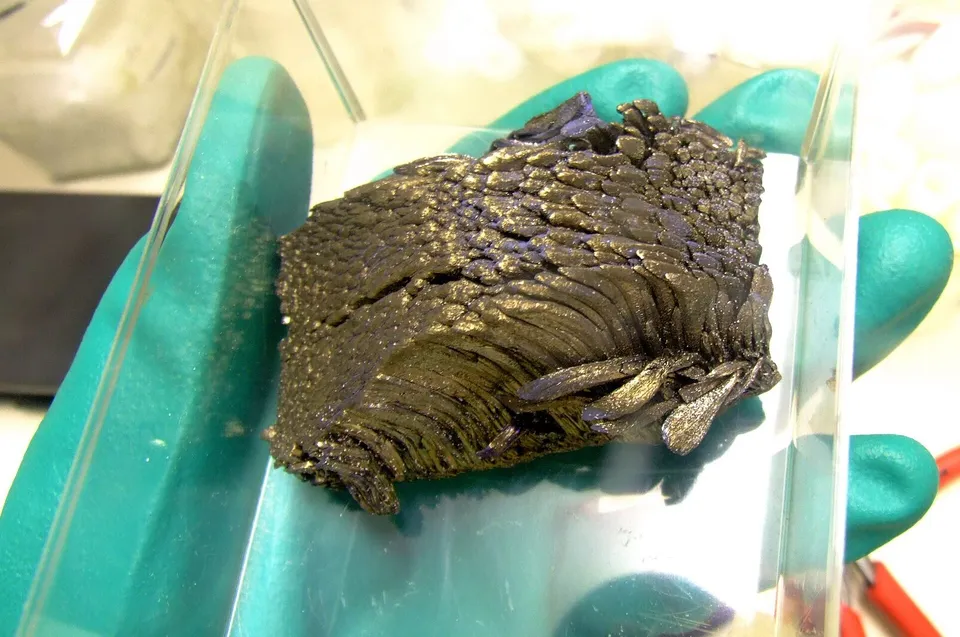

Specimen
- Atomic number
- 63
- Atomic mass
- 151.96
- State at room temperature
- Solid
- Melting point
- 821.9 °C
- Boiling point
- 1,529 °C
- Density
- 5.24 g/cm³
- Discovered
- 1901
Can I eat it?
- In food and water
- Not needed, little studied. Europium has no known function in the body. In a 28-day rat test, europium chloride caused weight loss only in females at the top dose, 415 mg europium per kg a day. TERA found only a few animal studies per lanthanide, and too little human data to set a safe daily dose. 89
- As the pure element
- Reacts violently or burns tissue. A Thermo Fisher safety sheet classes europium metal as catching fire in air by itself. In contact with water, it gives off flammable gas. Fisher has no data on how toxic the metal is. 10
Learn about europium
- 01 How much there is And how much of that can we reach? Europium makes up about 2 parts per million of the crust by mass. It is one of the least common rare earths. USGS gives no reserve for europium alone. Its supply depends on how much rare earth ore the mines treat. Read →
- 02 Where it is found What is it found in, and where on Earth? Europium comes from bastnaesite and monazite, and from ion-adsorption clays in south China. It is a very small part of the rare earths in these ores. Unlike most rare earths, it can take a +2 charge, so it often goes into feldspar and leaves the magma. Read →
- 03 How we get it How much do we make each year, and how? We found no recent world figure for europium alone. The world used about 441 tonnes of europium oxide in 2008. Plants separate europium by turning it into its +2 form. Almost none is recycled; a plant in France recycled lamp phosphors from 2011 until 2016. Read →
- 04 What we use it for Where does it go, and why this element? Almost all europium goes into phosphors, which give red and blue light in fluorescent lamps and old color screens. Small uses include euro banknotes and nuclear control rods. LED lamps need far less of it, so demand has fallen since 2011. Read →
- 05 What it costs What does it cost, and how is it bought and sold? Europium oxide sold for about $27 per kilogram in 2025, free on board. In July 2011, in another price series, it reached $6,800. By an EU account, it was the most expensive rare earth for more than 15 years, until 2014 to 2015. There is no exchange price. Read →
- 06 Who controls it Who controls the supply, and who depends on it? China does all of the world's europium processing, by the EU count. Lamp and phosphor makers depend on this supply. The EU, the US and the UK list it as critical. China added europium to its export controls in October 2025, then suspended them until January 2027. Read →
- 08 History How did our relationship with it begin and change? Eugène-Anatole Demarçay separated europium in 1901 and named it after Europe. From the 1960s, it gave the red color in color television. Then it went into fluorescent lamps and euro banknotes. Its price peaked in 2011, and LED lamps have since cut demand. Read →
Not covered: Social and political problems. Europium comes from the same mines as the other rare earths, mostly in China. Its social issues are those of the group, on the rare earths page. We found no dispute about europium alone.
Europium is one of the rare earth elements. How they are mined, separated, sold and controlled →
Worth knowing
-
Euro banknotes hold europium. Under ultraviolet light the europium glows red, so a forged note without the red glow can be found. 11
What we use it for → -
In 2008, the world used 441 tonnes of europium oxide, and all of it went into phosphors. 12
What we use it for → -
Europium oxide sold for $6,800 per kilogram in July 2011 and for $35 in 2019. LED lamps, which need far less europium, replaced fluorescent lamps. 13
What it costs → -
The early development of the Mountain Pass rare earth mine in California was paid for largely by the demand for europium for color television. 14
History → -
The word 'fluorescent' comes from fluorite. Some fluorite glows blue because it holds the same form of europium as the blue phosphor in fluorescent lamps. 11
What we use it for → -
In 2022, the US National Defense Stockpile held 35.8 tonnes of europium. 15
Who controls it →
The atom
Electrons
| Shell | Electrons |
|---|---|
| 1 (K) | 2 |
| 2 (L) | 8 |
| 3 (M) | 18 |
| 4 (N) | 25 |
| 5 (O) | 8 |
| 6 (P) outermost | 2 |
| Total | 63 |
Configuration [Xe] 4f⁷ 6s²
4f ↑ ↑ ↑ ↑ ↑ ↑ ↑
6s ↑ ↓
Nucleus
| Protons | 63 |
|---|---|
| Neutrons | 90 |
| Mass number | 153 |
Related elements
New articles by e-mail
Sources
- 1
U.S. Geological Survey (Shelby N. Johnston), 2026. Rare Earths, in Mineral Commodity Summaries 2026 , Pp. 152-153: domestic production and use, salient statistics (prices), events, world mine production and reserves.
Prices of europium oxide from 2021 to 2025, China's export controls of 2025, world rare earth output and reserves.
-
Bastnaesite was mined as a primary product in Mountain Pass, CA.
-
Europium oxide, 99.99% minimum ... 27
-
- 2
European Commission (M. Grohol and C. Veeh), 2023. Study on the Critical Raw Materials for the EU 2023: Final Report , Table A, major global supplier countries (row 14, europium); table of changes in results since 2020 (europium).
China's share of world europium supply at the processing stage, 2016-2020, and the change in the EU supply risk score.
-
14 europium P China 100%
-
- 3
Theodore Gray, periodictable.com (data from Wolfram ElementData), 2026. Technical data for Europium (from Wolfram ElementData) , Abundances.
Abundance in the universe and the crust, as mass fractions. It gives no value for the human body.
-
% in Earth's Crust 0.00018%
-
- 4
UK Critical Minerals Intelligence Centre, British Geological Survey, 2024. UK 2024 Criticality Assessment , Table 2, candidate materials; Appendix 6, end-of-life recycling rates (REE row and REE table by use, phosphors row).
The UK assessed europium with the other rare earths as one group, which it found critical.
-
Rare earth elements (REE) 0 Magnesite 52
-
- 5
UNEP International Resource Panel (T.E. Graedel et al.), 2011. Recycling Rates of Metals: A Status Report , Appendix table of OSR, RC and EOL-RR by metal (Eu row).
End-of-life recycling rate and recycled content below 1% for europium.
-
Eu <1 <1
-
- 6
IUPAC Commission on Isotopic Abundances and Atomic Weights (CIAAW), 2024. Abridged Standard Atomic Weights 2024 .
The atomic mass shown for the 84 elements that have a standard atomic weight.
- 7
National Center for Biotechnology Information (PubChem), 2026. Periodic Table of Elements .
Electron configuration, melting and boiling points, density and discovery year for all 118 elements.
- 8
Toxicology Excellence for Risk Assessment (TERA), for the US Bureau of Land Management, 1999. Development of Reference Doses and Reference Concentrations for Lanthanides , Section 2.4 (oral toxicity data in experimental animals).
-
the available human data are not sufficient as a basis for the development of either an RfC or an RfD. Moreover, the available animal toxicity data are limited to only a few studies for each of the several lanthanides
-
decreased body weight (17%) compared to the control was only observed in females at the highest dose 415 mg Eu/kg
-
- 9
Wenyu Wang, Yanfang Yang, Donglei Wang and Lihua Huang (Toxics 12(5):317), 2024. Toxic Effects of Rare Earth Elements on Human Health: A Review , Section 7, Challenges and Perspectives.
-
the hazards of REEs to human health are still largely unknown
-
- 10
Thermo Fisher Scientific (Fisher Scientific UK), 2024. Safety Data Sheet - Europium ingot, 99.9% (REO) , Section 2 (hazard statements); Section 11 (toxicological information).
-
H250 - Catches fire spontaneously if exposed to air
-
H261 - In contact with water releases flammable gases
-
No acute toxicity information is available for this product
-
- 11
Royal Society of Chemistry, 2026. Europium - Element information, properties and uses , Sections Uses, Biological role, Natural abundance, History, Isotopes; podcast transcript by Brian Clegg.
Discovery, name, uses in banknotes, lamps, phosphors and control rods, biological role, minerals and preparation of the metal.
-
Europium is used in the printing of euro banknotes. It glows red under UV light, and forgeries can be detected by the lack of this red glow
-
The same type of europium responsible for the blue phosphor in fluorescent lights is present in some variants of the mineral fluorite
-
- 12
U.S. Geological Survey (Thomas G. Goonan), 2011. Rare Earth Elements—End Use and Recyclability (Scientific Investigations Report 2011–5094) , Table 1 (europium oxide column); section on phosphors and figure 6.
World use of europium oxide by end use in 2008. Based on data from Bade (2010).
-
phosphors accounted for 100 percent of the consumption of europium oxide (441 t)
-
- 13
European Commission (G.A. Blengini and others), 2020. Study on the EU's list of Critical Raw Materials (2020): Factsheets on Critical Raw Materials , Chapter 21, rare earth elements: sections 21.1.1.4, 21.2.2.4, 21.2.4.5, 21.3.3.4, 21.4.2.4, recycling (21.4.5) and the yttrium recycling section.
Crust abundance, uses, forecast of demand, prices from 2003 to 2019, EU use and trade, separation and recycling at La Rochelle.
-
to an all-time high of USD 6,800 per kg in July 2011, then continuously decreasing to USD 35 USD/kg in 2019
-
- 14
U.S. Geological Survey (Gordon B. Haxel, James B. Hedrick and Greta J. Orris), 2002. Rare Earth Elements—Critical Resources for High Technology (Fact Sheet 087-02) , Pp. 1-2 (applications) and p. 3 (Mountain Pass).
Europium as the red phosphor in screens, its price in the 1990s, and its role in the early development of Mountain Pass.
-
Early development was supported largely by the sudden demand for Eu created by the commercialization of color television
-
- 15
U.S. Geological Survey (Daniel J. Cordier), 2023. Rare Earths, in Mineral Commodity Summaries 2023 , P. 143: government stockpile, inventory as of 30 September 2022.
Europium in the US National Defense Stockpile in 2022.
-
Europium (gross weight) ... 35.8
-
- 16
National Institute of Standards and Technology (NIST), 2026. Atomic Weights and Isotopic Compositions for All Elements .
Isotopic composition of each element; the most abundant isotope sets the neutron count in the nucleus view.