Last updated 5 October 2026.
Silicon
Element 14 · Metalloid · Mined for itself1
Silicon is the second most common element in the Earth's crust. Most of it is in sand, rock, glass and concrete, as silica and silicates. Industry outside the United States makes about 9.6 million tonnes of silicon a year from quartz. A little more than half goes into ferrosilicon for steel. The rest becomes silicon metal for aluminum alloys, silicones, solar cells and chips. China made almost 80% of it in 2025. In 2024 it made more than 90% of the world's polysilicon, the pure form used in solar cells. Polysilicon from Xinjiang is at the center of a dispute about forced labor.
How silicon compares
The scales are log scales, except for the shares, which go from 0 to 100%.
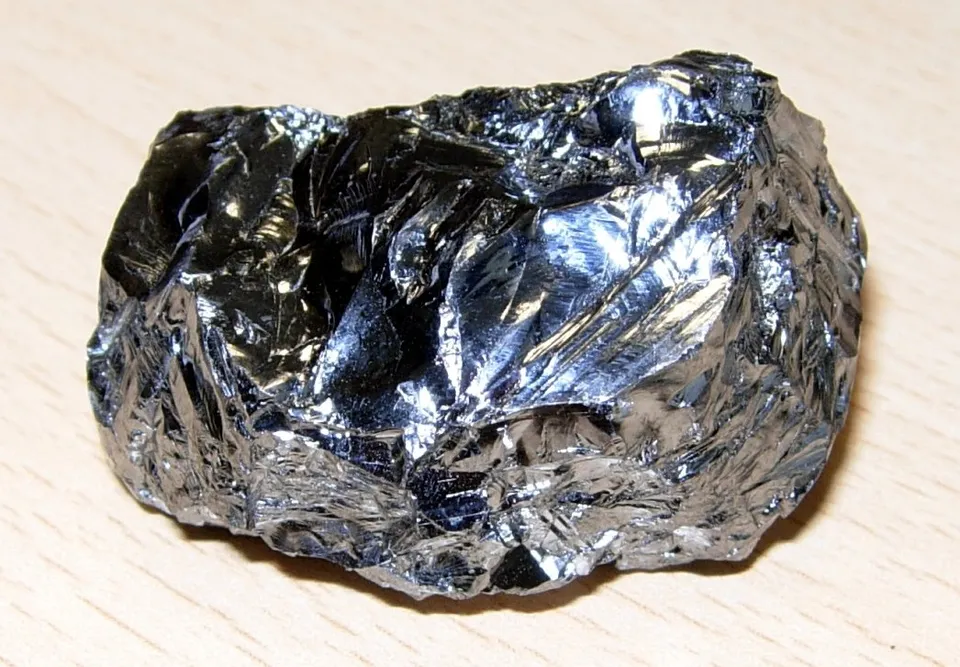

Specimen
- Atomic number
- 14
- Atomic mass
- 28.085
- State at room temperature
- Solid
- Melting point
- 1,414 °C
- Boiling point
- 3,265 °C
- Density
- 2.33 g/cm³
- Discovered
- 1854
Can I eat it?
- In food and water
- Allowed in food. The EU allows silicon dioxide (silica) as food additive E 551. In their reference intakes, US and Canadian experts state that silicon has not been shown to harm people. They also see no reason to add silicon to supplements. 89
- As the pure element
- Little harm known. In HSDB, a US toxicology database, 3160 mg per kg of body weight by mouth killed half of the rats (the oral LD50). HSDB states that silicon dust causes no important disease at controlled exposure. Silicon injected into rats and guinea pigs was biologically inert. 1011
Learn about silicon
- 01 How much there is And how much of that can we reach? A great deal. Silicon is about 27% of the Earth's crust, second only to oxygen. USGS gives no reserve figure and calls the resources abundant. The limits are cheap electricity, very pure quartz for some uses, and the carbon released in the furnace. Read →
- 02 Where it is found What is it found in, and where on Earth? Silicon comes from quartz, the mineral form of silica. Furnaces use lumps of quartzite or vein quartz with very few impurities. Such rock is found on every continent. The rare part is quartz pure enough for crucibles, for example from Spruce Pine in North Carolina. Read →
- 03 How we get it How much do we make each year, and how? Plants outside the United States made about 9.6 million tonnes of silicon in 2025. About 5.0 million tonnes were in ferrosilicon and 4.6 million in silicon metal. China made almost 80%. Silicon is almost never recycled as silicon. Read →
- 04 What we use it for Where does it go, and why this element? In 2020, about two thirds of the silicon made as the element went into ferrosilicon for steel and cast iron. The rest was silicon metal, used in aluminum alloys, silicones, solar cells and chips. Chips use only a small share. Read →
- 05 What it costs What does it cost, and how is it bought and sold? Silicon metal cost about $2.87 a kilogram in the United States in 2025, 21% less than in 2024. A year's output is worth roughly $15 billion at export prices. Prices more than doubled from 2020 to 2022, then fell back. China trades silicon and polysilicon futures. Read →
- 06 Who controls it Who controls the supply, and who depends on it? China made almost 80% of the world's silicon in 2025 and more than 90% of its polysilicon. The United States and the EU import much of what they use. All five lists we track call silicon critical, and the US and EU have put new duties on silicon products since 2025. Read →
- 07 Social and political problems What problems does it cause between people, and who carries them? We found no wars linked to silicon. The main dispute is about forced labor in Xinjiang, where much of the world's polysilicon is made. The US blocks goods from the region unless importers prove otherwise. China calls the claims lies. Trade disputes about tariffs grew from 2025. Read →
- 08 History How did our relationship with it begin and change? Jöns Jacob Berzelius made silicon in 1824, after Lavoisier and Davy had guessed that silica held a new element. The name comes from the Latin for flint. In the 1950s, silicon transistors, solar cells and chips turned a common rock into the base of electronics. Read →
Worth knowing
-
Silicates, compounds of silicon and oxygen, make up more than 90% of the Earth's crust. 12
Where it is found → -
Only 2.4% of the world's polysilicon is pure enough for semiconductors. Most of the rest goes into solar cells. 13
What we use it for → -
The US had 50% of the world's capacity to make polysilicon in 2005, and less than 2% in 2024. 13
Who controls it → -
Making polysilicon takes 40% of all the energy used to make a solar module. 14
-
Crystalline silicon solar cells used about 4% of the silicon mined in 2021. 15
What we use it for → -
The first silicon solar cells, shown by Bell Labs in 1954, turned about 6% of sunlight into electricity. 16
History →
The atom
Electrons
| Shell | Electrons |
|---|---|
| 1 (K) | 2 |
| 2 (L) | 8 |
| 3 (M) outermost | 4 |
| Total | 14 |
Configuration [Ne] 3s² 3p²
3s ↑ ↓
3p ↑ ↑
Nucleus
| Protons | 14 |
|---|---|
| Neutrons | 14 |
| Mass number | 28 |
Related elements
New articles by e-mail
Sources
- 1
L. Murphy and N. Elimä, Sheffield Hallam University Helena Kennedy Centre for International Justice, 2021. In Broad Daylight: Uyghur Forced Labour and Global Solar Supply Chains , Key findings; Introduction.
Labor transfer programs in Xinjiang and the silicon and polysilicon companies linked to them.
-
To create polysilicon, quartz is mined and then crushed, and then heated to remove the oxygen, leaving metallurgical-grade silicon
-
- 2
U.S. Geological Survey (E.K. Schnebele), 2026. Silicon, in Mineral Commodity Summaries 2026 , pp. 1–2: Domestic Production and Use; Salient Statistics; Recycling; Events, Trends, and Issues; World Production; World Resources; Substitutes.
World ferrosilicon and silicon metal output by country, 2024 and 2025; US prices, imports and trade measures.
-
World total (rounded) Ferrosilicone 2024 2025 ... 4,600 5,000 Silicon metale 2024 2025 ... 5,500 4,600
-
Price, average, cents per pound of silicon ... Silicon metal2, 5 ... 140 130
-
Ferrosilicone 2024 2025 ... 3,100 3,500 ... Silicon metale 2024 2025 ... 4,800 4,000
-
- 3
United Nations Statistics Division (UN Comtrade), 2026. UN Comtrade: exports of silicon with less than 99.99% silicon (HS 280469), 2025, by reporting country , reporterCode 156 (China): netWgt 720583825.0 kg, primaryValue 1012489061.0 USD; other reporters summed by us.
Export value and weight of silicon metal in 2025. China's unit value is about $1.41 per kg; all other exporters together about $2.46 per kg.
-
720583825.0 ... 1012489061.0
-
- 4
Theodore Gray (periodictable.com), data from Wolfram Research ElementData, 2026. Technical data for the element Silicon , Abundances.
Abundance of silicon in the universe, crust, oceans and humans, as mass fractions.
-
% in Earth's Crust 27%
-
- 5
G. Mudd and others, British Geological Survey, 2024. UK 2024 Criticality Assessment (Open Report OR/24/047) , Results table; appendix tables on end uses and end-of-life recycling rates.
Silicon rated critical; world end uses of silicon metal and recycling rates.
-
Silicon (Si) 15
-
- 6
IUPAC Commission on Isotopic Abundances and Atomic Weights (CIAAW), 2024. Abridged Standard Atomic Weights 2024 .
The atomic mass shown for the 84 elements that have a standard atomic weight.
- 7
National Center for Biotechnology Information (PubChem), 2026. Periodic Table of Elements .
Electron configuration, melting and boiling points, density and discovery year for all 118 elements.
- 8
European Commission, 2011. Commission Regulation (EU) No 1129/2011 establishing a Union list of food additives , Annex, Parts B and E.
The text as adopted by the EU in 2011, from legislation.gov.uk. Later EU amendments are not in it.
-
E 551 Silicon dioxide
-
- 9
Health Canada, from the Institute of Medicine (US) Dietary Reference Intakes reports, 2010. Dietary Reference Intakes tables (Institute of Medicine values), updated November 2010 , Reference Values for Elements, footnotes 20 to 27.
The joint US and Canadian reference intakes. The values are from the Institute of Medicine reports of 1997 to 2004 and 2010.
-
Although silicon has not been shown to cause adverse effects in humans, there is no justification for adding silicon to supplements.
-
- 10
National Center for Biotechnology Information (PubChem), with text from HSDB, 2026. Silicon (CID 5461123), compound summary , Toxicity, Non-Human Toxicity Values; Human Toxicity Excerpts (signs and symptoms).
-
LD50 Rat oral 3160 mg/kg
-
Silicon dust does not produce significant organic disease or toxic effect when exposures are kept under reasonable control.
-
- 11
National Center for Biotechnology Information (PubChem), with text from HSDB, 2026. Silicon (CID 5461123), compound summary, Non-Human Toxicity Excerpts , Toxicity, Non-Human Toxicity Excerpts (laboratory animals, subchronic exposure).
-
only minor local trauma and foreign-body reaction developed; parenterally, elemental silicon was considered biologically inert
-
- 12
U.S. Geological Survey (E.K. Schnebele), 2023. Silicon, in 2020 Minerals Yearbook , pp. 1–4: introduction; World Industry Structure; Outlook.
World consumption of ferrosilicon and silicon metal in 2020; Chinese producers and exports; main users.
-
it combines with oxygen and other elements to form silicates, which compose more than 90% of the Earth’s crust
-
- 13
EY Tax News, 2026. US Section 232 proclamation establishes minimum import prices and a 15 percent tariff on polysilicon and derivative products .
The US polysilicon tariff and minimum import price of August 2026, and the findings behind it.
-
semiconductor-grade polysilicon now accounts for only 2.4% of global polysilicon production
-
the US share of global polysilicon production capacity declined from 50% in 2005 to less than 2% in 2024
-
- 14
International Energy Agency, 2022. Special Report on Solar PV Global Supply Chains , Executive summary; Chapter 1.
Polysilicon production steps, energy use and China's share of the solar supply chain.
-
Polysilicon production accounts for 40% of all energy consumed to manufacture solar PV modules
-
- 15
U.S. Department of Energy, 2023. Critical Materials Assessment , Executive summary; silicon and electrical steel sections.
Silicon is near critical in the medium term; share of silicon used in solar cells; silicon in electrical steel.
-
which consumed about 4.0% of total mined silicon that year
-
- 16
American Physical Society (APS News), 2009. April 25, 1954: Bell Labs Demonstrates the First Practical Silicon Solar Cell .
The Bell Labs silicon solar cell of 1954 and its efficiency.
-
Those first silicon solar cells were about 6 percent efficient
-
- 17
National Institute of Standards and Technology (NIST), 2026. Atomic Weights and Isotopic Compositions for All Elements .
Isotopic composition of each element; the most abundant isotope sets the neutron count in the nucleus view.