Last updated 14 October 2026.
Astatine
Element 85 · Halogen · Made in reactors or accelerators1
Astatine is the rarest naturally occurring element on Earth. Published estimates of the amount on Earth at one time go from 0.07 grams to about 25 grams. Every isotope is radioactive, and the longest-lived has a half-life of 8.1 hours. No one has made a weighable amount. People make astatine-211 in cyclotrons, by firing alpha particles at bismuth. About a dozen laboratories in the United States, Europe and Asia make it. Doctors test it as a cancer treatment in small trials. We found no approved astatine medicine.
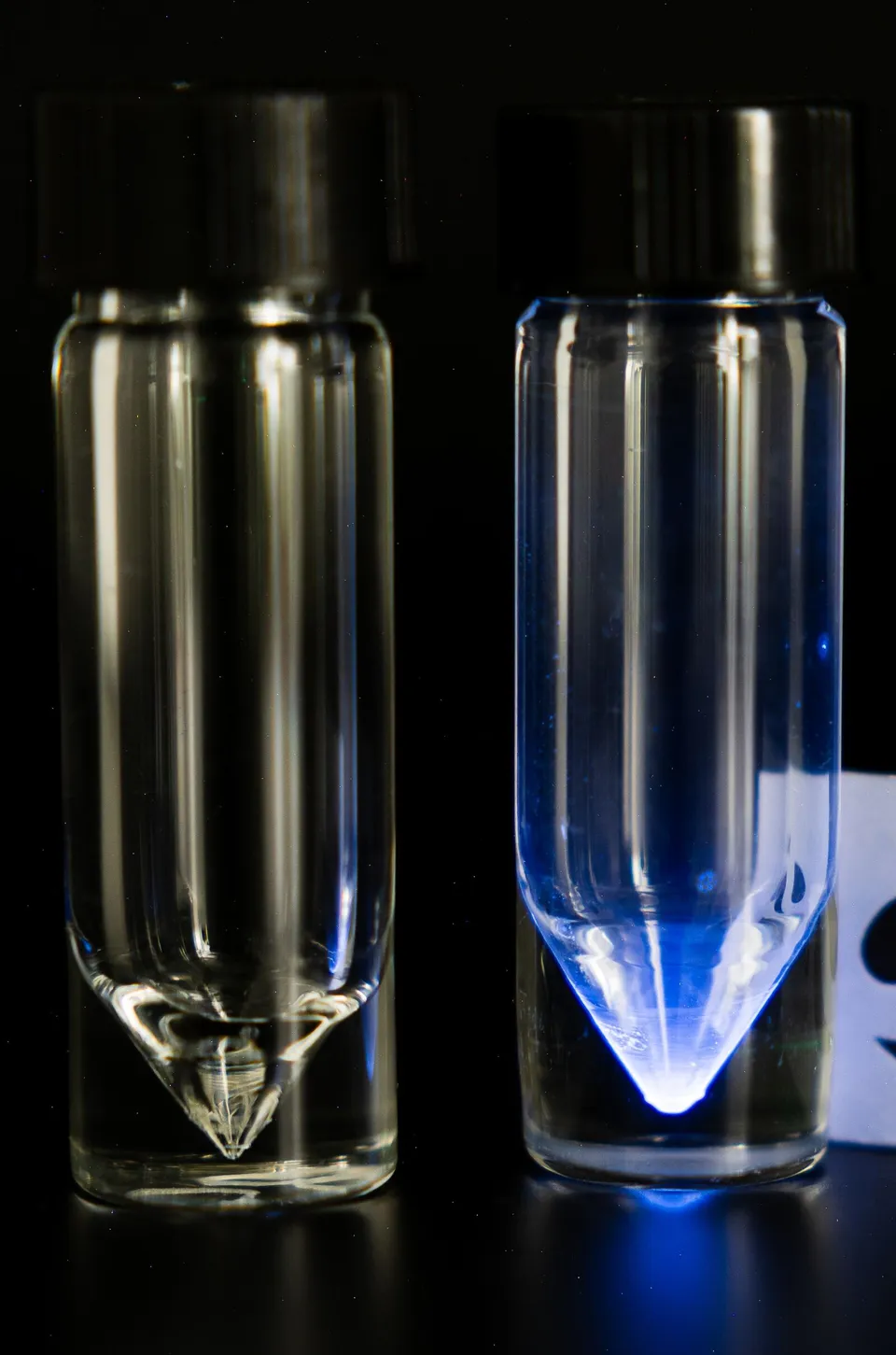

Specimen
- Atomic number
- 85
- Atomic mass
- [210]
- State at room temperature
- Solid
- Melting point
- 301.9 °C
- Boiling point
- Unknown
- Density
- 7 g/cm³
- Discovered
- 1940
Can I eat it?
Learn about astatine
- 01 How much there is And how much of that can we reach? Very little. Astatine forms when uranium and thorium decay, and it decays again within seconds or hours. The authors of a 2013 paper estimate the total on Earth at 0.07 grams. Natural astatine cannot be collected, so all the astatine that people use is made in accelerators. Read →
- 03 How we get it How much do we make each year, and how? Nobody mines astatine. Cyclotrons make astatine-211 by firing alpha particles at bismuth. About a dozen sites make it, in batches of a few gigabecquerels. By our calculation, a year's output at one large site weighs about one microgram. Read →
- 04 What we use it for Where does it go, and why this element? Only for research. The Royal Society of Chemistry says that there are no uses for astatine outside research. Most of this research is on astatine-211 as a cancer treatment. Its alpha particles travel only a few cell widths, so they can kill cancer cells and spare nearby tissue. Read →
- 05 What it costs What does it cost, and how is it bought and sold? Astatine has no public price and no open market. In the United States, the Department of Energy sells astatine-211 on special order, by the millicurie. It decays too fast to be stored or traded. Buyers get it from a cyclotron a few hours away. Read →
- 06 Who controls it Who controls the supply, and who depends on it? A few universities and national laboratories in the United States, Japan, Europe and China make astatine-211. A 2021 review listed 13 sites, five of them in the United States and five in Japan. No country can supply the world, because astatine-211 decays within hours. Read →
- 08 History How did our relationship with it begin and change? Dale Corson, Kenneth MacKenzie and Emilio Segrè made astatine in a cyclotron at Berkeley in 1940. The name comes from the Greek word for unstable. After decades of research in chemistry and physics, doctors now test astatine-211 as a cancer treatment. Read →
Not covered: Where it is found. Astatine forms no minerals and no deposits. It forms in the Earth's crust when uranium and thorium decay, and it decays again too fast to collect2. Social and political problems. We found no social or political problems that astatine causes. Only tiny amounts exist, and the Royal Society of Chemistry says that there are no uses outside research7.
Worth knowing
-
All the astatine on Earth at one time may weigh only 0.07 grams, according to a 2013 estimate. Other estimates are higher, up to about 25 grams. 8
How much there is → -
No one has seen a piece of astatine. The Los Alamos National Laboratory states that a visible amount would vaporize itself because of its radioactivity. 2
How much there is → -
Astatine was the last naturally occurring element whose ionization potential nobody had measured. A team at CERN measured it in 2013. 8
History → -
Berta Karlik and Traude Bernert found astatine in nature in Vienna in 1943. They would have named it viennium, but the Berkeley team had made it first. 9
History → -
Fewer than 10 atoms of astatine-211 bound to a cancer cell can kill it, according to a review by Feng and Zalutsky. 10
What we use it for → -
In the Osaka thyroid trial, patients could leave the treatment area after the injection. Treatment with radioactive iodine often needs a stay in an isolated hospital room. 11
What we use it for →
The atom
Electrons
| Shell | Electrons |
|---|---|
| 1 (K) | 2 |
| 2 (L) | 8 |
| 3 (M) | 18 |
| 4 (N) | 32 |
| 5 (O) | 18 |
| 6 (P) outermost | 7 |
| Total | 85 |
Configuration [Xe] 4f¹⁴ 5d¹⁰ 6s² 6p⁵
4f ↑ ↓ ↑ ↓ ↑ ↓ ↑ ↓ ↑ ↓ ↑ ↓ ↑ ↓
5d ↑ ↓ ↑ ↓ ↑ ↓ ↑ ↓ ↑ ↓
6s ↑ ↓
6p ↑ ↓ ↑ ↓ ↑
Nucleus
| Protons | 85 |
|---|---|
| Neutrons | 125 |
| Mass number | 210 |
Related elements
New articles by e-mail
Sources
- 1
Per Albertsson and others (Frontiers in Medicine 9:1076210), 2023. Astatine-211 based radionuclide therapy: Current clinical trial landscape , Sections 1 to 4; tables 1 and 2.
Natural abundance, why astatine-211 suits therapy, completed and ongoing clinical trials, production sites, other alpha emitters, supply networks.
-
The main production route today is to irradiate a bismuth-209 target in a cyclotron capable of producing a 28 MeV alpha beam.
-
- 2
Los Alamos National Laboratory, 2025. Astatine, in the Periodic Table of Elements .
The 1940 synthesis and its reaction, the amount on Earth, the half-life, uses and health.
-
In 1940, D.R. Corson, K.R. MacKenzie, and Emilio Segrè were able to create element 85 in a particle accelerator (called a cyclotron) at the University of California, Berkeley.
-
The team bombarded bismuth-209 with alpha particles, causing the bismuth to emit two neutrons and, in doing so, become astatine-211.
-
Its half-life is so short (a matter of seconds for most isotopes), that it does not accumulate, decaying rapidly into other elements.
-
Any visible portion of astatine would immediately vaporize itself because of its extreme radioactivity.
-
- 3
IUPAC Commission on Isotopic Abundances and Atomic Weights (CIAAW), 2024. Radioactive Elements .
Mass number and half-life of the longest-lived isotope of the 34 elements with no standard atomic weight.
-
85 At astatine 210 8.1(4) h
-
- 4
National Center for Biotechnology Information (PubChem), 2026. Periodic Table of Elements .
Electron configuration, melting and boiling points, density and discovery year for all 118 elements.
- 5
Royal Society of Chemistry, Periodic Table, 2026. Astatine - Element information, properties and uses .
Reference page; its Biological role and Natural abundance sections are quoted.
-
Astatine can be obtained in a variety of ways, but not in weighable amounts.
-
- 6
Los Alamos National Laboratory, Periodic Table of Elements, 2026. Astatine .
-
A weighable sample of the pure element is nearly impossible to assemble for study. Any visible portion of astatine would immediately vaporize itself because of its extreme radioactivity.
-
Any visible portion of astatine would immediately vaporize itself because of its extreme radioactivity.
-
- 7
Royal Society of Chemistry, 2025. Astatine, in the Periodic Table .
Uses, biological role, the 1939 and 1940 claims, and the podcast 'Chemistry in its element: astatine' by Mark Peplow, with the Greenwood and Earnshaw estimate of astatine in the crust.
-
There are currently no uses for astatine outside of research.
-
- 8
S. Rothe and others (Nature Communications 4:1835), 2013. Measurement of the first ionization potential of astatine by laser ionization spectroscopy , Abstract and introduction.
The total abundance of 0.07 g, the first measurement of the ionization potential, and the 70 ng sample of earlier spectroscopy.
-
is the rarest naturally occurring element on earth with an estimated total abundance of 0.07 g
-
Of all the naturally occurring elements, At is the only one whose IP has not been experimentally deduced.
-
- 9
Brigitte Strohmaier, University of Vienna, 2024. Berta Karlik: The Grande Dame of the Vienna Radium Institute , Section 3.5, Discovery of the natural occurrence of element 85.
Karlik and Bernert's detection of astatine-218, priority and the name viennium. An English translation of an article of 2010.
-
They would have chosen the name Viennium; the U.S. discoverers named it astatine.
-
- 10
Yutian Feng and Michael R. Zalutsky (Nuclear Medicine and Biology 100-101), 2021. Production, purification and availability of 211At: Near term steps towards global access , Sections 3, 5, 6, 7 and 10; table 1.
The production route, the 13 production sites and their output, the limits to supply, distribution networks and dose estimates. Read with Firecrawl (author manuscript on PMC).
-
with effective killing achievable with less than 10 atoms bound per cell
-
- 11
Tadashi Watabe and others (Journal of Nuclear Medicine 66:1941-1947), 2025. First-in-Human Study of [211At]NaAt as Targeted α-Therapy in Patients with Radioiodine-Refractory Thyroid Cancer (Alpha-T1 Trial) .
Results of the Osaka trial, production at RIKEN, and outpatient treatment.
-
Isolated hospitalization in a dedicated room was not required
-