Cadmium
Element 48 · Transition metal · By-product of zinc
Cadmium is a soft, toxic metal that nobody mines for itself. Zinc refineries recover it from zinc ores, which hold about 0.03% cadmium. The world made about 23,000 tonnes in 2025, two fifths of it in China. A century ago it went into yellow paint and steel plating. By 2000 three quarters of US use went into nickel-cadmium batteries. Cadmium telluride solar panels are now a growing use. Cadmium is also a poison. Mine pollution in Japan's Jinzu River basin caused itai-itai disease, the most severe known case of cadmium poisoning.
Last updated 3 October 2026.
Where cadmium sits
How cadmium compares to other elements. Each link on the right goes to the chapter about that number.
The scales are log scales, except for the shares, which go from 0 to 100%.
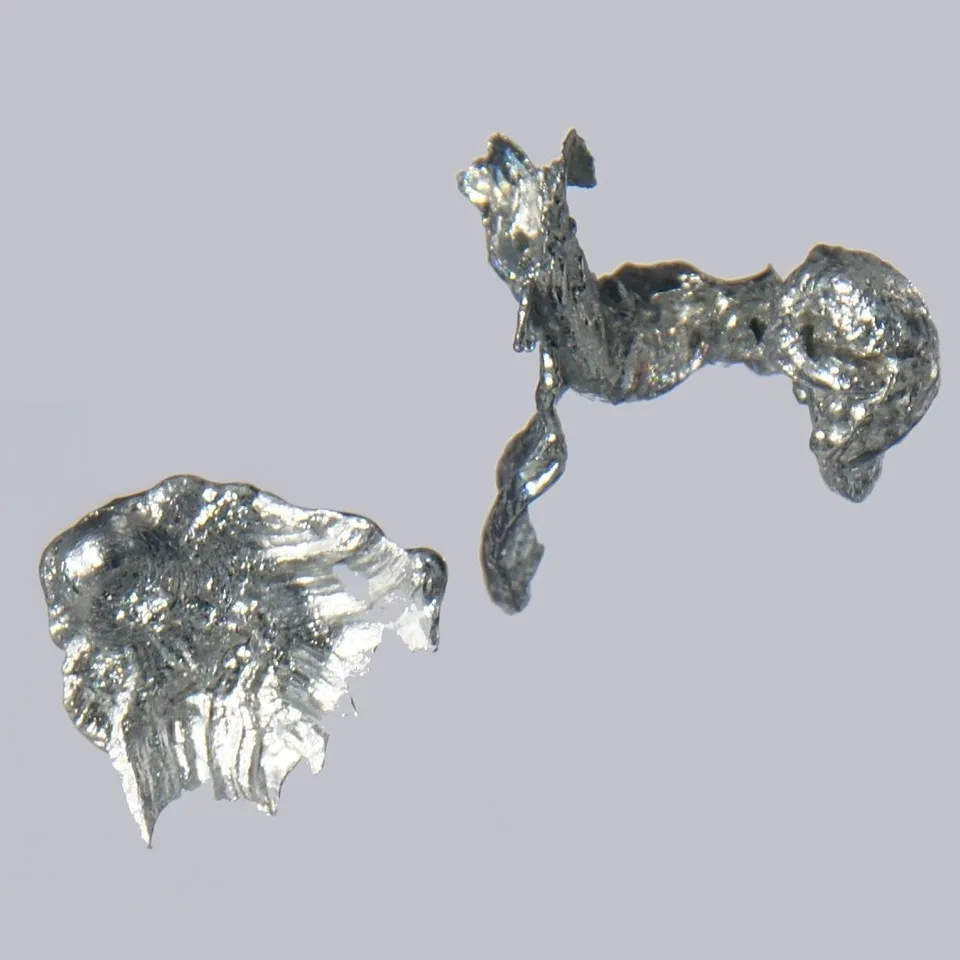

Specimen
- Atomic number
- 48
- Atomic mass
- 112.41
- State at room temperature
- Solid
- Melting point
- 321.1 °C
- Boiling point
- 766.9 °C
- Density
- 8.69 g/cm³
- Discovered
- 1817
Can I eat it?
- In food and water
- Poison. Cadmium in food collects in the kidneys and damages them. It also weakens bones, and IARC says it causes cancer. WHO says normal intake is only a small margin below the tolerable intake. 78
- As the pure element
- Poison. Swallowed cadmium metal causes stomach pain, vomiting and diarrhea. The larger danger is the fume from hot cadmium, which can fill the lungs with fluid. Over time, cadmium can damage the kidneys, and it causes cancer. 9
Nine chapters
- 01 How much there is How much of it exists, and how much of that can we reach? Cadmium is scarce in the crust, about 0.15 parts per million, but it occurs with zinc. USGS stopped publishing estimates of its reserves in 2015. Supply depends on how much zinc is refined, not on how much cadmium is in the ground. Read →
- 02 Where it is found What is it found in, and where on Earth? Cadmium occurs in zinc ores, mostly in the zinc sulfide sphalerite. Typical zinc ores hold about 0.03% cadmium. It is recovered wherever zinc concentrates are refined, so its deposits are the world's zinc deposits. Read →
- 03 How we get it How much do we make each year, and how? Zinc refineries made about 23,000 tonnes of cadmium metal in 2025, two fifths of it in China. Output has stayed between about 16,000 and 27,000 tonnes a year since 1980. Only a small share of used cadmium is recycled. Read →
- 04 What we use it for Where does it go, and why this element? USGS ranks nickel-cadmium batteries first, at 85% in its last breakdown. On an industry chart, jewellery is first, at 57%. Jewellery made in India is poorly measured. Coatings, pigments, alloys and solar panels take smaller amounts. Read →
- 05 What it costs What does it cost, and how is it bought and sold? Cadmium metal sold for about $3.90 a kilogram in 2025, so a year's output is worth roughly $90 million. In real terms the price has fallen to a small fraction of its level in the first half of the 20th century. Read →
- 06 Who controls it Who controls the supply, and who depends on it? China refines about 41% of the world's cadmium and South Korea about 19%. Cadmium is on none of the main critical-mineral lists. Governments mostly treat it as a poison to restrict. Since 2025 China has controlled exports of cadmium tellurides. Read →
- 07 Social and political problems What problems does it cause between people, and who carries them? No armed conflict was found. Itai-itai victims in Japan won lawsuits against Mitsui Mining in 1971 and 1972. Later fights covered cadmium rice in Hunan, sick battery workers in China, and EU rules on batteries and solar panels. Read →
- 08 Harm to health and the planet What harm does getting and using it do to bodies and the environment? Making cadmium emits little carbon, but the metal is a poison. It harms the kidneys and bones and causes lung cancer. Pollution from a mine caused itai-itai disease in Japan, the most severe known case of cadmium poisoning. Read →
- 09 History How did our relationship with it begin and change? Friedrich Stromeyer found cadmium in a zinc ore in 1817. It was used first as a yellow pigment, then for plating steel, then in nickel-cadmium batteries. Now cadmium telluride solar panels are its growing use. Read →
Worth knowing
-
Itai means 'ouch' in Japanese. Most itai-itai patients were women farmers who ate rice and drank river water polluted by a mine upstream. Their bones softened, bent and broke. 10
Harm to health and the planet → -
Once in the body, cadmium stays. It builds up in the kidneys and takes 10 to 35 years to fall by half. 11
Harm to health and the planet → -
From 1972 to 1997 Mitsui Mining and Smelting paid ¥36.5 billion for itai-itai disease, by one study's count. Patients received ¥7.5 billion of it; the rest went to farmers, soil clean-up and pollution control. 12
Social and political problems → -
Most commercial and corporate aircraft carry nickel-cadmium batteries, for engine starts and emergency power. 13
What we use it for → -
Cheap fashion jewellery made in India can be more than 90% cadmium, the industry association says. It calls this the segment with the highest cadmium use. 14
What we use it for → -
Zinc concentrates hold enough cadmium for about 42,000 tonnes a year, but refiners recovered only about 24,000 tonnes in 2018. 14
Where it is found →
The atom
| Shell | Electrons |
|---|---|
| 1 (K) | 2 |
| 2 (L) | 8 |
| 3 (M) | 18 |
| 4 (N) | 18 |
| 5 (O) outermost | 2 |
| Total | 48 |
Configuration [Kr] 4d¹⁰ 5s²
4d ↑ ↓ ↑ ↓ ↑ ↓ ↑ ↓ ↑ ↓
5s ↑ ↓
Related elements
New elements by e-mail
Sources
- 1
U.S. Geological Survey, 2026. Cadmium, in Mineral Commodity Summaries 2026 , pp. 52-53.
World refinery production, price, US trade, substitutes and events for 2025.
-
World total (rounded) ... 22,800 23,000
-
W 4.06 E W 4.12 E W 3.90 <25
-
W 4.12 E W 3.90 <25
-
Canadae Chinae Germanye Japane ... 1,300 1,300 8,900 9,500 130 220 1,580 1,300 ... 4,300 4,300
-
- 2
Theodore Gray, periodictable.com (data from Wolfram ElementData), 2026. Technical data for Cadmium (from Wolfram ElementData) , Abundances.
Abundance in the universe, crust, oceans and human body, as mass fractions.
-
% in Earth's Crust 0.000015%
-
- 3
T.E. Graedel and others, UNEP International Resource Panel, 2011. Recycling Rates of Metals: A Status Report , Appendix F, table F1, p. 36.
End-of-life recycling rate and recycled content for cadmium.
-
Cd 76d 25j, 32d, 50 -75 15d
-
- 4
U.S. Geological Survey, 2014. Cadmium, in Mineral Commodity Summaries 2014 , World Refinery Production and Reserves table.
Last USGS estimate of cadmium reserves, by country, for 2013.
-
World total (rounded) ... 500,000
-
- 5
P. Nuss and M.J. Eckelman (PLOS ONE), 2014. Life Cycle Assessment of Metals: A Scientific Synthesis , Supporting Information S1, table S38 (Cd rows) and table S8.
Cradle-to-gate energy and greenhouse gas figures for cadmium.
-
Cd TOTAL 2.279E+07 100% 53.0 28.1 118 1.2 3.0 1.8 5.1
-
- 6
National Center for Biotechnology Information (PubChem), 2026. Periodic Table of Elements .
Atomic mass, electron configuration, melting and boiling points, density and discovery year for all 118 elements.
- 7
Agency for Toxic Substances and Disease Registry (ATSDR), 2026. ToxFAQs for Cadmium .
-
Repeated exposure to cadmium results in build-up of cadmium in the kidneys, which damages them. Weak, brittle bones are also associated with repeated exposure to cadmium.
-
The International Agency for Research on Cancer (IARC) classified cadmium and cadmium compounds as carcinogenic to humans.
-
- 8
World Health Organization, 2011. Guidelines for drinking-water quality, chemical fact sheets: Cadmium .
The fact sheet gives 2011 as its assessment date.
-
It is recognized that the margin between the PTMI and the actual monthly intake of cadmium by the general population is small
-
- 9
International Labour Organization and World Health Organization (International Chemical Safety Cards), 2005. ICSC 0020 - Cadmium , Ingestion; Effects of short-term exposure; Effects of long-term or repeated exposure.
-
Ingestion Abdominal pain. Diarrhoea. Headache. Nausea. Vomiting.
-
Inhalation of fumes may cause lung oedema.
-
The substance may have effects on the kidneys. This may result in kidney impairment. This substance is carcinogenic to humans.
-
- 10
T. Sasaki, H. Horiguchi and others (Environmental Health and Preventive Medicine), 2024. A suspected case of "itai-itai disease" in a cadmium-polluted area in Akita prefecture, Japan , Introduction.
Cause and symptoms of itai-itai disease; 201 recognized patients by 2022.
-
most of whom were female farmers, were highly exposed to Cd through the consumption of self-harvested rice and river water. They developed osteomalacia, severe pain throughout the body ... means ... ouch ... and bone deformities and fractures
-
- 11
World Health Organization, 2019. Exposure to cadmium: a major public health concern .
Sources of exposure, health effects, WHO guideline values and the IARC classification.
-
Cadmium accumulates primarily in the kidneys and its biological half-life in humans is 10-35 years
-
- 12
F. Yoshida, A. Hata and H. Tonegawa (Environmental Economics and Policy Studies 2: 215-229), 1999. Itai-Itai disease and the countermeasures against cadmium pollution by the Kamioka mine .
Lawsuits, the 1972 agreement, compensation paid by Mitsui to 1997, and the authors' estimate of the company's share of the burden.
-
and ¥7.5 billion in total ... From 1972 to 1997, the monies paid out by Mitsui Company to compensate for the injuries incurred by Itai-Itai disease totaled ¥36.5 billion
-
- 13
R.M. Callaghan, U.S. Geological Survey, 2024. Cadmium, in 2019 Minerals Yearbook (advance release) , pp. 15.1-15.4.
Uses, trade, consumers, China's pollution campaign and the outlook.
-
Most commercial and corporate aircraft use NiCd batteries. In addition to engine startup, the batteries are needed for functions such as emergency power
-
- 14
International Cadmium Association (industry association), 2021. Worldwide Production, Trade and Consumption of Cadmium , pp. 2-3, 6-9.
World production and consumption about 24,450 t in 2018; India's use mostly in jewellery; NiCd batteries listed first among 2019 uses, estimated at 11,000 to 14,000 t; alloys, including jewellery, estimated as the remainder.
-
alloys containing more than 90% cadmium are used. In this segment, cost is a driving factor for using cadmium. It is also the segment with the highest cadmium consumption
-
there is a potential production of 42 000 tonnes of cadmium. However, not all zinc refiners do refine contained cadmium. In 2018, the cadmium production was estimated to be about 24 000 t
-