Iron
Element 26 · Transition metal · Mined for itself
Almost all iron becomes steel, and about half of all steel goes into buildings and infrastructure. Mines produced about 2.6 billion tonnes of usable iron ore in 2025, which held about 1.6 billion tonnes of iron. Australia and Brazil dig most of the traded ore, and China makes about half of the world's steel. Iron is the fourth most common element in the Earth's crust and is not running out. The limits are carbon and safety: steelmaking emits about 7% of energy-system carbon dioxide, and two tailings dam failures in Brazil killed 289 people.
Last updated 3 October 2026.
Where iron sits
How iron compares to other elements. Each link on the right goes to the chapter about that number.
The scales are log scales, except for the shares, which go from 0 to 100%.
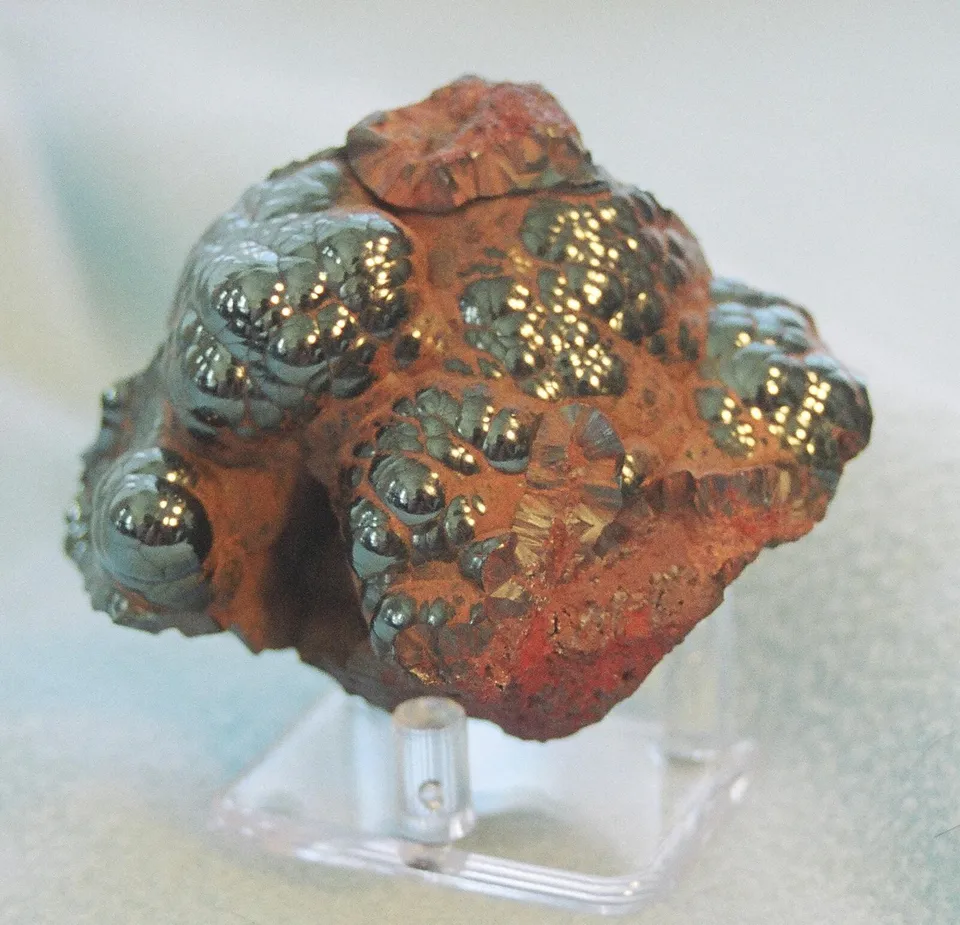

Specimen
- Atomic number
- 26
- Atomic mass
- 55.84
- State at room temperature
- Solid
- Melting point
- 1,538 °C
- Boiling point
- 2,861 °C
- Density
- 7.874 g/cm³
- Discovered
- Ancient
Can I eat it?
- In food and water
- Your body needs it. The body needs iron to carry oxygen and to make energy. Iron deficiency anemia is the most common nutritional deficiency disorder, according to EFSA. 7
Nine chapters
- 01 How much there is How much of it exists, and how much of that can we reach? There is a great deal. Iron is about 5 to 6% of the Earth's crust. Known reserves hold about 87 billion tonnes of iron, some 54 years of mining at the 2025 rate. The limits are ore grade, carbon and mine safety, not the amount in the ground. Read →
- 02 Where it is found What is it found in, and where on Earth? Almost all iron ore is hematite or magnetite. Most of it comes from banded iron formations, sea-floor rocks laid down 3.7 to 1.8 billion years ago. Australia, Brazil and Russia hold about two thirds of the iron in known reserves. Read →
- 03 How we get it How much do we make each year, and how? Mines produced about 2.6 billion tonnes of usable iron ore in 2025, with about 1.6 billion tonnes of iron in it. Blast furnaces made about 1.3 billion tonnes of pig iron. With scrap, this became 1.85 billion tonnes of crude steel. Read →
- 04 What we use it for Where does it go, and why this element? About 98% of iron ore becomes steel. Buildings and infrastructure take about half of all steel, then machinery, cars and metal goods. Iron is used because steel is strong and easy to shape, and iron is the least expensive metal. Read →
- 05 What it costs What does it cost, and how is it bought and sold? Iron ore sold for about US$100 per dry tonne in 2025 (62% iron, delivered to China), or about 16 US cents per kilogram of iron. Australia and Brazil sell most of the ore, and China buys almost three quarters of what is traded. Read →
- 06 Who controls it Who controls the supply, and who depends on it? Australia mined 38% of the world's iron in 2025. Steelmaking is more concentrated: China made 52% of the world's steel and bought about 72% of the ore traded. Iron is on the UK critical list only. Read →
- 07 Social and political problems What problems does it cause between people, and who carries them? Two dam failures at Brazilian iron ore mines killed 289 people and led to large settlements and court cases. Iron ore miners pay most of Western Australia's royalties. Steel trade has led to tariffs, a WTO case and a dispute over the sale of US Steel. Read →
- 08 Harm to health and the planet What harm does getting and using it do to bodies and the environment? Steelmaking emits about 2.6 billion tonnes of carbon dioxide a year, about 7% of energy-system emissions, mostly from coal used to smelt ore. Two tailings dam failures at Brazilian iron ore mines killed 289 people. Lack of iron is the most common nutrient deficiency. Read →
- 09 History How did our relationship with it begin and change? People first used iron from meteorites more than 5,000 years ago and learned to smelt it from ore by about 1200 BCE. Coke, the Bessemer converter and the oxygen furnace made it cheap. World ore output has more than doubled since 2000, as China's steelmaking grew. Read →
Worth knowing
-
The early Hittites traded iron for silver, at 40 times the weight of the iron. 10
-
After the US required unit-dose packs for iron pills in 1997, deaths of young children from iron poisoning fell from 29 in ten years to 1 in five years. 11
Harm to health and the planet → -
Making steel from scrap takes about one eighth of the energy needed to make it from iron ore. 12
Harm to health and the planet → -
Iron ore miners paid 87% of Western Australia's mining royalties in 2024-25, A$8.6 billion. 13
Social and political problems → -
The Juukan rock shelters, which Rio Tinto destroyed in 2020, held evidence of human life going back 46,000 years. 14
Social and political problems → -
Iron was the first element known to be essential for people. In 1681 a physician used it to treat pale, tired patients with anaemia. 15
History →
The atom
| Shell | Electrons |
|---|---|
| 1 (K) | 2 |
| 2 (L) | 8 |
| 3 (M) | 14 |
| 4 (N) outermost | 2 |
| Total | 26 |
Configuration [Ar] 3d⁶ 4s²
3d ↑ ↓ ↑ ↑ ↑ ↑
4s ↑ ↓
Related elements
New elements by e-mail
Sources
- 1
U.S. Geological Survey (C.C. Tuck), 2026. Iron Ore, in Mineral Commodity Summaries 2026 , p. 2, World Mine Production and Reserves table; World Resources.
World mine production, reserves and resources of iron ore and its iron content, 2024 and 2025.
-
World total (rounded) ... 2,600,000 2,600,000 1,600,000 1,600,000
-
Australia Brazil Canada Chile China India ... 982,000 980,000 607,000 600,000 428,000 420,000
-
Crude ore Iron content ... 200,000 ... 87,000
-
- 2
World Bank, 2026. Commodity Price Data (The Pink Sheet), annual and monthly prices , Annual Prices (Nominal), 'Iron ore, cfr spot'; Description sheet; file updated 2 September 2026.
Iron ore price, annual averages 1960 to 2025. Contract price for Brazilian ore in US cents per dry metric tonne unit to 2005, spot price in US dollars per dry tonne after.
-
Iron ore, cfr spot ... 2025 ... 100.2
-
- 3
Theodore Gray (periodictable.com), data from Wolfram Research ElementData, 2026. Technical data for the element Iron , Abundances.
Abundance of iron in the universe, crust, oceans and humans, as mass fractions.
-
% in Earth's Crust 6.3%
-
- 4
UNEP International Resource Panel (T.E. Graedel et al.), 2011. Recycling Rates of Metals: A Status Report , Appendix C, p. 30, Table C1.
End-of-life recycling rate (70 to 90%) and recycled content of iron and steel.
-
an EOL-RR of 70 –90 % can be estimated for iron and steel
-
- 5
World Steel Association (worldsteel), the steel industry's association, 2026. World Steel in Figures 2026 , Sustainability indicators; Top 50 companies; Major steel-producing countries; Production by process; Pig iron; DRI; Iron ore 2024; Steel use by sector (p. 30).
Crude steel, pig iron and DRI output by country, top companies, iron ore trade, emissions and energy per tonne of steel.
-
2.18 tonnes of CO2e emitted per tonne of crude steel
-
- 6
National Center for Biotechnology Information (PubChem), 2026. Periodic Table of Elements .
Atomic mass, electron configuration, melting and boiling points, density and discovery year for all 118 elements.
- 7
European Food Safety Authority (EFSA), 2017. Dietary Reference Values for nutrients. Summary report (amended 2019) .
Summaries of the EFSA NDA Panel opinions on each vitamin and mineral, section 4 (minerals) and section 5 (cobalamin).
-
Iron is required for oxygen transport, electron transfer, oxidase activities and energy metabolism
-
Iron deficiency anaemia ... is the most common nutritional deficiency disorder
-
- 8
US Food and Drug Administration (Electronic Code of Federal Regulations), 2026. 21 CFR 184.1375 Iron, elemental , § 184.1375(c).
The eCFR renderer address that holds the text of the section. The reader page is https://www.ecfr.gov/current/title-21/chapter-I/subchapter-B/part-184/subpart-B/section-184.1375, which builds its text with scripts.
-
the ingredient is used in food as a nutrient supplement as defined in § 170.3(o)(20) of this chapter, with no limitation other than current good manufacturing practice
-
- 9
European Parliament and Council of the European Union, 2006. Regulation (EC) No 1925/2006 on the addition of vitamins and minerals and of certain other substances to foods, Annex II , Annex II, point 2 (mineral substances).
The text as adopted by the EU, from legislation.gov.uk. Annex III of Regulation (EC) No 1170/2009 replaced this annex and kept elemental iron in the list.
-
VITAMIN FORMULATIONS AND MINERAL SUBSTANCES WHICH MAY BE ADDED TO FOODS ... elemental iron (carbonyl + electrolytic + hydrogen reduced)
-
- 10
Wikipedia contributors, 2026. History of ferrous metallurgy .
Dates of early meteoritic iron, smelting, Chinese cast iron, coke smelting, Bessemer and basic oxygen steelmaking.
-
The early Hittites are known to have bartered iron (meteoric or smelted) for silver , at a rate of 40 times the iron's weight
-
- 11
Tenenbein M. (Archives of Pediatrics & Adolescent Medicine), 2005. Unit-dose packaging of iron supplements and reduction of iron poisoning in young children , Abstract (PubMed record 15939855, text format).
Deaths from iron poisoning in US children under six fell from 29 (1988 to 1997) to 1 (1998 to 2002) after the 1997 unit-dose packaging rule.
-
The 10 years prior to the intervention were compared with the 5 years after its promulgation ... The number of deaths decreased from 29 to 1
-
- 12
International Energy Agency, 2020. Iron and Steel Technology Roadmap: Towards more sustainable steelmaking , Executive summary.
Sector CO2 emissions (2.6 Gt, 7% of the energy system), coal use, scrap share and energy, demand projection to 2050.
-
Steel production from scrap requires around one-eighth of the energy of that produced from iron ore
-
- 13
Western Australian Treasury Corporation, 2026. Western Australia Iron Ore Profile: January 2026 .
Western Australia's iron ore royalties, jobs, exports and buyers, world imports, and the output of Rio Tinto, BHP and Fortescue.
-
The Western Australian Government's iron ore royalty receipts fell 17% to $8.6 billion in 2024-25 ... iron ore royalties accounted for 87% of Western Australia's royalty receipts
-
- 14
Australian Government, 2022. Australian Government response to the Joint Standing Committee on Northern Australia's reports on the destruction of Indigenous heritage sites at Juukan Gorge , Minister's foreword; background.
Age of the Juukan rock shelters and the government's response to the parliamentary inquiry.
-
The rock shelters contain evidence of human life going back 46,000 years
-
- 15
Geoscience Australia, 2023. Iron (Australian mineral facts) , Properties; Formation; Resources; Mining; Processing.
Ore minerals and their iron content, banded iron formations, Hamersley Province deposit types and grades, processing.
-
Iron was the first element to be recognised as essential for people. A physician in 1681 successfully used iron to treat patients who were pale, lacking in energy and suffering from anaemia
-