Last updated 10 October 2026.
Ruthenium
Element 44 · Transition metal · By-product of platinum and nickel1
Ruthenium is a hard platinum group metal. Mining companies sold about 30 tonnes of it in 2025, by Johnson Matthey's figures, and more than 85% came from South Africa. Factories use it in catalysts for nylon chemicals, in hard disks, in chip resistors and on the anodes used to make chlorine. Use grew faster than supply, and the price rose 53% in 2025, by USGS figures.
How ruthenium compares
The scales are log scales, except for the shares, which go from 0 to 100%.
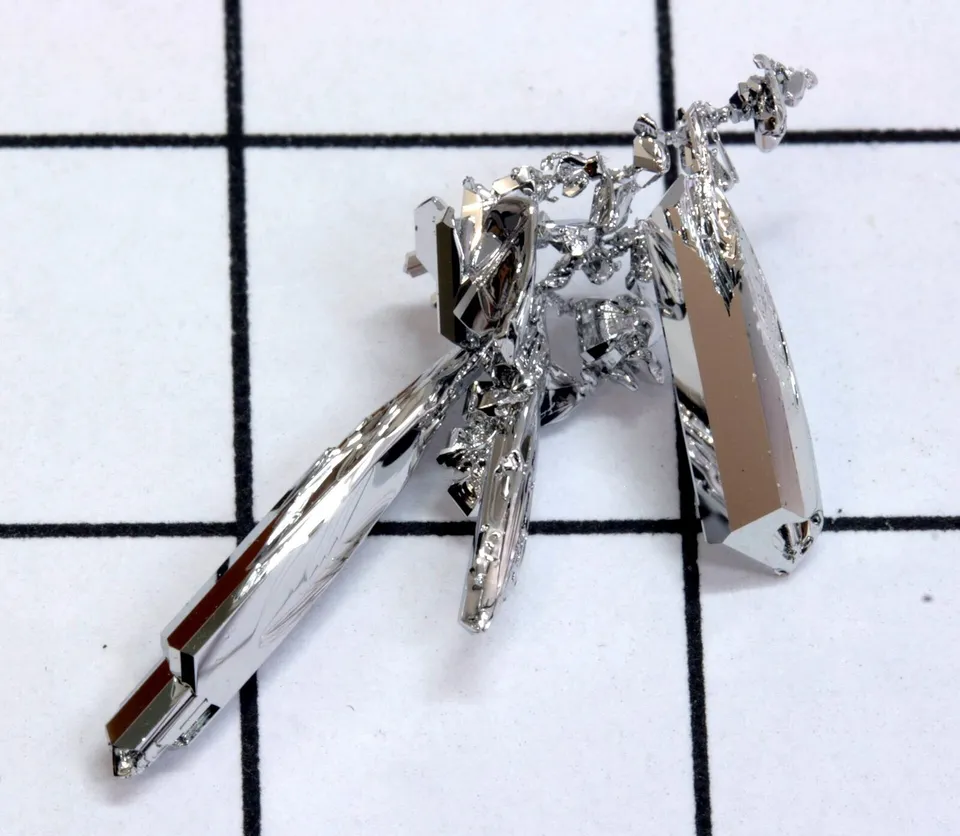

Specimen
- Atomic number
- 44
- Atomic mass
- 101.07
- State at room temperature
- Solid
- Melting point
- 2,334 °C
- Boiling point
- 4,150 °C
- Density
- 12.1 g/cm³
- Discovered
- 1827
Can I eat it?
- In food and water
- Not needed, little studied. Ruthenium has no known function in the body. ICH says there are very few safety data for it. ICH also says the gut absorbs about 4% of ruthenium, and the bones keep it. 910
- As the pure element
- Little studied. Ruthenium is a hard silvery metal. ICH says there are very few safety data for it. ICH also says the soluble salts of these metals seem to be more toxic than the metals. 9
Learn about ruthenium
- 01 How much there is And how much of that can we reach? Ruthenium is one of the rarest metals in the Earth's crust. Nobody publishes reserves for ruthenium alone. The amount mined depends on the mining of platinum and palladium, mostly in South Africa. Johnson Matthey writes that supply has fallen short of use in recent years. Read →
- 03 How we get it How much do we make each year, and how? Mining companies sold about 30 tonnes of new ruthenium in 2025, by Johnson Matthey's figures. Ruthenium is a by-product of platinum and palladium mines. Much factory scrap is recycled. Estimates of recycling from discarded products are 0 to 15%. Read →
- 04 What we use it for Where does it go, and why this element? Chemical catalysts took 45% in 2025, with record buying in China for nylon raw materials. Electronics took a third, for hard disks and chip resistors. About a tenth went to electrochemical uses, such as chlorine anodes. Other platinum group metals can replace it in some uses. Read →
- 05 What it costs What does it cost, and how is it bought and sold? Ruthenium cost $690 per troy ounce on average in 2025, about $22,200 per kilogram, by USGS estimates. That was 53% more than in 2024. Johnson Matthey reports a record of $1,750 in early 2026. Sharp rises came before, in 2000 with speculation and in 2007 with hard disk demand. Read →
- 06 Who controls it Who controls the supply, and who depends on it? South Africa supplies more than 85% of new ruthenium. The United States, the United Kingdom and the European Union list it as critical. Johnson Matthey reports Chinese export controls on ruthenium from 2025. We found no Chinese notice that names it. Read →
- 07 Social and political problems What problems does it cause between people, and who carries them? In 2017 radioactive ruthenium-106 spread over Europe. Researchers point to a plant in the Southern Urals, and Russian officials said that it was not the source. High prices in 2025 helped South African mines and pushed some users away. Read →
- 08 History How did our relationship with it begin and change? Ruthenium was the last platinum group metal to be found. Karl Klaus of Kazan reported it in 1844. For a long time it had few uses. Since about 2000, hard disks and chemical catalysts have brought large new uses. Read →
Ruthenium is one of the platinum group metals. How they are mined, separated, sold and controlled →
Where it is found
What is it found in, and where on Earth?
Ruthenium occurs with the other platinum group metals, in deposits mined mainly for platinum and palladium. One of its minerals is laurite, a ruthenium sulfide. The UK puts 94% of ruthenium in layered platinum group deposits and most of the rest in nickel-copper deposits.
Minerals and ores
The RSC writes that ruthenium can occur as the metal, but more often it occurs with the other platinum metals11. USGS lists laurite, a ruthenium sulfide, among the platinum group minerals12.
Some ruthenium also occurs inside common sulfide minerals. Pyrrhotite, an iron sulfide, can contain some ruthenium, iridium, osmium and rhodium, but not platinum or palladium12.
How deposits form
Ruthenium collects in sulfide liquids in cooling magma, together with the other platinum group metals. The platinum group page has the general process. One step separates ruthenium from platinum and palladium. At about 1,000 °C, osmium, iridium and ruthenium go into an early sulfide mineral. Platinum and palladium stay in the liquid that is left12.
Where the deposits are
What it comes with
Worth knowing
-
In 2001 IBM began to make hard disks with a layer of ruthenium only three atoms thick. Some IBM scientists called it pixie dust. 14
What we use it for → -
The mining companies of the world sold about 30 tonnes of new ruthenium in 2025, by Johnson Matthey's figures. That much ruthenium would fit in a cube about 1.4 meters on each side (our calculation from its density). 2
How we get it → -
Karl Klaus named ruthenium in 1844 after Ruthenia, the Latin name for Russia. 15
History → -
In 2007 the price of ruthenium rose to $694 per troy ounce because disk makers bought it for a new type of hard disk. By early 2009 it was back at $89. 16
What it costs → -
In 2025 Chinese plants bought a record amount of ruthenium catalysts for caprolactam and adipic acid, two raw materials for nylon. 2
What we use it for → -
In 2017 radioactive ruthenium-106 was measured in the air across Europe. No country declared an accident. 17
Social and political problems →
The atom
Electrons
| Shell | Electrons |
|---|---|
| 1 (K) | 2 |
| 2 (L) | 8 |
| 3 (M) | 18 |
| 4 (N) | 15 |
| 5 (O) outermost | 1 |
| Total | 44 |
Configuration [Kr] 4d⁷ 5s¹
4d ↑ ↓ ↑ ↓ ↑ ↑ ↑
5s ↑
Nucleus
| Protons | 44 |
|---|---|
| Neutrons | 58 |
| Mass number | 102 |
Related elements
New articles by e-mail
Sources
- 1
Johnson Matthey, 2021. PGM Market Report May 2021 .
World supply, demand and prices of platinum, palladium, rhodium, iridium and ruthenium in 2020, with the 2020 supply losses in South Africa.
-
Both iridium and ruthenium are supplied almost entirely as minor byproducts of platinum mining
-
- 2
Johnson Matthey, 2026. PGM market report May 2026 , Market overview: ruthenium and iridium; South African supplies; Industrial demand; Outlook; Ruthenium supply and demand table, p. 32.
World supply and demand of ruthenium by use, 2021 to 2026, the 2025 deficit, prices, chemical and electronics demand.
-
Total primary supply 44.1 30.2 28.4 35.0 30.2
-
Total primary supply 1,417 971 914 1,125 972
-
record demand for ruthenium catalysts used to produce caprolactam and adipic acid, precursors for nylon production
-
- 3
Ruth F. Schulte, U.S. Geological Survey, 2026. Platinum-group metals, in Mineral Commodity Summaries 2026 , Domestic Production and Use; Salient Statistics; Events, Trends, and Issues; Substitutes.
The 2021 to 2025 average prices of ruthenium, the 2025 price rise, US uses and substitutes.
-
Price, dollars per troy ounce ... 5,800 690
-
- 4
Theodore Gray (data from Wolfram ElementData), 2026. Technical data for Ruthenium .
Abundance of ruthenium in the crust, the oceans and the universe.
-
% in Earth's Crust 1×10⁻⁷%
-
- 5
UK Critical Minerals Intelligence Centre, British Geological Survey, 2024. UK 2024 Criticality Assessment , Table 1; criticality scores; production concentration; end-of-life recycling rates by use; deposit types; trade concentration.
Ruthenium's criticality score, South Africa's share of mined ruthenium, the recycling rate, deposit types and import shares.
-
Ruthenium (Ru) 0
-
Ruthenium (Ru) … Stratiform-hosted PGE Magmatic sulfide-based NiCu Placer Pt Fraction (%) 94.18 5.75
-
- 6
UNEP International Resource Panel (T.E. Graedel et al.), 2011. Recycling Rates of Metals: A Status Report , Table 3 and notes; Appendix E.
Recycled content and end-of-life recycling rate of ruthenium.
-
Ru < 20 50–60 5 –15
-
- 7
IUPAC Commission on Isotopic Abundances and Atomic Weights (CIAAW), 2024. Abridged Standard Atomic Weights 2024 .
The atomic mass shown for the 84 elements that have a standard atomic weight.
- 8
National Center for Biotechnology Information (PubChem), 2026. Periodic Table of Elements .
Electron configuration, melting and boiling points, density and discovery year for all 118 elements.
- 9
International Council for Harmonisation (ICH), 2022. ICH Q3D(R2) Guideline for Elemental Impurities , Appendix 3, Platinum-group elements: Safety Evaluation.
The few safety data on ruthenium, and how the body takes it up.
-
There are very few published data on the safety of Iridium, Osmium, Rhodium and Ruthenium.
-
Oral absorption of Ru is low (about 4%) ... Ingested ruthenium compounds are retained in bones
-
It appears that the soluble salts of the PGE are more toxic than the metal
-
- 10
Royal Society of Chemistry, 2026. Ruthenium - Element information, properties and uses .
-
Ruthenium has no known biological role.
-
- 11
Royal Society of Chemistry, 2026. Ruthenium - Element information, properties and uses , Uses and properties; History; podcast 'Chemistry in its element: ruthenium' (Jonathan Steed).
Uses of ruthenium, its discovery and name, and the Parker 51 pen nib.
-
It is found uncombined in nature; however, it is more commonly found associated with other platinum metals
-
- 12
M.L. Zientek, P.J. Loferski, H.L. Parks, R.F. Schulte and R.R. Seal II, U.S. Geological Survey, 2017. Platinum-group elements, chapter N of Critical Mineral Resources of the United States (Professional Paper 1802) , Introduction; Mineralogy; Geochemistry; Sources and Fate in the Environment; table N7; figure N28.
Ruthenium minerals, its behavior in sulfide melts, its abundance in the crust and seawater.
-
Laurite RuS2
-
Pyrrhotite (Fe1-xS) can contain some iridium, osmium, rhodium, and ruthenium, but not palladium or platinum
-
At high temperature (about 1,000 °C), osmium, iridium, and ruthenium preferentially partition from the immiscible sulfide liquid into a mineral called monosulfide solid solution (MSS). Platinum, palladium, and gold, on the other hand, behave as incompatible elements
-
- 13
European Commission (M. Grohol and C. Veeh), 2023. Study on the Critical Raw Materials for the EU 2023: Final Report , Table 5 (global supply of the CRMs, individual materials); section on platinum group metals.
South Africa's share of world ruthenium supply, and the five platinum group metals the EU assessed.
-
For iridium, platinum, rhodium and ruthenium, the major global supplier is South Africa
-
They have similar physical and chemical properties, tend to be found together, and are commonly associated with ores of nickel and copper
-
- 14
IBM Research, via ScienceDaily, 2001. IBM's 'Pixie Dust' Breakthrough To Quadruple Disk Drive Density .
IBM's use of a thin ruthenium layer in hard disks, and its discovery of the effect in 1990.
-
a three-atom-thick layer of the element ruthenium
-
- 15
V. N. Pitchkov, Platinum Metals Review 40(4), 1996. The Discovery of Ruthenium , Abstract.
Karl Klaus's discovery of ruthenium in 1844 and the origin of its name.
-
named ruthenium, afer Ruthenia, the latinised name for Russia ... ruthenium – the last one to be discovered
-
- 16
U.S. Geological Survey (Patricia J. Loferski), 2013. Platinum-group metals, in Metal Prices in the United States Through 2010 (Scientific Investigations Report 2012-5188) , Platinum-group metals chapter, pp. 117-126; Table 6 (annual average ruthenium price).
Annual average ruthenium prices from 1930 to 2010, their bases, and the reasons for the price changes.
-
In 2007, ruthenium prices soared to $694 per troy ounce owing to purchases by the computer industry ... the price fell back to $89 per troy ounce by early 2009
-
- 17
O. Masson, G. Steinhauser and others, PNAS, 2019. Airborne concentrations and chemical considerations of radioactive ruthenium from an undeclared major nuclear release in 2017 .
The 2017 release of ruthenium-106 in Europe, its size, its likely origin and the statements of Russian bodies.
-
All members submitted the requested data, but none declared an accident and none declared being aware of any source
-
- 18
National Institute of Standards and Technology (NIST), 2026. Atomic Weights and Isotopic Compositions for All Elements .
Isotopic composition of each element; the most abundant isotope sets the neutron count in the nucleus view.